
 What if you could remember facts, names and entire case files the way Sherlock Holmes remembers clues using the legendary Mind Palace technique?
I asked myself that very question many years ago.
And today, as the founder of the Magnetic Memory Method and someone who has trained thousands of people worldwide in using advanced memory techniques, I can tell you:
The Mind Palace isn’t a literary trick.
It’s a real, scientifically valid memory method you can use to sharpen recall, accelerate learning and think critically under pressure.
Over the years, I’ve been asked countless times:
“Can I actually memorize like Sherlock Holmes?”
The answer is “yes,” and to prove it, I ran a personal learning experiment:
- Re-read every Sherlock Holmes story to study how memory is portrayed
- Completed an online detective course with a real investigator
- Revisited my graduate school research into how fictional detectives (including Hannibal Lecter) use memory and logic
- Developed a proper Mind Palace optimized for the kinds of details Sherlock himself would track at a crime scene
The results?
Better observation, sharper recall and even more astonishing accuracy than before.
In this guide, I’ll show you exactly how to create your own Sherlock Holmes-style Mind Palace and how to use it for real-life goals like learning languages, acing exams and delivering speeches without notes.
Let’s dive in.
Sherlock Holmes and the Mind Palace Technique:
How to Build One Step-by-Step
There are a number of steps involved in using memory techniques well.
As we go through this list, consider your goals first. This is important because Sherlock doesn’t always use Mind Palaces. He sometimes uses other techniques related to critical thinking.
As tempting as it can be to focus all our efforts on just one tactic, we have to be realistic. The Mind Palace technique is not always the best mnemonic device for the job.
But once you’ve tested that it’s the tool you want to use, it will serve you very well.
Step One: Pick A Reliable Location
The Mind Palace technique relies on using mental imagery based on locations.
And this is where many people make a big mistake. For example, they try to use an imaginary Memory Palace based on one of the Sherlock Holmes stories. Or, they might choose a location from some other movie or series.
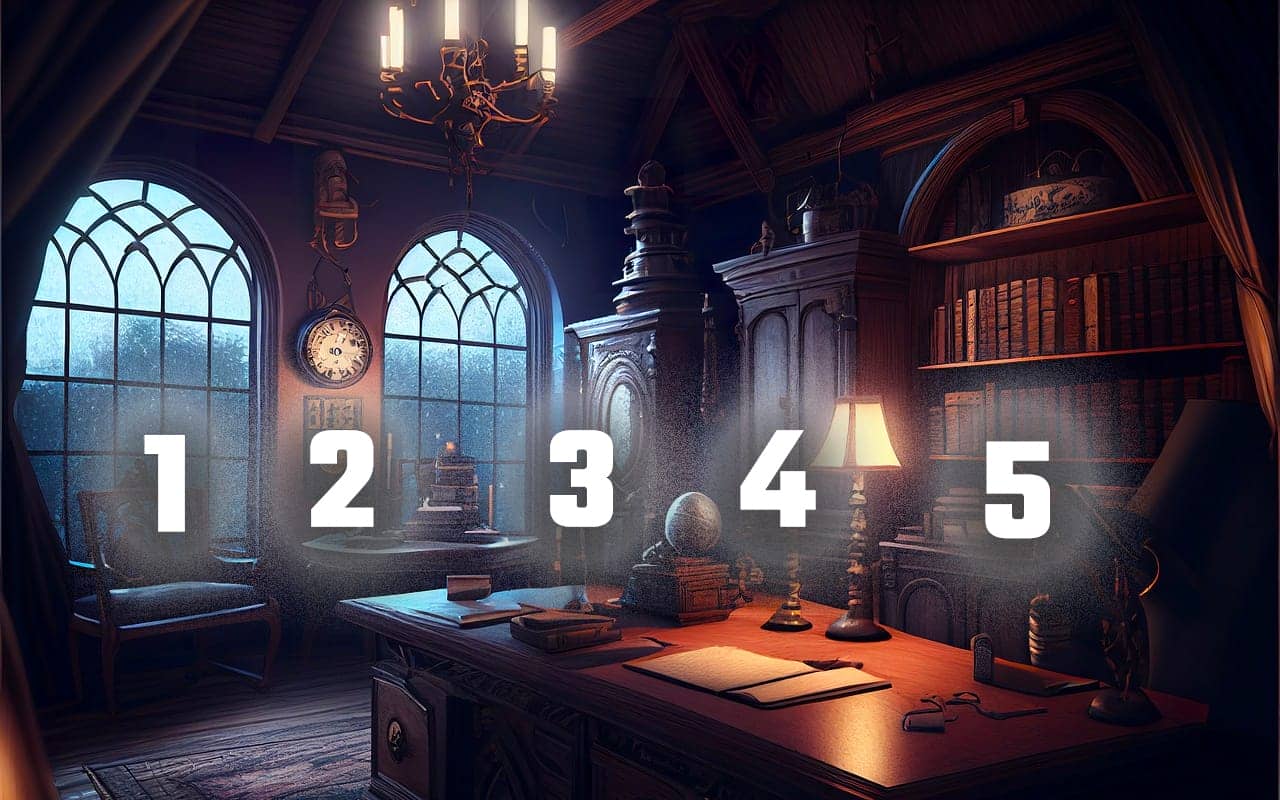
If you’d like to do that, you can either pick an existing scene from a Sherlock show or movie or an illustration in a book. Or you could ask an AI to create Victorian Study for you like this:

Then, using the method of loci, a small number of Magnetic Stations to your new Mind Palace.
Once done, your Sherlock Mind Palace will look something like this:
Step Two: Split Test Your Sherlock Mind Palace Against A Real Memory Palace
There’s technically nothing wrong with basing your Mind Palace on a fantasy location. It certainly can work for some people.
For example, memory athlete Idriz Zogaj told me on this episode of the Magnetic Memory Method Podcast that some competitors do fine with virtual Memory Palaces.
But not everyone is a memory competitor. Not only that, memory competitors aren’t actually “learning.”
Rather, they are temporarily storing specific types of information chosen for the competition setting.
That’s why the Renaissance memory master Robert Fludd always recommended basing your Mind Palaces on real locations if you’re using the technique for long-term retention.
I suggest you go one step further.
In addition to selecting real locations, draw out each Mind Palace by hand during the development process.
Here’s a personal Memory Palace example based on my elementary school:

Step Three: Compare Your Mind Palace Against The Sherlock Mind Palace Examples
Yeah, I know.
Hand-drawn Mind Palaces don’t seem nearly as sexy as what you may have seen in the series or short story illustrations.
But the truth is that real memory abilities, like the kind people like Derren Brown have demonstrated along with memory champions like Mark Channon and Alex Mullen are real.
They’re not fictional and memory science backs them up. Even successful mnemonists like Solomon Shereshevsky use real locations as their source for well-functioning Mind Palaces.
In fact, even people with unusually strong memory skills from brain lesions are known to have used real locations for their Mind Palaces. For more information on that, I suggest learning about Solomon Shereshevsky.
That said, it’s worth trying both options: emulating what you see in the series for your Mind Palace and working with the ancient tradition I teach (sometimes called the art of memory).
My prediction?
You’ll probably find it faster and easier to use Mind Palaces after you’ve based them on real locations and drawn them out by hand.
Step Four: Fill Your Memory Palaces With Information & Associations
Different people have different priorities.
In my time using memory techniques regularly for over twenty years, I’ve used Mind Palaces to pass exams, assist with language learning and give speeches.
For example, when I needed to memorize and deliver this TEDx Talk, I quickly based the Mind Palace I used on a neighborhood in Brisbane:

As you can see, the Mind Palace has the same numbering as you would place in a Mind Palace based on a location derived from a Sherlock Holmes story.
To take another example, I once learned the Japanese hiragana.
If you know the novel, A Slight Trick of the Mind, you know that Holmes himself once went to Japan. That’s one of several reasons I wanted to test the technique on this character set.
Here’s the good news:
It was a simple matter to place weird and interesting mnemonic images on stations in my Mind Palace. Like you see illustrated in this Mind Palace example with the first two hiragana characters elaborated on two stations in a bedroom:

Step Five: Practice Recalling Information From The Mind Palace
For the purposes of the Sherlock Holmes case study shared in the video above, I realized that I’d need to remember a lot of things related to crime. Literally dozens of details will demand your attention in real time. This would include, without being limited to:
- Name of deceased, and there might be several names, even nicknames involved
- Last time seen alive with potentially multiple locations involved
- Where/when the body was discovered and by whom
- Weight, height, eye color, hair color, other visible features of the deceased
- Estimated time of death, which will involve a range that will be useful to remember
- Cause of death
- Social life of the victim
- Family members
- Vehicles owned
- Property details, including the address, property access points, furniture, damaged and/or missing items
In your case, you will have different types of information. The key point is that you will use spaced repetition in order to usher the information into long-term memory.
So whether you’re memorizing the details of a crime or using the technique to remember names, it’s important to recall the information.
You do that very simply by thinking back to where in the Mind Palace you placed the associations. Then trigger the associations so that they bring back the target information.
Take the example above with Japanese. I just had to think about station one in the Mind Palace and ask: What was happening there? Within seconds, the mnemonic image of Ezra Pound going “ah!” came to mind and I remembered both the shape and the sound of the first hiragana.
Step Six: Keep Practicing With Life-Improving Goals (and Avoid Villainous Mistakes)
Now that you have the bird’s eye overview, I suggest that you regularly put the techniques to work in the service of a long-term learning goal.
As the founder of the Magnetic Memory Method, I recommend choosing a goal that compounds in value over time.
Personally, one of my favorite long-term learning projects centers on language learning. In fact, the Mind Palace for language learning is a well-proven process that works for any language, as shown in this detailed tutorial.
Whatever topic you pursue, consistency over time is key. Mastering memory techniques is kind of like music and requires deliberate practice.
And remember one of Sherlock’s best lessons, one hidden between the lines:
Don’t drift into the habits of the villains he investigates.
Many of them get sloppy in matters of mind and memory. Or they take shortcuts.
But you?
You need to train completely. Verify details, audit your mnemonic associations and practice encoding and decoding under pressure.
Here’s a real-world case study that details what can happen when a powerfully trained memory heads in the wrong direction:
As you can see, the Ana Montes story shows how far trained recall can take you. And what happens when pressure meets poor strategy.
For more on how this criminal spy went wrong, read my LinkedIn analysis of the memory mistakes revealed by the case of Ana Montes.
Sherlock Holmes Mind Palace: Frequently Asked Questions
Since you’ve read this far, you know you’re not alone when it comes to interest in Sherlock Holmes and the Mind Palace technique.
To give you even more value, I’ve gathered the most common questions and answers in a rapid-fire format.
Let’s dig in:
Did Sherlock Holmes really use a Mind Palace?
Holmes is a fictional detective created by Arthur Conan Doyle.
This means that Holmes never existed.
However, Doyle combined an interest in the art of memory with the critical thinking used by the detectives of the time. He also brought in his knowledge of how doctors think to help patients solve health problems.
This combination of factors is part of what has inspired so many people to look into the Mind Palace technique described in the stories.
And real people really do use these techniques. Frequently.
Can I use a Mind Palace like Sherlock Holmes even if I don’t have a great memory?
Yes, and that’s the point.
See, almost nobody has a naturally “good memory.”
That’s why ancient people like Simonides of Ceos developed the technique in the first place.
It’s important to note that Sherlock Holmes was also distracted at times. Using the technique helped him focus, which is an additional benefit on top of better recall ability.
What’s the biggest mistake people make when trying the Sherlock Holmes Mind Palace?
The most common mistake I find is not following the instructions given by a real-life mnemonist who helps you ensure that you’ve planned your Mind Palaces first.
People often wind up choosing imaginary or unstable locations that are not already embedded in memory.
As a result, they create cognitive load when the point of the technique (when used well) is to reduct it.
So even if Sherlock might get away with all kinds of poor choices related to the technique in fiction, successful people in reality benefit most from following the principles used by actual practitioners.
For more information, I’ve answered over 100 memory-related questions in detail during a Reddit AMA, which you can explore here.
At the end of the day, real results form the Mind Palace technique comes from real practice.
Sherlock-Level Memory Techniques: Yours For The Taking
That’s really all there is to it.
Except for adding the ability to think as critically as Sherlock Holmes and as linearly as his brother Mycroft.
But to think critically, you’ll want to master the best possible memory skills first. Or, if you have any doubts, you might like to read one of the many scientific studies demonstrating just how well this approach to remembering information can be.
And if you’d like more help after reading and putting the steps above into use, please consider registering for this free course:

This fun memory course gives you four video lessons and simple worksheets that will help you master the Mind Palace technique quickly.
So what do you say?
Ready to memorize like Sherlock?
Make it happen!