
Podcast: Download
Subscribe: Apple Podcasts | RSS

To remember things effectively and efficiently, there are three main things you need to do:
- “Encode” the thing you want to remember with meaning using the processes you’ll learn today
- Use active recall to test your memory and its accuracy
- Time your reviews using spaced repetition
Plus, there are dozens of memory tricks I’ve picked up since I first learned memory techniques during my PhD. I’ve taught them for the past 15 years and have compiled the best for you on this page.
For the full set, you can either read the article below, or enjoy this video version by clicking “play”:

Now, to set the stage properly, let’s start with a very basic fact when it comes to improving your memory:
People with excellent memories and memory championship winners are not too different from you. They just use a combination of techniques to enable their minds to memorize things.
Now, you might find it hard to remember names, facts, equations, lists, tasks you need to take care of, a new language, and so on.
But if you follow the right techniques, you can remember almost anything you want. The techniques you’ll discover on this page will work for you, no matter how bad you think your memory is.
How to Remember Things:
The Top 21 Ways To Boost Your Recall
As we go through this list, rather than try to master each and every strategy overnight, I suggest you explore each approach over time.
Start by picking the ones that resonate with you the most.
Then come back and add another.
1. Apply Mnemonics
Mnemonics is a big topic. In brief, the word “mnemonic” refers to any memory technique that helps you form a strong, long-term memory.
Usually when people use the term, we specifically mean the use of mnemonic images and multi-sensory associations.
For example, if you meet a new person named James, mentally associating him with James T. Kirk from Star Trek, or James Hetfield from Metallica will form a mnemonic link in your mind.
By hearing the voice of a James you already know, you add a multi-sensory element that makes the mnemonic even stronger.
Beyond memorizing names, many people use mnemonics to improve their retention while studying. Throughout this page, you’ll find the most common mnemonic devices.
You can also consult my complete Dictionary of Mnemonics for other tools. This mnemonics dictionary is also freely available on this website.
Why Use Mnemonics to Remember A Variety of Things?
Mnemonics are incredibly versatile. You can use them to help you remember:
- What you read
- Names
- Remember lists and things you need to do in the future (prospective memory)
- Music (theory, notation, melodies, even the names of your guitar strings when just starting out)
- Math
- Help with learning a language
Of special interest is the role of mnemonics in daily life. As this study shows, when mnemonics are combined with other memory aids like the ones explored on this page, your overall memory can be substantially improved.
2. Memory Palaces
The Memory Palace technique is perhaps the most powerful mnemonic device ever formulated.
It works by using a familiar location to lay out the kinds of mnemonic associations we just discussed.
Here’s a Memory Palace Walkthrough shot in one of my homes using a complex poem I memorized to help explain the technique:

If you are a fan of ‘Sherlock’ – the BBC series, you have seen Sherlock Holmes use his ‘mind palace’ to remember practically everything. This memorization method isn’t just used by fictional detectives. Memory champions swear by the memory palace.
The mnemonic device, also referred to as the ‘Method of Loci’ or ‘Cicero Method’ was developed in Ancient Greece.
How does it work?
As I discussed in the Memory Palace walkthrough video, I suggest you get started by making a quick drawing of a familiar location first, like your home.
The following illustration is a Memory Palace drawing made by my friend and language learning expert, Olly Richards:
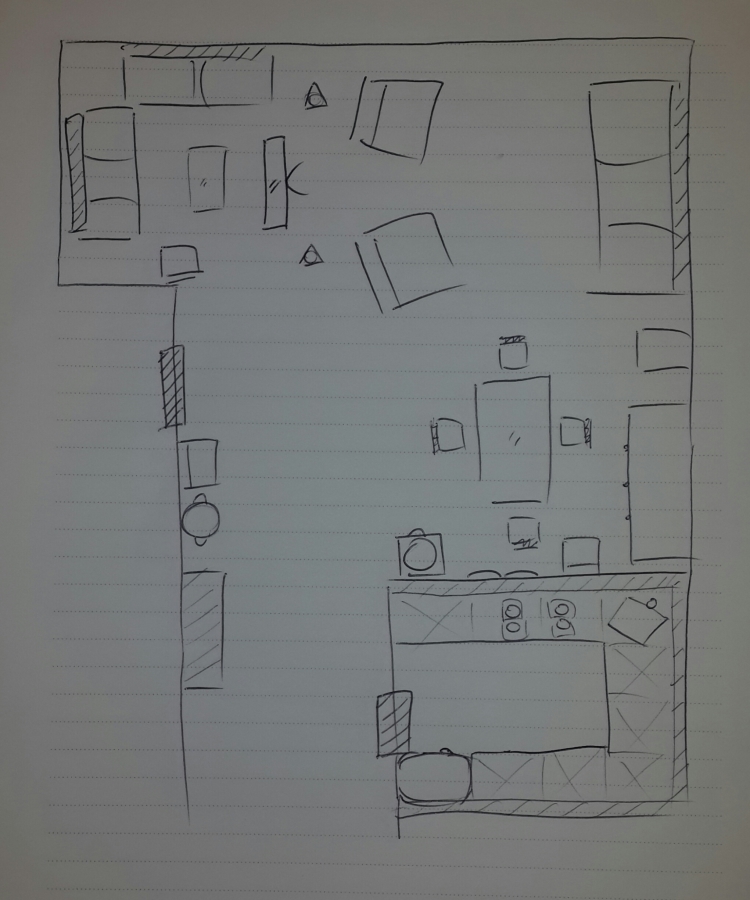
Once you have your first Memory Palace drawing, you’re better equipped to understand how the technique works.
That’s because this memorization method begins by visualizing yourself walking through your home and remembering every single detail that you can. It’s also a great mental exercise, but one made much easier when you’re just getting started because looking at your sketch reduces cognitive load.
However, you do not necessarily need to visualize at all. You can physically walk through your home when first learning this technique.
Linking Information with your Memory Palaces
To remember each item you want to remember, you associate it with a specific object or space in your home.
For example, if you are trying to remember a new language, you might want to store all the words related to weather in your wardrobe.
By grouping related words together, they become easier to recall.
You can group them by theme, sound or any other category that makes sense to you.
Associating items within your mind with a real physical space helps your brain ‘file’ important things to remember more easily.
Mind Palaces can be used to remember names, faces, languages, lists, academic material, and pretty much anything under the sun.
For a full tutorial on this technique, please check out my Complete Guide to the Memory Palace Technique.
3. Spaced Repetition
It’s easier to remember something that you read yesterday than a paragraph you have read a year back.
Why?
Hermann Ebbinghaus described what we now call the forgetting curve. His research into the psychology of memory observed that we forget most newly acquired information within a few hours or at the most a couple of days.
Unless you do something about it to reinforce what you learn at regular intervals. When you do, it’s easier to retain that piece of information in long-term memory.
The spaced repetition method is all about practicing remembering at the right time.

You do that by reinforcing a bit of information in your mind just when you are about to forget it.
A simple way of applying this memory technique is to use flashcards. You can organize your flashcards into three batches depending on how easy it is for you to remember.
If you remember something clearly, test yourself with the same flashcard within ten minutes, but if you do remember, test yourself at a longer interval.
There are several tools out there that claim to be spaced repetition software, but which are actually not. If you wish to try out spaced repetition, the best approach is to make your own flashcards.
Ideally, you’ll combine these cards with Memory Palaces. You can also consider bringing in Zettelkasten (an advanced type of flashcard with Leitner boxes to help organize how you revisit them).
For more detail on spaced repetition in daily life, I’ve written extensively on how to stop forgetting things and how these principles apply to never losing your keys again, and more.
4. Use Chunking to Remember
Chunking is the process of breaking information down into smaller units or groups.
For example, when someone recites a phone number, they usually give it to you in clusters of 3 or 4 digits. That’s chunking.
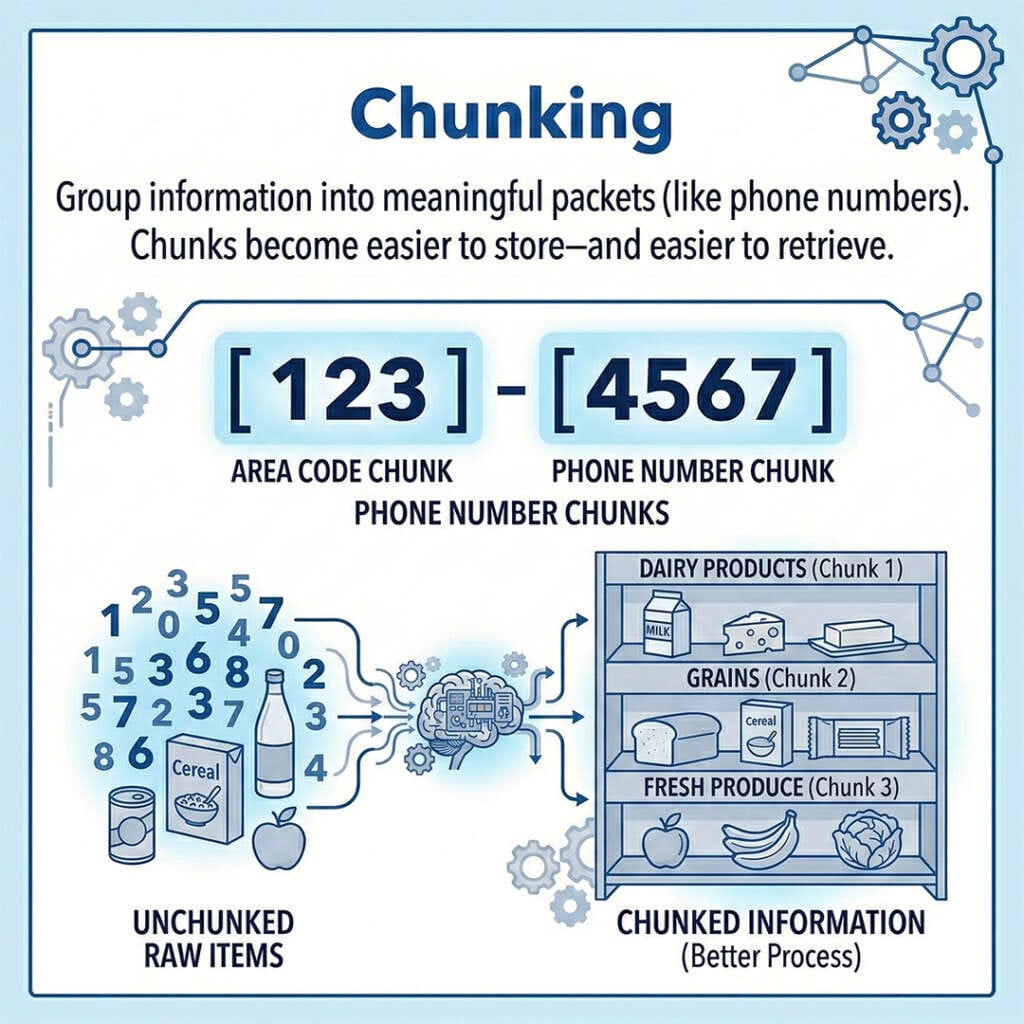
As a memory strategy, you can apply the chunking principle in many different ways.
For example, rather than memorize your grocery list from top to bottom, you can use chunking to arrange the items on the list according to where you normally find them on the store shelves.
As you can see in the illustration above, all the dairy products are chunked away from the produce and grains.
The same principle applies when learning a new language. As mentioned above, when words are related by a strong context, such as breakfast food items, winter clothing, grammatical function and so on, you can place them in specific Memory Palaces.
This approach is helpful for memorizing at scale because the human brain naturally tends to look for patterns. Because chunking allows the brain to store information in easy-to-remember packets, the combination of methods leads to better retention.
Read more of my best tips for studying faster based around chunking and other principles.
5. “Expression Mnemonics” or Acronyms to Remember Things
You have probably come across this method in school. You create an acronym of the different things that you wish to remember.
If you have taken music lessons, you would remember EGBDF (the treble clef) with the acronym, “Every Good Boy Does Fine.”
Another common expression mnemonic you might remember from your school days is HOMES – for the Great Lakes (Huron, Ontario, Michigan, Erie, and Superior).
Acronyms are best when they’re difficult to forget. There are similar Expression Mnemonics which involve rhymes, songs, and so on, but sometimes simply coming up with a keyword in which a principle helps trigger your recall of a larger list of information is best.
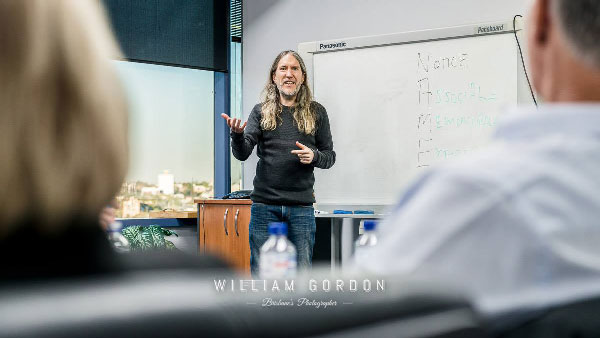
I even give presentations from memory sometimes based entirely on simple acronyms.
For example, I sometimes write “NAME” on a chalkboard when teaching people how to remember names using the strategy we’ll discuss next. If you look at the image of me above from one of my live memory training sessions, you can see NAME on the whiteboard behind me.
How to Use the N.A.M.E. Process
The NAME acronym is a process used to remember names. This specific technique for memorizing people’s names quickly is based on an interesting book I read recently – Boost Your Memory by Darren Bridger.
It’s very simple:
- N = Notice
- A = Associate
- M = Memory Palace
- E = Express (use the name)
Noticing that a name is incoming takes a bit of practice. But as memory expert Harry Lorayne’s often put it, you can’t remember information to which you haven’t paid adequate attention.
But once you’ve noticed that you have a name to memorize, the rest of the steps are easy and fun to use after they’ve been practiced.
6. Use Tactile Mnemonics from Ancestral Memory Approaches
Did you know that people used to carry portable Memory Palaces covered in beads?
They’re called lukasa or memory boards. Here’s a picture of an example lukasa:

Here’s how they work:
- Each bead represents a specific fact, name of a person or law
- By running your finger over the board, you can recall the information you’ve encoded on the memory board
By combining spatial memory with touch, you create more memory hooks in your brain.
Applying the Lukasa Technique to Everyday Life
When I was first struggling to improve my memory, I used to meet people and squeeze a coin in my pocket when I heard their name.
As I did, I imagined writing their name onto the coin.
Although coins don’t provide much space, it’s a place to start that doesn’t require carrying around a large memory board.
Using Your Hand as a Tactile Memory Space
Another technique that I’ve used a lot is based on the Guidonian Hand memory system.
You’ve probably seen an image of someone with string tied around their finger to help them remember something. Think of the Guidonian Hand as a more elaborate version of that principle.
One of the most common uses of this approach was in music as you can learn in this video:

But as I learned from Tyson Yunkporta in his book Sand Talk, the “Hand Memory Palace” technique is useful for remembering points that come up during meetings.
If you apply numbers to each finger, you can also remember when you have various meetings. Even if it’s only for short-term recall, it’s a powerful memory strategy.
And as with most ancient memory techniques, the hand can be used in combination with other strategies.
7. Learn How to Remember Numbers with The Major System
Except for phone numbers where we can use chunking, numbers are very hard to remember.
That’s why our ancestors created techniques people still use today.
One of them is called the Major System. Sometimes people refer to it as Harry Lorayne’s Number Mnemonics based on his book How to Develop a Super Power Memory.
It works by associating each number from 0-9 with a consonant sound. Like this:
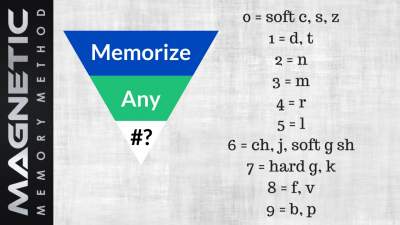
- 0 = soft c, s or z
- 1 = d, t
- 2 = n
- 3 = m
- 4 = r
- 5 = l
- 6 = ch, j, soft g, sh
- 7 = g, k
- 8 = f, v
- 9 = b, p
Although this simple formula has to be learned before you can use it, it works because it allows you to form simple words.
For instance, you can insert a vowel in between 22 and imagine a nun (formed by combining n and n). You combine these words to visualize an animated sequence of activities, which makes it difficult for you to forget.
Or for a number like 235 you could imagine an “animal.” For 22235, you could imagine a nun in a martial arts battle with an animal as illustrated in the cartoon below:

The Major System can be used to memorize very long digits, multiplication tables, phone numbers, number-based passwords, and so on.
If you would like a particularly amazing example, check out how Akira Haraguchi used this technique to memorize 100,000 digits of pi.
Want to go deeper? Here’s my complete Major System guide.
8. Story Method & Linking
A neat way to remember things is to embed the details in a story.
In fact, our ancestors have used stories to link facts for easier recall for decades. The technique is called the story method.
It’s related to the linking strategy we discussed above.
Linking is interesting because you don’t strictly have to combine it with the Memory Palace technique.
For example, if you have a list of words, instead of trying to memorize them as isolated elements, you chunk them into units.
If soap and tomatoes are on your shopping list, imagine soap bubbles flying up into the sky and bursting against potato clouds. If celery and corn are next on the list, have celery stalks raining down on a corn field.
This technique may need a bit of practice, but it’s very effective. If you want to learn more, here’s my complete guide on how to master linking.
9. Rote Rehearsal
Believe it or not, simply repeating things is a legitimate learning strategy. Sure, rote learning can be boring, but I use it when practicing music, to take one example. In this context, it is very helpful.
One way to make rote rehearsal more fun is to use flashcards with lots of colors and drawings on them.
For example, look at this example flash card from my own learning process below:
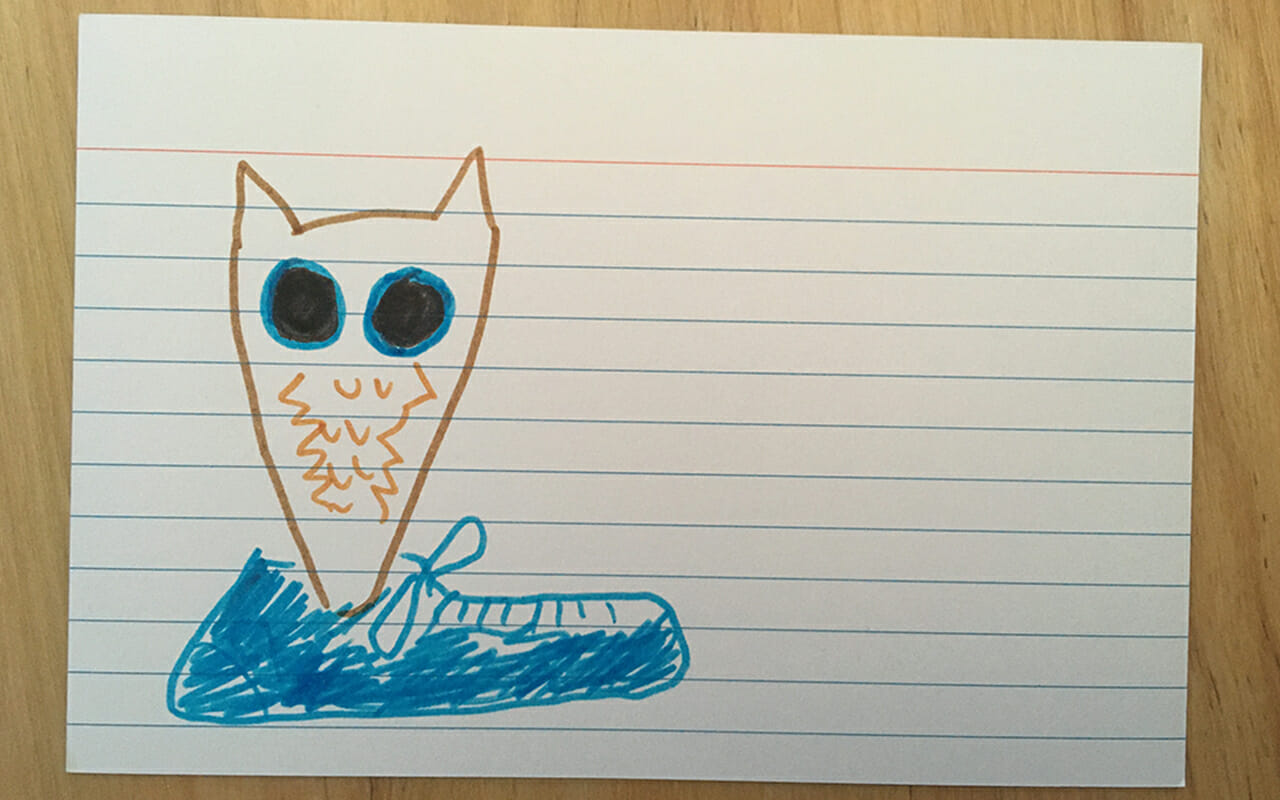
When I wanted to learn “C’est chouette” in French (for “it’s cool!”), I made a simple drawing of an owl in a shoe. That’s because la chouette in French means owl.
It doesn’t necessarily make sense to the English native speaker, but by looking at the card a few times and using active recall as an additional strategy, it only took a few repetitions to memorize the word.
10. Keep a Memory Journal
Mnemonics, when done well, already make information more personal and relevant.
But there’s an additional step you can take that goes beyond the important kinds of memorization tactics we’ve discussed so far.
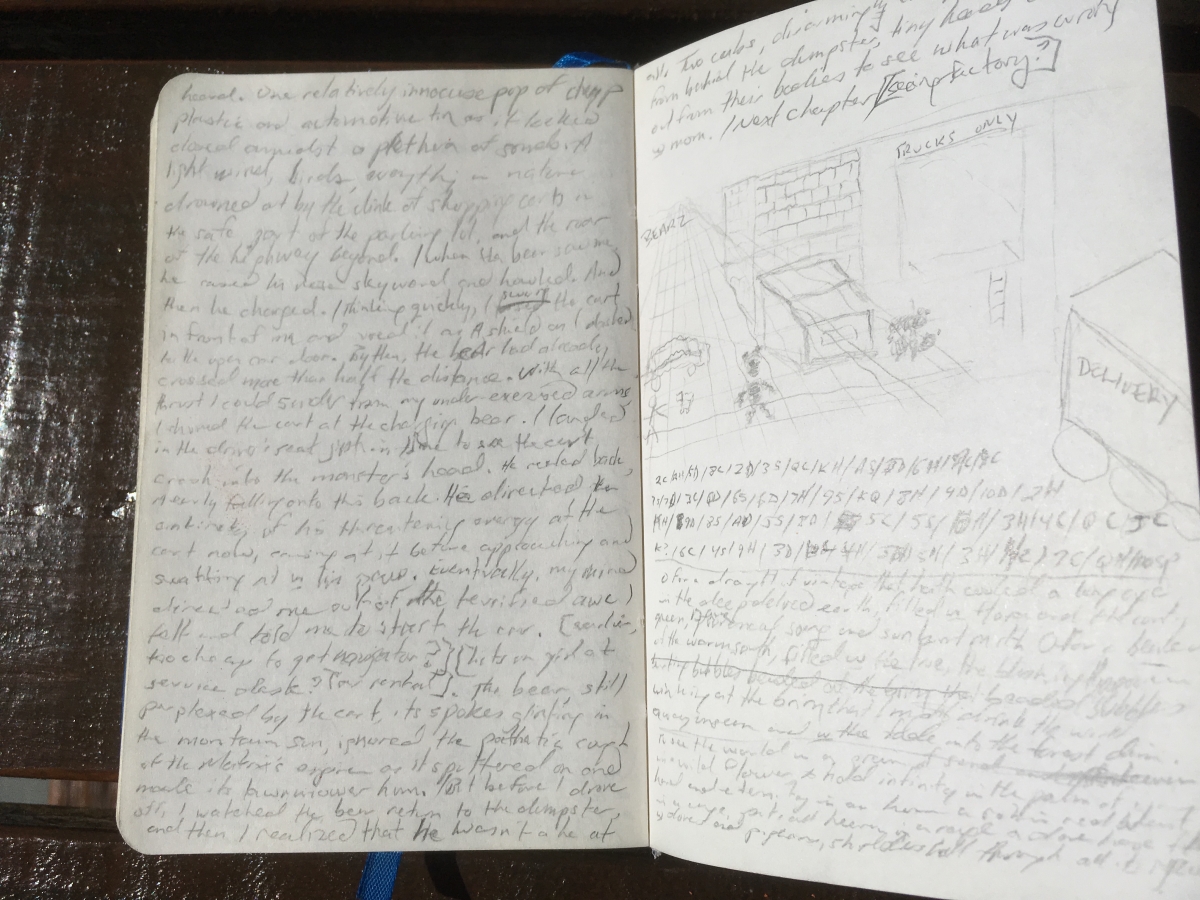
It’s journaling, or at least writing out summaries of what you want to remember, ideally by hand.
As I discuss in my detailed tutorial on journaling for self improvement, there’s a lot of science-backed information on why writing by hand about your own life is so effective.
Journaling is effective for all of us.
One effect that happens when you regularly test what you’ve memorized from memory in writing is that the journal becomes like a secondary Memory Palace. I can think both of the Memory Palace and the page in the journal as I tamp the material down into memory.
It’s hard to explain, but Gary Weber told me he has experienced a similar effect as part of all the Sanskrit he memorized while preparing his books Happiness Beyond Thought and Evolving Beyond Thought.
It’s also helpful to know that memory champions also journal in order to keep their recall abilities functioning at the highest possible level. My friend and fellow memory expert Johannes Mallow shared his journaling method for sharper memory on this episode of the Magnetic Memory Method Podcast.
Personally, I always have a small notebook with me wherever I go. It’s very useful for making sure I can always remember things that come up in every day life.
How To Remember Things
By Developing Habits That Support Everything Above
Your lifestyle and habits have a significant impact on your memory. The following suggestions are not memory techniques. But they do influence how well the techniques we’ve just discussed work so they are worth a look.
11. Getting Adequate Sleep will Help you Remember Things
One of the biggest mistakes that students make is trying to study longer hours by skipping on sleep. What they forget is that sleep deprivation affects several cognitive abilities, including memory.
This should hardly be a surprise. In addition to affecting the mind, lack of sleep is also considered to be a risk factor for heart disease, cancer, diminished immunity, obesity, and several other complications.
Numerous studies have established that sleep helps in the second stage of memory – consolidation.
And there’s no doubt about it:
Sleep helps you recall facts as well as the procedural memory formation involved in learning new skills faster when they involve movements and various routines (Diekelmann and Born, 2010).
And there’s more to it.
Sleep also contributes to reorganizing memories, by forming stronger connections between different memories. Sleep helps the brain to link newly absorbed information with previously acquired information, which spurs creativity (Diekelmann and Born, 2010)
Other studies have indicated that lack of sleep also makes us remember things incorrectly (Diekelmann 2008). Therefore, for several reasons, getting a good night’s sleep can significantly contribute to memory improvement.
12. Take Naps
What if you are unable to get adequate sleep? Try taking naps.
David Dinges (University of Pennsylvania) concluded from sleep experiments supported by NASA that naps help in boosting working memory.
Dinges also says that working memory “involves focusing attention on one task while holding other tasks in memory … and is a fundamental ability critical to performing complex work.” Another study concluded that a nap as short as six minutes can help boost memory (Lahl et al 2008)
13. Support Your Memory with a Balanced Diet
A balanced diet can play a useful role in supporting overall brain function. Foods such as fish, walnuts, pumpkin seeds, and other nutrient-rich whole foods can provide nutrients that the brain and body use as part of normal functioning.
Green tea is another popular option and has been studied for its potential effects on attention and cognitive performance. Rather than relying on any single food or drink, however, it makes more sense to think about your diet as a whole.
A Mediterranean-style eating pattern, which typically includes vegetables, fruit, whole grains, legumes, nuts, olive oil, and fish, is one practical example of a varied and balanced approach.
For memory improvement, diet is best treated as one part of a broader lifestyle that also includes sufficient sleep, regular physical activity, learning, and consistent memory practice.
14. Exercise
Exercising often is another great way to improve your memory.

It’s well known that exercise leads to increased blood flow to the brain, which has several cognitive benefits, such as alertness, better concentration, more positive mood, and so on.
Exercising also improves memory by releasing cathepsin B. It’s a protein that triggers the growth of neurons and forms new connections in the hippocampus, a section of the brain playing a vital role in memory.
Memory improvement necessarily doesn’t require rigorous exercise. Just 150 minutes of walking every week has been known to improve memory. But if you want to explicitly retain information, consider using formal memory techniques.
15. Socialize for Stronger Memories
Australian researchers conducted a study involving 700 participants over 15 years. The researchers concluded that maintaining close relationships helps in improving memory. Other studies have also indicated that socializing helps prevent memory loss through dementia and Alzheimer’s disease.
Since better relationships are also linked to happiness and improvement in a number of health parameters, it’s a great reason to invest more in your current relationships as well as get back in touch with people you haven’t spoken to for years.
16. New Hobbies
Columbia University researchers have found that people having more than six hobbies have a 38% lower chance of developing dementia. Researchers at Berkeley, California also found that people who regularly engage in activities that stimulate their brains avoid the formation of a protein that causes Alzheimer’s.
The key is to pick up new hobbies that force you to expand the capabilities of your mind.
For example, you could:
- Read a book on a topic that you are completely unfamiliar with
- Learning a new musical instrument or a new dance form
- Pick up a new form of exercise
- Regularly meet new people
The key here is to engage in activities that lead to the formation of new neurons in the brain as well as new connections between existing neurons. Continual neoronal development helps maintain the brain’s cognitive reserve – its ability to avoid memory loss. That’s very likely to help you learn faster.
17. Learn a New Language
There are several reasons why learning a new language is great for memory.

The process of remembering vocabulary, phrases, and grammar rules all exercise your brain cells. Mental exercise like this leads to overall memory improvement. Studies have indicated that bilingual people are at less risk of Alzheimer’s.
You also develop renewed curiosity about everything around you, which helps you to focus more on everyday activities and objects. As I have pointed out earlier, focus is another factor that helps us to remember things better.
Remembering is an essential skill that you have to pick up while learning any new language. When you are actively looking for ways to remember, you pick up lots of memorization techniques – which in turn improve your memory.
It’s a cycle that helps you to keep improving continuously. So why not spend a few minutes every day in brushing up your French or Spanish or pick up a completely new language like Mandarin!
18. Do More Challenging Work
We live in an era that constantly sells us on the idea that “less is more.”
However, studies presented by the Alzheimer’s Society in the UK have found that people who do more mentally challenging work are less likely to develop Alzheimer’s. Deliberately working on things that are mentally taxing keeps your neurons on their toes and prevents them from deteriorating over time.
Some scientists call this principle “desirable difficulty.” Interestingly, this study links the principle to the spaced repetition strategies you’ve learned today.
How can you reasonably take on more desirable difficulties?
You could also ask your boss to give you additional responsibilities every day that place you out of your comfort zone. Something as simple as that will help ensure that your cognitive abilities stay in peak shape.
If you’re already retired, consider volunteering.
Or you can start up a YouTube channel or a podcast and share your knowledge with younger generations. Developing and interacting with an audience is incredibly rewarding and will exercise your mind and memory as you complete a wide variety of challenging tasks.
19. Positivity Promotes Memory Improvement
A 2012 study indicated that feelings of positivity have a beneficial effect on remembering things in the case of older adults. Positive thinking and happiness are believed to trigger the release of dopamine in the memory-related regions of the brain, which stimulates memory formation and retention.
Try to engage in activities that make you happy. It can be as simple as setting aside 10 minutes a day to revive a hobby that you used to enjoy, such as reading or singing.
Using memory tricks definitely makes me happy, and research by Tim Dalgliesh shows how and why. In “Method-of-Loci as a Mnemonic Device to Facilitate Access to Self-Affirming Personal Memories for Individuals With Depression,” he shows precisely how and why using a memory technique relieves mental anguish and creates more joy.
20. Meditation for Memory
Meditation is the most effective way of improving the ability of our mind to pay attention to tasks – which is important for improving retention and converting short-term memory into long-term memory.
Studies have demonstrated that practicing meditation improves our ability to focus on smaller details. (Maclean et al. 2010). Other studies have shown that mindfulness meditation works better as a memory technique than yoga. (Quach et al 2015).
Building a habit of meditating every day isn’t too hard.
What if the thought of sitting still for even a couple of minutes is too painful?
Try walking meditation. Lots of people find this approach far easier than the regular sitting meditation approach, yet just as effective at calming the mind.
21. Explore and Incorporate Other Accelerated Learning Tactics
There are so many more tips to share. Some of my favorites involve acronyms, such as the PQRST method: Preview, Question, Read, Self-Recitation, Test. It’s great to use this when studying, but can also be applied to work and even novels you might want to remember better.
One issue people face, however, involves what I call “topic exhaustion.”
This effect takes place usually when cramming, but you can even get tired of learning from books you love. To combat this problem, I suggest learning to use interleaving. It’s a study method that lets you take quick breaks while switching between books. You’ll naturally remember more by using this specific switching and resting strategy.
Finally, there are new tools you can explore, such as the demonstration I give here for using ChatGPT as part of your language learning efforts. This specific “laddering” strategy is not new.
But it is a bit unconventional given the recency of chatbot technology. Nonetheless, I’ve found laddering to be one of the most helpful learning and memory-based applications for chatbot technology so far.
Bonus Video Tips:
If you’d like a video overview and a few more tips, here’s an older video I produced going through 21 techniques for Memory Improvement in detail:

Remembering Things Isn’t Hard!
We have covered a wide range of methods that will help you to remember. You don’t need to practice all of them. Just picking up a few of these memorization techniques will make a substantial difference to your memory.
If you’re interested in learning more about memory techniques, I recommend you read these Memory Palace books and consider these memory courses.
And if you’d like to test the Magnetic Memory Method course, for free, click the course graphic below for a detailed video course on developing and using your first Memory Palace:

Once you’re set up with your first Memory Palace, you’ll be able to commit all kinds of things to memory.
And enjoy greater success as a result.

 Anthony Metivier is the founder of the Magnetic Memory Method, a systematic, 21st century approach to memorizing foreign language vocabulary, names, music, poetry and more in ways that are easy, elegant, effective and fun.
Dr. Metivier holds a Ph.D. in Humanities from York University and has been featured in Forbes, Viva Magazine, Fluent in 3 Months, Daily Stoic, Learning How to Learn and he has delivered one of the most popular TEDx Talks on memory improvement.
His most popular books include, The Victorious Mind and…
Anthony Metivier is the founder of the Magnetic Memory Method, a systematic, 21st century approach to memorizing foreign language vocabulary, names, music, poetry and more in ways that are easy, elegant, effective and fun.
Dr. Metivier holds a Ph.D. in Humanities from York University and has been featured in Forbes, Viva Magazine, Fluent in 3 Months, Daily Stoic, Learning How to Learn and he has delivered one of the most popular TEDx Talks on memory improvement.
His most popular books include, The Victorious Mind and… 



66 Responses
This is very complete and has a lot of good information… I’ve had a lot of success with Memory Palaces myself. Thanks Anthony!
That’s great to hear, and of course people should check out your post on memory techniques for a difficult language. It’s a great one!
Thanks a lot for what you are offering. you’ve changed different aspects of our life. I truly appreciate you besides your job.
My pleasure, Mohammad.
Are you currently doing some memory improvement activities at the moment? Do you have any questions? Let me know if any come up and I’ll answer a.s.a.p.
I am not using any method to memorize right now. I just reading to get familirize with the information. I will like to try different memory methods to see witch one i feel and see will work for me. In life style i fail in sleep habits and socialize
Thanks for checking this out, Maricela, and great that you’re familiarizing yourself with these techniques.
Dive in as soon as you can with using them. One of the “traps” that people fall into is the activity of learning about the techniques without diving in and learning by doing. Keep the D.O.C. and S.I.P principles of the Magnetic Memory Method in mind:
D.O.C.
Doing is the Origin of Consistency
Doing is the Origin of Creativity Doing is the Origin of Courage
Doing is the Origin of Clarity
Doing is the Origin of Control
S.I.P
Study memory techniques
Implement memory techniques
Practice memory techniques with information that improves your life
Thank you for this. I just started nursing school last week and I’m 49 yrs old. I am going to try these methods and see what works best for me. There’s so much information to learn in the medical field! Do you have any recommendations for me?
Thanks for reaching out, Elizabeth.
The number one recommendation I have is to master the fundamentals of mnemonics.
That means:
1. The Memory Palace technique
2. Associative or “Magnetic” Imagery for using in your MPs
3. Solid Recall Rehearsal for long term memory
4. The Big 5 (Reading, writing, speaking and listening from Memory for greater consolidation)
5. Consistency of practice
Therein lies the magic that will make nursing school so much easier for you. And being part of this community will help too.
Enjoy and I look forward to hearing from you again soon!
Hello! The only problem I face is earworms, even though I’m not listening to some songs for weeks. But as I have started to improve my mind power even i am beginning to recall some of them from 5+ years ago. So yeah, I need help a bit with that…
Earworms are an interesting issue.
Have you seen my TEDx Talk? The technique I share in it might help you out.
Very helpful tips to remember things.Thank you for sharing!
My pleasure, Oren. Which of the strategies did you find most useful and want to try first?
Very nice article for helping people memorize things. These memory tricks are very doable. Thanks
Thanks for letting us know you appreciated this, Zulfiqar.
It is very useful and super fantastic article. I love it. I was not able to remember facts, history dates, and one word answers. I am doing graduation. This article will always help me lifetime specially in national level examination. I am Indian . And I want to say a great thank you . At this moment , you are really a Santa Claus for me, who fulfil my wish. Thank you so much sir…..!
Glad you found this useful, Neha. I really appreciate you taking a moment to let me know.
And to be like Santa Claus – what an honor! 🙂
Impressive tips, I must say. These tips must be practiced by everyone. I am not sure whether I have some illness or what but I do struggle with remembering things. Sometimes I even forget the name of the person I met a day before. I was looking for some helpful tips and found a lot of them. Thanks for sharing this valuable post 🙂
Thanks for checking this out, Oren. I’m glad you found useful tips.
If you have any feeling whatsoever that an illness might be involved, please do see a doctor. Memory training is tremendously useful in many ways, but it’s good to get any concerns you have checked out.
When revising, or wanting to learn and memorise a new subject, I find it very useful to write down questions about the subject matter instead of lots of notes. Reading and making notes is very passive but asking questions automatically stimulates the brain to active recall. It’s very hard not to answer a question even when you feel lethargic. It’s a stimulus and we can’t help but respond. It also tests your recall. If you can answer the question then you know it by heart. If you can’t then you can go back and just review the things you can’t recall rather than everything. This makes it a time-effective method as well.
Thanks for this important and profound tip, David. Self-testing along the way is great and brings to mind the Feynman Technique. I’ve done some YouTube material on it before and certainly need to get more about it on this site.
You’re so right that the Q&A process stimulates recall and that it’s doable even when tired. In fact, being tired might even be a benefit in that situation due to a slight dreaminess and tendency towards the fantastic.
We might also add that people can ask questions while walking, showering and performing all kinds of tasks. An ongoing inner dialog is a great way to continually learn more while bolstering one’s memory.
These are some very helpful tips! I have been looking for ways to improve my memorization. I usually try to repeat things as often as I can, but it is very time-consuming. Thank you for sharing!
Excessive repetition is a waste of time, Brittany. By using effective memory techniques, you can save a ton of time and learn far more.
Anthony, for spaced repetition for learning something new or technically complex, what is your recommendation for how often to study the material?
Thanks for the question, Christopher.
Can you let me know more about what the technically complex information is that you’re referring to?
A lot of people will give you some kind of generic answer, but nuance will probably help best based on an actual example.
Are you using general memory techniques or specific ones like the Memory Palace technique? If you’re using the Memory Palace, it has a recommended schedule built in (or how to think about review and strategize on your own), if the training you’ve received is any good.
Look forward to your reply for more details.
Anthony, thanks for the reply.
The technically complex info I’m referring to can either be Professional IT Certification and software development.
I’m just learning the details of memory palaces and applying them to learning.
I thought you were referring to say, study on Monday, don’t study on Tuesday, study on Wednesday, don’t study on Thursday, and study on Friday. Basically you don’t study every day of the week Vs trying to study every day and overworking your brain. It would be like going to the gym every day and not giving your muscles time to rest.
Thanks for the follow-up, Christopher.
It depends on your level of skill. I would not personally treat this like going to the gym, but you can use interleaving to take pauses.
When it comes specifically to the Memory Palace technique, one would do well to learn the role of Primacy, Recency and Serial Positioning to ensure that you’re getting adequate exposure. These matters are covered in the free course on this site.
It’s also recommended that people make Memory Palace Networks, not one MP. It’s very unlikely that anyone will develop solid skills with just one, and even though some competitors talk about “one” Memory Palace, here’s the thing:
Everyone I’ve interviewed on the Magnetic Memory Method Podcast or talked to off-the-record says that they use heavily segmented MPs. So even if they use the term in the singular, it really breaks down to networks of them in strategic segments.
Anthony,
Well written article with factual information. Very excited to try some new methods. Thanks for helping myself and others.
All the best your way,
Michael
Thanks, Michael. Great to meet you here and I look forward to hearing which of these methods work best for you.
Is there a particular kind of info you would like to remember better?
Anthony,
Hope all is going well during this wild time with you! And kudos to responding and being so engaged with the replies on here! Can tell this is something you love and are passionate about.
BLUF: To skip my quarantine ramble and get your answer, please just scroll to “your question answer” at the bottom haha!
Looking forward to seeing which methods work the best for me too ha. I use expression mnemonics & acronyms pretty regularly and they work well. The acronym use definitely came with the military for 10 years, but now I’m I’m enrolled in a personal trainer certification and there is a lot of info. The info there doesn’t scare me too much; I think I’ll manage. However, when I hopefully succeed with this, I’m thinking about an R.D or N.D program and I feel I need new ways to retrieve and store information if I am to be successful in those fields. I work hard, very hard, on all aspects of physical and mental health, but I feel maybe I need to apply some new memory tactics to stop being so down on myself in the cognition area.
It would be best to employ and practice some of the above-mentioned methods now rather than waiting to later. I just used the chunking method last time I was at the supermarket (even though I had my list on my phone just in case ha), and it worked quite well. I’ve been more aware after the reading of the article of the spaced repetition, makes sense and have been using it with the flashcards for this certification.
Lifestyle topic, I’ve been all over that for a long time. I’ve beat it to death haha.
So, to sum it up, I’m very excited to mainly try working on the memory palace, recalling before writing (I sometimes struggle to retain what I read), and working on a new language.
Your question answer – Info I’m working to remember better is medical terms & lots of health information(took Latin in school so thats helping break words down.) Also, just general stuff I read. I liked the summarizing in the margins tip. Oh an focus, my brain skips everywhere which can be problematic so any tips with focus would be appreciated. I’ve really limited electronics use and it’s helped but I still find my brain just skipping all day (most days). I’m increasing my green tea & matcha and reducing my caffeine to achieve that “calm energy” ha! Anywhooooo.
Way more information than you probably desired to know, but writing this all out was probably more for me anyway ha!
All the best your way,
Michael
My pleasure, and writing summaries like this itself a great memory and self-development strategy. I wish more people would write at length.
Eventually, you might like to explore replacing flashcards with the Memory Palace technique. This is where your memory will really start improving. The longer we use external references, the longer we delay the more profound results of letting spatial memory do the “heavy lifting.”
Meditation is one of the best ways to increase focus. I have a whole book on the topic coming out soon called The Victorious Mind: How to Master Memory, Meditation and Mental Well-Being.
In the meantime, there are a lot of resources on focus and meditation on this site. Here’s one for improving concentration using meditation.
Green tea is indeed a nice alternative to coffee. Unfortunately, I have bad reactions to it – otherwise I’d go green tea all the way. Science shows that it has great benefits for memory.
Thanks and look forward to your next post!
Great article. I love your memory techniques!
Glad that you enjoy the Magnetic Memory Method – thanks for stopping by to read this one. 🙂
Very good techniques. I will surely practice them.
That’s great to hear – enjoy the memory improvement journey!
Thank you so much for sharing interesting detailed information.
Thanks for letting me know you found it useful.
Anything you’d like to see added to this page or on a future post?
Thanks, Anthony. Great to see these suggestions assembled. By the way, are you familiar with Anki? It’s a spaced repetition App (or via desktop). Very supportive for language learning, amongst other things. Best wishes,
Frank
Thanks for checking this one out, Frank.
I am familiar with Anki and recommend limiting its use to those serious about memory techniques.
True, it does work for some, but we’re still awaiting a lot of research on how and why some use it correctly and others don’t. We know that without elaborative encoding, the rate of recall is actually very low and there are many problems with self reporting that spaced repetition apps not only enable, but often encourage.
Thus, if people are going to use them, they are advised to be very careful that they’re using them well and are well versed in the alternative: app free mnemonics and what is called the levels of processing effect: reading, writing, speaking and listening from memory so things are consolidated in memory.
Your thoughts?
I use it to practise my Spanish vocabulary. I use imagery to help me remember words as I am learning them. Eg I had a colleague with the surname Hill. When I was learning the word for spinning (Hillando) I imagined her spinning around (the -ando suffix I already knew in my long term memory). I entered it into my Anki app and practised the word. Now it’s in my long term memory and although I may still see her spinning around, I don’t need to search for the image to help me recall what it means any more. So, I find Anki helpful to work the vocab into my memory but I use other methods to help me recall the word in the first place. My gut feeling is that the wider repertoire of ‘tools’ we have at our dispoosal the more likey we are to find a suitable one for the job in hand.
Well, it’s late here so I have to go to bed (as you say, sleep is important). Loving the work you are doing here. You give so much value in these videos and the podcasts. Thank you, again. Frank
You do have a more sophisticated way of doing things.
You raise another issue with apps, however. I am thinking of it because I can’t find “hillando” as a common form of el hilado. Is it regional?
I don’t know, but we often find that people borrow or buy vocabulary sources that aren’t correct.
Memory techniques obviously can’t check, but the Magnetic Memory Method never advises people to memorize vocabulary without also speaking with native speakers, ideally from the regional dialect one wants to learn. Spanish tends to be fairly regular around the world, but there are many local pronunciations and expressions that one might miss or learn well but incorrectly depending on the source material.
Hi. I came across ‘hillando’ while reading Nada by Carmen Laforet. It’s from ‘Hilar.’ Hillando means spinning in the sense of turning around (not, say, spinning yarn).
I know that Anki provides ready made lists. Like you, I wouldn’t subscribe to them because context is so important. Besides, by creating the lists from my reading I can focus on new vocabulary that I find interesting enough to want to learn.
On another note, after watching your neurobics video, I worte my journal left-handed last night. My penmanship looks like its from an Elizabethan document!
Very best wishes,
Frank
Interesting and thanks for adding something new to memorize from Spanish. Nada looks very interesting too.
I could only suggest a split test between writing your own cards and pumping them digitally into an app. I do not know for certain that you’d notice a difference, but I certainly do. Using multiple colors and drawings also creates space for the kind of diffuse thinking that is so essential for memorizing.
And since you have Elizabethan handwriting, that would be very fine to behold indeed. Developing such script would itself be a form of neurobics! 🙂
Dear Anthony,
Thank you for your guidance. I am applying your memory techniques in my studies. Its incredible. Most importantly, you are so much care about users questions and answering immediately. As a user, I really appreciated your politeness.
So the question I was requested to you in YouTube comments is, “How to apply memory techniques in Computer Data structure algorithm subject ?”
If you suggest some suitable memory techniques then it will be good. I can understand the concepts but steps are really important with some computer syntax. Most of the computer students are struggling especially “Datastructures and algorithm subject”, even many are failing to achieve pass marks.
Thank you. I’ve had a look at the code and removed it because it’s probably not good to have on the site. But I do appreciate taking a look.
What I still don’t understand is why that has to be memorized? What concept is it going to help a person understand to memorize it all?
To memorize such code is incredibly simple and can be solved right now:
1) Create proper Memory Palaces
2) Develop a Major System
3) Develop an Alphabet System
4) Develop a Symbols System
5) Memorize the code
But I believe that if people can explain more about what the specific concepts are and why they have to be memorized, it won’t be necessary to memorize that much code.
I suggest all people learn these techniques and then start practicing with the highest order of information possible so they can start to develop the understanding they seek. There’s no reason to delay and every reason to rest assured that these techniques work. It’s sad that science doesn’t motivate more people because we’ve got the evidence in droves that this works. (As do fitness gyms for physical fitness.)
Thank you sir for giving us such a great article but, please can you help me how to learn anything faster and contain it in my mind for a long time after short revision.
Thanks for stopping by.
If you want to reduce the amount of revision, the Memory Palace is the best bet. There are many articles on this blog teaching the technique and you’re welcome to register for the free course.
Hello!
I am intigued by the techniques given in the free course, but before buying the full class i have a few questions about the effectivnes of the mental palace that needs clearing up:
1. I am studying biology and it is a lot of terminology that i need to use, for instance to memories the parts of the cell. and In my (very elementary) memory palace I only have about 4 ‘places’ to locate information in each room.
would you recommend that either a) locate each part of the cell in each location in every room? or b) locate an image of the entire cell on one of the locations in 1 room?
because if i where to locate each part in different places in my palace, my palace woudl be “full” with just the cell? and it is only a minor part of the entier chapter of which i am supposed to memories? if i where to use this technique for the entier book i woudl need at least 100 palaces?
2 so, how much should i limit to each location in each room, and am i supposed to have multiple palaces at once? in that case recalling all that i am supposed to learn would take hours and hours to do and would seem even more complicated, should i just use a different techniqe for each chapter?
Thanks, love your energy and passion (got a hold of you when viewing the Theories of Everything podcast)
Thanks for your post and your kind words, Olof. It’s great that you’re asking these questions.
To your questions:
When we assign Magnetic Stations, we can use four in a room for four different pieces of information. But if you want to memorize something like a cell, there is a different procedure I would suggest on a modified station. There are some FAQ videos in the MMM Masterclass that relate to this – and if they aren’t clear, I will create another one for the program.
You definitely don’t have to worry about a room being “full” with just one cell using the procedure I would recommend. However, it sounds like you still have a relatively limited view of what the Memory Palace technique is, and more importantly what it can be. This program would expand your view and give you a much more powerful way to think about projects like these. I would expect that you can get at least 4 full cells per room without any issues – provided your association skills are strong enough. We’ll make sure they are in the program and especially the Exercises page.
For your second question, the answer has to do with the specific information and your strategy. The limit is relative. In the beginning, you want to start small as you learn the fundamentals. But there are a lot of neat tricks for “compounding” information into space.
Plus, you’ll have the knowledge of Recall Rehearsal to get the most out of all your efforts.
Please let me know if you have further questions and I’ll get back to you a.s.a.p.
In the meantime, thanks for listening to the interview with Curt. He’s great!
Sir I’m a doctor. But I’m not confident to say that I can remember what I read. I hope I can improve.
Thanks, Latakumari.
Please consider learning the Memory Palace technique. If you use it to commit things that you read to memory, you should see quick improvement.
This is because the more we remember from what we read, the more we can remember.
Once you have the foundational skills, you can memorize a lot more, a lot faster.
This article was so useful.
Thank you so much.
You helped us alot.
My pleasure!
What are you currently studying?
Hello Anthony, thanks for sharing this detailed information about memorization. I will definitely try out the Memory Palace. Keep up the good work!
That’s great news. The Memory Palace is the best of them all!
I learn so much from this, thank you for sharing it!
Thanks, Ashley. That’s great news!
Hello everybody, How are you?
I’m from Brazil and I’m starting these memorization techniques. I haven’t started training yet, but I certainly believe in the method and I congratulate Anthony for making these gems about memory available. Thank you and congratulations Anthony!!!!
Thanks for commenting, Sérgio.
What kinds of things do you want to remember better?
I learned so much to help me in the future thank you!
Thanks, Ayla.
What kinds of topics are you studying?
Thank you for sharing with us.
You bet!
I learned what I can do to try to memorize my medical terminology and see if it helps me. Thank you for this.
You bet!
Anthony, do you have any positive experience with recovering autobiographical memories? I have a personal problem recalling things from my childhood and adolescence, but I haven’t experienced any trauma. Have you ever used any techniques like self-hypnosis or lucid dreaming for this purpose? Or do you have any other good recommendations? Thanks, and best regards!
Thanks for this question.
I do have a variety of experiences and an entire course in the Magnetic Memory Method Masterclass on dreaming that could be useful to you in this regard.
Recovering autobiographical memories is not the express purpose of the training I offer, however.
And one of the issues to consider is the extent to which the memories were actually encoded in the first place.
One research avenue you might explore involves the theory of engrams and ecphory developed by Richard Semon. I’ve seen a few studies trying to revive and test his ideas, but do not know what has come out of it.
But I do find his concepts interesting because if the material has been encoded sufficiently, and if he’s right, there could indeed be a path back to it.
Generally, however, we have the problem of confabulation, in which people unintentionally change or even fabricate memories. In other words, one could experience the feeling that they remember something they can’t quite reach, when that memory of the memory is in fact a fiction.
Not sure if those realms will provide fruit for you, but even the dream recall course I offer would require effective initial encoding and an absence of confabulation. And the dream state itself makes preventing confabulation pretty much impossible.