Podcast: Download
Subscribe: Apple Podcasts | RSS
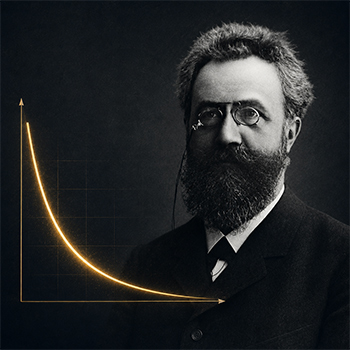 Hermann Ebbinghaus is remembered mostly for discovering the forgetting curve. Open any psychology textbook, any blog devoted to a flashcard app or any study-tips listicle, and you’ll find his name alongside a distinctive graph.
Memory expert Tony Buzan called it the most important graph in the world. That’s because its iconic line shows memory plummeting within hours of learning something new, then flattening out over days.
Countless discussions of how to reduce forgetting give you the same tidy recommendations. Usually they tell you to review your study materials at intervals, just at the point you’re starting to forget.
That way, many authors promise, you’ll beat the curve.
The problem, just one of many you’ll discover today, is this:
Ebbinghaus didn’t discover the forgetting curve. He discovered his forgetting curve.
He was one man, testing his own memory, on one kind of material, using one method.
And although the forgetting curve is indeed one of the most repeatable and reproducible principles in the history of scientific studies, reproducibility in laboratory settings does not mean you’ll stop forgetting by using the conventional recommendations.
Besides, here’s something almost no one else will tell you:
The deepest principles the Ebbinghaus experiments revealed were already written down more than two thousand years earlier by Aristotle.
You’ll find them in a short treatise that describes something remarkably close to using a Memory Palace in combination with the same kind of serial positioning Ebbinghaus described as a means for reducing forgetting.
So today I’m going to cover a few aspects of the forgetting curve all serious users of memory techniques need to know.
These are points I’ve been putting off writing about for a long time. However, a few emails and comments I’ve received over the past few years have convinced me that now is finally the time.
Especially since I’ve spent decades memorizing poetry, scripture, mantras, complex terms, the names of people from various backgrounds and vocabulary and phrases in multiple languages.
And I’ve done this all while teaching thousands of students to do the same. From where I sit as a practitioner, the forgetting curve is real, useful and badly misunderstood.
But treated correctly, it’s an invitation to success.
First, however, for the uninitiated, let’s make sure we’re on the same page about the definition of this term. That way, you’ll be able to discover your own curve and work on reducing its impact in your learning life.

What Is the Forgetting Curve?
In 1885, Ebbinghaus published Über das Gedächtnis (Memory: A Contribution to Experimental Psychology). In this monumental work, he reported years of experiments he had run on a single subject: himself. He memorized lists of sinnlose Silben, the German term for nonsense syllables.
These were consonant-vowel-consonant combinations like ZOF and KEB. After committing lists of such invented words, he then tested how much effort it took to relearn them after various delays.
Notice two things. First, these were invented words. Nothing with any meaning.
Second, pay attention to the word relearn. Ebbinghaus did not measure memory only by asking whether he could reproduce an entire list perfectly. He also measured what he called “savings” in the context of relearning. This study goes quite deep into the nuances and implications of this particular concept for memory.
To get the concept in brief, suppose it initially took you 20 repetitions to learn something. If it took only 10 repetitions to relearn it later, some trace of the original learning clearly remained. Your inability to reproduce the information perfectly would not mean the memory had disappeared completely.
Keep this idea of “savings” in mind. It matters more than the famous graph, and we’ll return to it when I show you what happened to a long Sanskrit mantra I intentionally abandoned for years. It also connects to some concepts in memory introduced by Richard Semon and studied more recently by Dr. Paul Garrett in relation to the role of fuzzy memory.
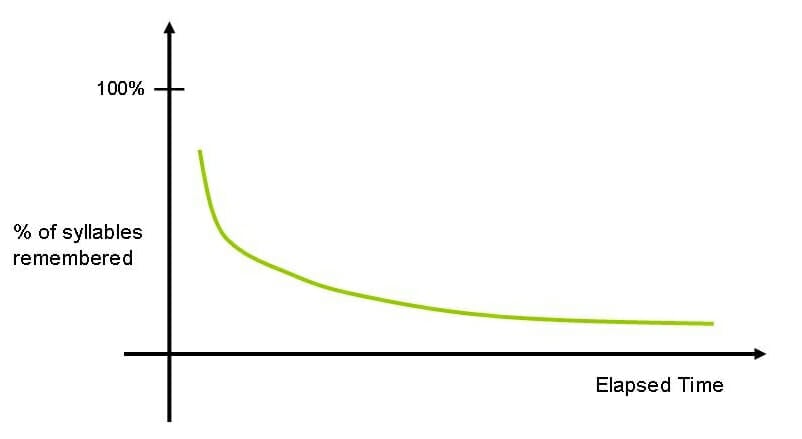
Back to Ebbinghaus, the result of his experiments is what we now call the forgetting curve. It shows how retention drops steeply at first, then the decline slows. He also documented what we now call the spacing effect. It describes how reviews distributed over time preserve more in long-term memory than the same number of reviews crammed together.
All of what Ebbinghaus found replicates, so his science is not in question here. What’s in question is what you and I should actually do with his findings. And that’s where things really start to get interesting.
Ebbinghaus Was an Early n=1 Memorizer
Notice what Ebbinghaus actually was:
A practitioner running experiments on his own memory. In today’s language, he was doing n=1 self-experimentation. He had skin in the game, memorized real material with his own mind, and measured what happened.
I took his actions as both a lesson and an inspiration.
It’s just that rather than memorize nonsense (apart from a bit of Kurt Schwitters’ “Ursonate”), I’ve focused on applying memory techniques to Chinese, scripture, poetry and facts related to law school.
But you will never see the results you can achieve by reading about Ebbinghaus. You’ll only see it by memorizing information yourself and paying attention to what happens next.
Tony Buzan was great about splitting the difference during his ThinkBuzan seminars. He taught memory techniques, but also had participants draw their own graph of the forgetting curve.
Here’s mine:

In sum, reading about the forgetting curve while never memorizing anything is like reading about swimming while refusing to get wet.
Is There Such a Thing As Too Much Scientific Literacy?
Years ago, Harry Lorayne coached me on becoming a successful memory coach.
I followed just about everything he said, except one thing. He said, “whatever you do, don’t tell ’em about the science.”
The reason I ignored the advice is that:
- I’m very interested in memory science
- Studying it has helped me discover many powerful memory activities and brain exercises
The only problem I’ve seen is that about a year ago, students of all ages started writing to me in the language of science at an increasing rate. And for many, the various terms and memory statistics available online have created anxiety and perfectionism I don’t think needs to exist.
For example, a medical student taking the Magnetic Memory Method Masterclass recently emailed multiple times with worries about whether his review schedule was set to properly combat the “decay function.”
Now, obviously, the research on memory genuinely matters. I cite it often and terms like this can be useful for forming a solid practice with using mnemonics.
But Lorayne’s warning has started to take on a strange and unexpected sense because something strange happens when the vocabulary of science replaces practice. After all, science is mostly there to describe, not proscribe.
We can certainly use scientific findings to improve our practice, but it’s not helpful to let techniques that have been used happily for thousands of years become the source of anxiety thanks to scientific papers.
Don’t Let These Terms Interfere With Your Memory Training
It’s not only beginners with memory techniques or medical students who would tend towards scientific verbiage when contacting me.
I regularly hear from people fluent in the terminology, sometimes with publications to their name.
A published researcher wrote me recently and had thoroughly reasoned himself into genuine paradox. Amongst other things, he wanted to know what a trained mnemonist’s memory does “without any technique.”
Now, you certainly can get a swimmer to demonstrate what a particular stroke looks like without the water.
And in the context of memory training, the question can sound rigorous.
But in my view, this kind of question suggests that the researcher has lost contact with the very thing he’s asking about. This is because someone with a trained memory can’t isolate a ‘raw baseline’ without risking cognitive paradox. I would have to reflect on my use of mnemonic methods while not using them.
And since he immediately followed-up with a pseudo-scientific claim about photographic memory, I knew he was not taking Ebbinghaus’ n=1 practice as an example by actually using the techniques himself. After all, photographic memory has been thoroughly debunked and I’ve demonstrated many times over that it not only does not exist. The term itself makes zero sense.
So this is where some nuance about the forgetting curve is very important to the serious user of memory techniques. No matter who you are, you need to make contact with actual remembering.
Aristotle Described the Core Principle Two Thousand Years Ago
Actually studying and practicing a wide variety of memory techniques will get you insight far more interesting and impactful than any psychology textbook could hope to provide.
In De Memoria et Reminiscentia, Aristotle describes recollection as movement through an ordered series. At one point in the book, he uses a sequence like the letters of the alphabet and gives strikingly practical advice that deeply inspired what I call Recall Rehearsal. This is a form of spaced repetition applied specifically to the Memory Palace technique.
As Aristotle puts it, if you forget something, don’t start over from the beginning. Start from the middle of the series and move outward from there.
Richard Sorabji, in his landmark study Aristotle on Memory, admits that he doesn’t understand what Aristotle is talking about in this passage. That’s a courageous confession, as many scholars would just make something up or speculate.
As a practitioner of memory techniques with decades of experience, I can tell you what I believe Aristotle is describing. It’s either:
- An alphabetically labeled Memory Palace
- An early description of serial positioning and spaced repetition
- Or a description that provided the inspiration for creating this kind of Memory Palace practice.
It’s genuinely difficult to say which. But either way, the principle and how it reduces unwanted forgetting is unmistakable to anyone who has actually run the technique.
In case you have never used a Memory Palace, it involves ordered locations, deliberate starting points, and strategic entry into the middle of a sequence as part of several spaced repetition patterns that establish substantial retention.
Modern Practitioners Who Know How to Beat the Forgetting Curve
You can trace this practitioner lineage forward through Peter of Ravenna, Jacobus Publicius, Robert Fludd, Giordano Bruno, and in our own time, mnemonists like myself and Lynne Kelly (especially in her book, Memory Craft). Our combination of fieldwork and daily personal practice in particular sets the standard for studying these techniques.
Certainly Frances Yates deserves credit for reviving scholarly interest in mnemonics through her book, The Art of Memory, but she acknowledged never practicing the techniques herself.
Frankly, it shows. Her treatment of memory wheels, for example, creates the impression they were used as Memory Palaces, which is possible but unlikely. Practice changes what you can see in the Memory Palace books you read.
Why does the Aristotle passage matter for the forgetting curve? Because his advice that you should “start from the middle” of a sequence of information you keep forgetting is serial positioning in action. And serial positioning is the key to defeating the curve.
My Own Forgetting Curve, Observed in the Wild
The reason I’ve never tried to reproduce Ebbinghaus’s experiment formally by memorizing nonsense is precisely because you see advice on how to beat the forgetting curve thousands of years before he conducted his research.
That said, I have watched my own forgetting curve operate over years, and the observations I’ve made are instructive.
For example, I worked daily with one long-form mantra built from a few dozen Sanskrit phrases for many years: the Song Celestial.
Then I deliberately let it lapse with no rehearsal at all for approximately two years. I was not as deliberate as I could have been in terms of tracking like Ebbinghaus would have. But since the research is so heavily reproducible and we know why Memory Palaces work, I was happy to be casual about it.
When I finally came back to this mantra, I was shocked by how much I could still recall. The forgetting curve had certainly caused some “decay.” But it was nothing like what Ebbinghaus’s graph would predict for material of that length after that much neglect. In Ebbinghaus’s own terms, the “savings” were enormous. And the relearning cost me a fraction of the original effort, because the trace was never gone. It was waiting for me.
The question is, why? After all, I can’t sing songs I used to know by heart when I was a kid?
Part of the answer is that I never stopped reciting the other three Sanskrit mantras I have memorized. They have very similar meanings, and in many cases, some of the same words.
The meaning element in particular suggests that I partly benefitted from stronger retention due to what scientists call context dependence. Because I never left the realm of reciting Sanskrit entirely, that must explain the higher rate of retention.
Compare this to my previous career as a Film Studies professor. I hardly watch movies anymore, let alone read theoretical books about them or lecture for weeks on end during a traditional university semester. The lack of context has accelerated the force of the forgetting curve and deskilled my chops as a film scholar.
Memory Palaces: Structured Spaced Retrieval Systems That Beat Forgetting
Apart from context-dependent memory benefits, another reason I could recall so much of a mantra despite not reciting it for years has to do with how I memorized it: using the Memory Palace technique.
Not as a party trick, but as a structured spaced retrieval system. To learn more about how it works, check out my Complete Guide to the Memory Palace technique.
In brief, the key is to place information tethered to associations along the stations of a Memory Palace and then practice Recall Rehearsal following patterns no software like Anki can guide you through.
Titus Andronicus and Recall Rehearsal in Action
My favorite demonstration where I show you Recall Rehearsal in action involves Shakespeare, specifically a passage from Titus Andronicus I memorized for my case study of how Anthony Hopkins memorizes his scripts.

I’ve retained the passage ever since running it through Recall Rehearsal with minimal repetition.
Or better said, I repeat these lines often, but now it’s performance, not just recitation.
But the interesting thing isn’t really that I can recite this passage. Anyone can chain words together through brute force rote learning and recite lines like these forward.
The proof of the power of Recall Rehearsal is that I can recite the lines out of order:
- Jumping between sections
- Running lines in reverse
- Reciting the odd-numbered lines and then the even numbered lines
It’s now probably my favorite demonstration because it makes the power of serial positioning visible.
Even better: I’m not alone in enjoying the benefits of improved retention.
Magnetic Memory Method Students Who Have Bent the Curve
I’ve watched this play out in my students for years, and two cases capture it especially well.
Jeannie Koh spent years learning Koine Greek using rote learning during years of what she said were filled with tears and pain.
But after learning to encode with Memory Palaces, she found memorizing “much less painful, and much more enduring over time,” now recalling whole passages in that ancient language with an ease she says feels almost suspicious. Same brain, same language, two encoding methods, two completely different forgetting curves. She’s a one-person controlled experiment.
For more success stories, including physicians who used these methods to retrieve high-volume, complex information under exam pressure months after encoding it, check out my testimonials page.
The pattern is always the same: the forgetting curve is not destiny.
So long as you’re using memory techniques optimally, you can resist it, if not beat it.
Should You Reproduce Ebbinghaus’s Experiment?
One problem I see time and again is that many people want the exact steps needed to measure their progress. Especially when they hear me discuss how rigorously I use journaling as part of my memory activities.
I’m sorry, but the demand for “exact steps” is mostly a desire installed by content marketing. The truth is that there isn’t one exact path. There are several and the real lesson in Ebbinghaus’ story is that you need to get involved in creating your own.
You can journal manually by simply memorizing real words or nonsense words. Note the dates, and test yourself over time. What matters is that you work inside projects that matter to you. Whether that’s language learning, poetry, mantras, scripture, use a memory journal to help you test what holds and what fades as you use memory techniques.
If you’re competitive, you can study how memory athletes use journaling to sharpen their game. My podcast conversation with Johannes Mallow, in which he explains how journaling improved his competitive standing, will be useful in that regard.
Often Forgetting Is Actually a Crisis of Commitment
If there’s one thing I’ve noticed over the years, it’s that people often take on learning projects connected to lives they do not actually want.
They study for a qualification because they believe they should, or to please a family member.
As a result, they struggle to memorize information for a job they already suspect will make them miserable. Then they interpret their resistance as a defective memory, when the deeper problem is in fact a conflict of purpose.
I’ve had to face this in my own law-school experiment.
I could not know in advance exactly what studying law would involve or how well the field would suit me.
The saving grace is that trying it has given me greater insight into what’s involved.
But now that I’ve seen some of the field from within, I have to ask a different question:
Just because I am a mnemonist who can memorize legal Latin quickly and an upcoming presentation I have to give does not mean I must continue pursuing every possible outcome associated with the degree. The ability to remember something does not prove that it deserves years of my life.
As I know from my studies in polymathy, memory mastery must include the development of careful selection parameters.
In other words, one of the best “meta level” ways to beat the forgetting curve is to decide whether the material deserves a place in your memory at all.
If you’d like help picking what to memorize on top of using the Memory Palace technique and Recall Rehearsal, my new training “The System” can help you pick a first project you actually care about.

Once you have a learning goal you love, keep a journal as you memorize.
Not to reproduce a nineteenth-century experiment, but to watch yourself break the forgetting curve, one piece of info at a time.

 Anthony Metivier is the founder of the Magnetic Memory Method, a systematic, 21st century approach to memorizing foreign language vocabulary, names, music, poetry and more in ways that are easy, elegant, effective and fun.
Dr. Metivier holds a Ph.D. in Humanities from York University and has been featured in Forbes, Viva Magazine, Fluent in 3 Months, Daily Stoic, Learning How to Learn and he has delivered one of the most popular TEDx Talks on memory improvement.
His most popular books include, The Victorious Mind and…
Anthony Metivier is the founder of the Magnetic Memory Method, a systematic, 21st century approach to memorizing foreign language vocabulary, names, music, poetry and more in ways that are easy, elegant, effective and fun.
Dr. Metivier holds a Ph.D. in Humanities from York University and has been featured in Forbes, Viva Magazine, Fluent in 3 Months, Daily Stoic, Learning How to Learn and he has delivered one of the most popular TEDx Talks on memory improvement.
His most popular books include, The Victorious Mind and…