
Podcast: Download
Subscribe: Apple Podcasts | RSS
 I just sat my first open book exam, the format where you’re allowed to bring your notes.
You can even bring the physical textbook if you want, a testing format that was totally new to me.
Should be easy, right?
That’s what your tricky examiners want you to think.
And I know not to fall for it. I have a PhD in Humanities, two MA degrees and taught at three universities around the world.
During my years of teaching, I wrote, administered and graded more exams and assignments than I can count.
Now, back in school as I near my 50s, I’m working on a second Bachelor’s degree. This time in law so I can develop an exact understanding for what law memorization is all about.
For my first exam, I scored “High Distinction.” That’s the top grade here in Australia.
But here’s something to consider that probably no one else will tell you about open book exams:
There was one question I got wrong. And it wasn’t even the one I thought I’d missed.
This “error” suggests that having the textbook wouldn’t have saved me even if I’d brought it with me.
No, the problem was caused by the open book format itself.
In this experience-based guide, I’ll show you what this kind of exam actually tests, and how to prepare properly. That way you can avoid the same recycled study advice just about everyone else gives online.

What an Open Book Exam Actually Tests (It Isn’t What Most Guides Tell You)
First, I have to tell you that I was initially surprised that open book testing exists in law school at all.
Especially since to pay for my earlier university studies I took some high-stakes exams for jobs I worked to help pay my tuition at York University.
For example, I worked as a store detective and having open book testing for the required security guard license would have been absurd. No employer wants a guard who needs to flip through a textbook to determine whether or not they’ve witnessed a crime, after all.
But now that I’ve taken my first exam of this type, I’m fascinated and did some research on why such tests are administered in the first place.
In this study, researchers Ming-Yin Chan and Kwok-Wai Mui reveal that open book examinations have existed since at least the 1930s.
Using my university library access, I found one such early study in the Journal of Higher Education from March, 1934.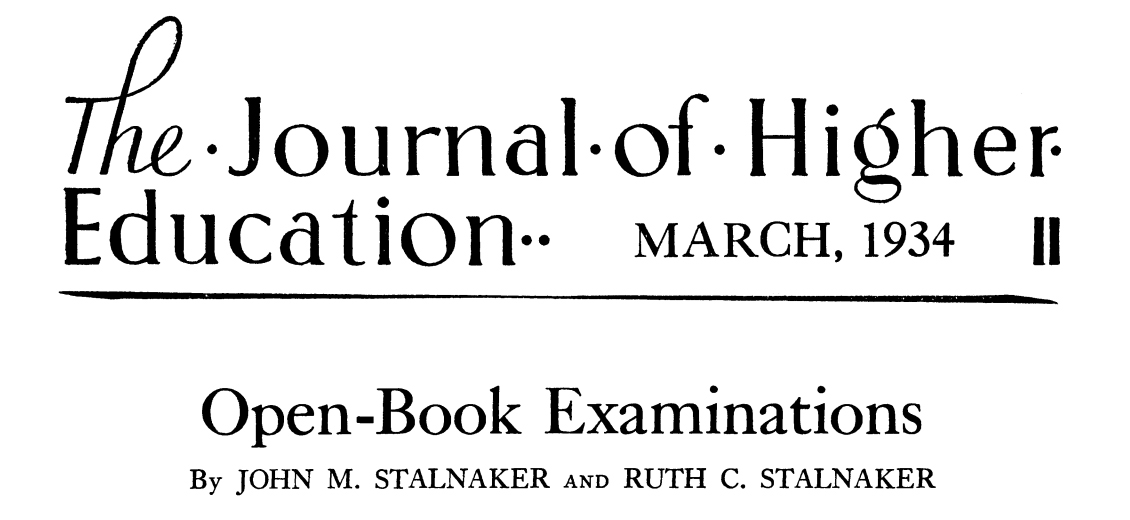
As John and Ruth Stalnaker argue in Open-Book Examinations, such testing has many positives:
- Emphasis falls on the course objectives
- Students utilize facts to solve problems
- Inference skills are exercised
- More time tends to be spent by students on preparation rather than cramming
They predict that these kinds of tests will be more widely used in the future and encourage more research into the best kinds of questions suited to this format.
Are the questions suitable to the format of studying law?
Now that I’ve sat for a couple, I think so. After all, law is the field where getting even just one section number wrong could change the outcome of a case.
That means this kind of testing is only partially about testing recall.
It’s more about determining whether you can read with precision and work with the exact information as worded on a variety of source materials while the clock is ticking.
Twenty Questions, Sixty Minutes, and No Authentic Way to “Look Things Up”
So there I was at my laptop, the entire device reduced to just one screen by a lockdown browser called Respondus.
My first exam was for a course called “Legal Institutions and Processes.”
It is heavy on history and legislation. The first few weeks involved a ton of dense reading from multiple textbooks and a legal dictionary.
This is the kind of reading I really haven’t done since I changed my major from Political Science to English during the second year of my first undergraduate degree.
Although I had dreamed at my naive young age of one day becoming the Prime Minister of Canada, I changed my mind that year after interviewing the premier of British Columbia for the student newspaper. He clearly lied in response to my question and I determined right then that I was never going to be anything like him.
Anyhow, do the math with me.
Twenty questions during an hour-long exam gives you three minutes per question. During that time, you need to
- Read each question carefully
- Check your answers
- Fight off all kinds of urges and fidgety feelings that arise when you’re trapped
And due to how the lockdown browser software works, I was literally trapped. The rules dictated that I could not leave the computer until I ended the session or the time ran out.
The Practical Reality of Flipping Through Notes
If you’ve never sat for an exam like this, ask yourself:
How much time can you really afford to spend flipping through fifty pages of notes looking for an answer you don’t know?
There’s no cookie-cutter answer here, but without preparation, the answer may as well be “zero.”
The research agrees. In a 2024 study involving 112 open book and 83 closed book cognitive psychology students, the open book group scored higher.
However, they also took longer to finish their exams.
One way to interpret these research findings is that having access to your textbook increases your accuracy. But at what price in a world where time is your scarcest resource?
How Long Did I Spend?
As a time-poor entrepreneur with lots of polymathic projects on the go, I finished my first open book test in approximately thirty minutes.
But needing the time to do other things was only part of the reason.
A lot of the questions I was able to answer simply by using critical thinking, a skill I taught at university as a professor myself for four years. If you’re interested, here’s a list of my favorite critical thinking books.
But the real reason I finished early is because I took the exam without a textbook.
And that means for me, it wasn’t an open book situation at all. At least not in the normal sense.
Here’s what I mean:
My Notes-Only Experiment: Testing Digital Amnesia Under Exam Conditions
Years ago, I wrote about a condition the Kaspersky Lab researchers called “digital amnesia.”
In brief, your mind blanks out when trying to access information because you’ve stored it on a device you trust instead of in your head.
Back then, I argued that every time you reach for a search engine instead of pausing to ask your own memory first, you deskill it. This is not unlike the way your muscles droop when you stop performing pushups.
Here’s my original digital amnesia article if you’re interested.
Anyhow, I don’t know if I’ll take more advanced law school courses without buying the physical textbooks.
But for this exam, I took it as my chance to run a more high-stakes experiment with digital amnesia than I’d ever tried before.
Did I have to experiment under proctored conditions, with a grade attached?
Of course. Because real test conditions matter.
And all the more so in the age of Artificial Intelligence, which challenges many aspects of mind and memory as I’ve previously written about in the context of learning.
Let me take you a bit deeper behind the scenes. Because if you know my work with the Magnetic Memory Method, you’ve probably seen me with books frequently.
And it can be confusing to suddenly hear that I decided to study 100% online.

Why I Refused to Buy the Course Textbooks on Purpose
Two reasons.
First, I’ve said it on the Magnetic Memory Method Podcast for years:
I don’t memorize well from screens.
In fact, 3x USA memory champion John Graham and I have talked about this “problem” of mine on more than one of our podcast conversations.
I’m not alone with this problem. Some researchers even have a name for people who forget what they read from digital devices: the screen inferiority effect.
Pablo Delgado and his research team probably gave away the best advice about how to handle the fact that we forget what we read from screens. They gave the solution away in the title of their 2018 Educational Research Review meta-analysis, “Don’t throw away your printed books.”
Don’t throw print away indeed.
Even some of the most pro-digital people I know follow this advice. For example, Andrew Mayne, host of the OpenAI podcast has been on my podcast to talk about how and why he still uses print journals and physical notebooks as part of training his memory.
Second, I made this choice to dimensionalize my work on Peter of Ravenna, the 15th-century jurist who wrote about his legendary memory techniques. In my imagination, he wouldn’t have bought the textbooks either.
All of which is to say that I knew what I was getting into when I made the deliberate choice to forgo ordering any of the physical textbooks for my first trimester of law school.
But when I learned that my first test settings were going to be open book?
I immediately had to reconsider my approach. And handle a frustration I faced with a contradiction in terms.
The Unprintable Textbook Problem
The assigned textbook, Laying Down the Law, is available through the university’s online library. But they’ve offered it in a digital format that makes printing individual chapters impossible.
This means that a student who can’t afford the print edition, or doesn’t want to study from print, has exactly one permitted way to use the textbook: effective note taking.
Could I have opened the library copy on a second computer during the exam?
Technically, perhaps. But the rules make clear that accessing any secondary device counts as cheating.
So I showed up to the test prepared with my handwritten textbook notes instead.
I also prepared my own version of the lecture slides to make sure I could refer to them if needed.
This required a couple of steps:
- Download them from the online course platform
- Upload them into Google Slides
- Export them as text files
- Edit the text into useful notes in a Google Doc
- Supplement the notes with my own observations
- Print them out
- Study them further from the printout
These steps took time.
But I wound up with much more understandable notes as a result.
The notes not only fused the lecture content with the readings. I also got an additional review of the material.
An Absurd Study Requirement
Still, part of my mind couldn’t let go of the absurdity of the situation.
I was preparing for an open book exam where the book is locked behind a screen you’re not allowed to open. Students willing to spend the money get to bring the textbook.
Anyone else has to bring whatever they managed to copy out by hand.
This is not a level testing field. It’s a paywall wearing an academic gown.
In my case, the absurdity of this barrier served my learning experiment. But I had a choice. Plenty of students don’t.
Think First, Verify Second: How I Actually Used My Notes
So how did my handwritten notes and transformed notes based on the slides perform against the clock?
At first, I didn’t use the notes at all.
Instead, I initially answered every question by thinking first.
Then I went over everything a minimum of three times, checking my answers for accuracy against the notes.
In other words, I used my notes as a verification instrument, letting the answers come first from my memory.
Now that you know how my exam went, let me consolidate everything into some tips for your own open book test.
How to Prepare for Your First Open Book Exam: My Best Tips
My study suggestions break down into practical strategies and mindset management.
You really can’t have one without the other because unexpected things can and do happen no matter how prepared you come to a test.
Build a Reading “Moat” Well In Advance
Even before I knew about the assignment structure and course exams, I started reading the instant I had access to the course area.
But not just the textbook.
I made ample use of the included dictionary and memorized new terms using this tried and true vocabulary memorization process.
To supplement the reading, I also found as many YouTube channels and podcasts about Australian law as I could. I listened intensely and watched as many hours of video tutorials as possible.
Sometimes these audio and video supplements went quite ahead of the reading. So I took care to balance going too far afield of the requirements against making sure I was going through additional material related to legal institutions.
Placing guardrails on myself required vigilant self-monitoring and discipline, but I wound up with a “moat” around the core reading. In other words, my core reading was surrounded by related multi-media study.
How to Pass an Open Book Exam? Complete All the Readings & Every Exercise
Often students ask me about how to find the most important details in their study materials.
As I discussed in my tutorial on finding the main points in books and articles, many books include summaries and conclusions.
And some include dedicated exercises. That was the case with Laying Down the Law.
The instructor also included some additional exercises, and so I completed both.
And this is exactly what you need to do too.
Be a completist.
I know it is tempting to search for hacks of every kind under the sun. But in reality, the point of studying something is to become an expert in that topic.
Some experts certainly do skim and scan, but that doesn’t mean you should.
Frankly, I found both the readings and the exercises for my first exam a bit boring. But I went through them anyway to help develop my understanding of the material.
And to go beyond the call of duty so that later on, I will know I at least tried my best.
How to Pass an Open Book Test with Help from AI
As I discussed in my video tutorial on studying complex topics, I wrote an AI prompt to spar with and test my answers:

The prompt is called A.I.M. and you’re welcome to grab it below if you want to give this GPT I trained for myself a try with your study material.
Here’s an important point:
Getting your reading down early and supplementing it with additional material enriches how you complete your exercises.
Memorize Anyway, Even If You Have Textbook Access & Keep Flawless Notes
One thing I kept hearing early on were sentiments like, “No one cares if you can remember legal Latin.”
I took this point into consideration, but memorized the phrases I came across anyway.
It turns out one Latin phrase did show up on the quiz. If I hadn’t memorized it, I would have been underprepared (especially since I did not have the textbook with me).
Memorization of terms, dates, important names, sections and other minutiae related to your studies might not prove valuable in the end.
But more practice with a variety of memory training techniques will provide many benefits.
The core techniques I used for this part of the study process were:
Although it can take a while to learn and practice these mnemonic devices, it is well worth having them on your side.
Organize & Supplement Your Notes Effectively
I actually got the idea to print out the slides and then rearrange them from my friend Nick.
At first, I thought it might be a waste of time. I already faced the problem of forgetting more from digital exposure.
But as I edited the slides in a Google document, I realized that the additional exposure involved looking at the information from a unique perspective.
While changing the format and organizing them into a structure I better understood, I was processing the information again.
I wouldn’t call this form of learning either deep or shallow. It was simply an integrative step that enabled further questioning after I printed out the notes.
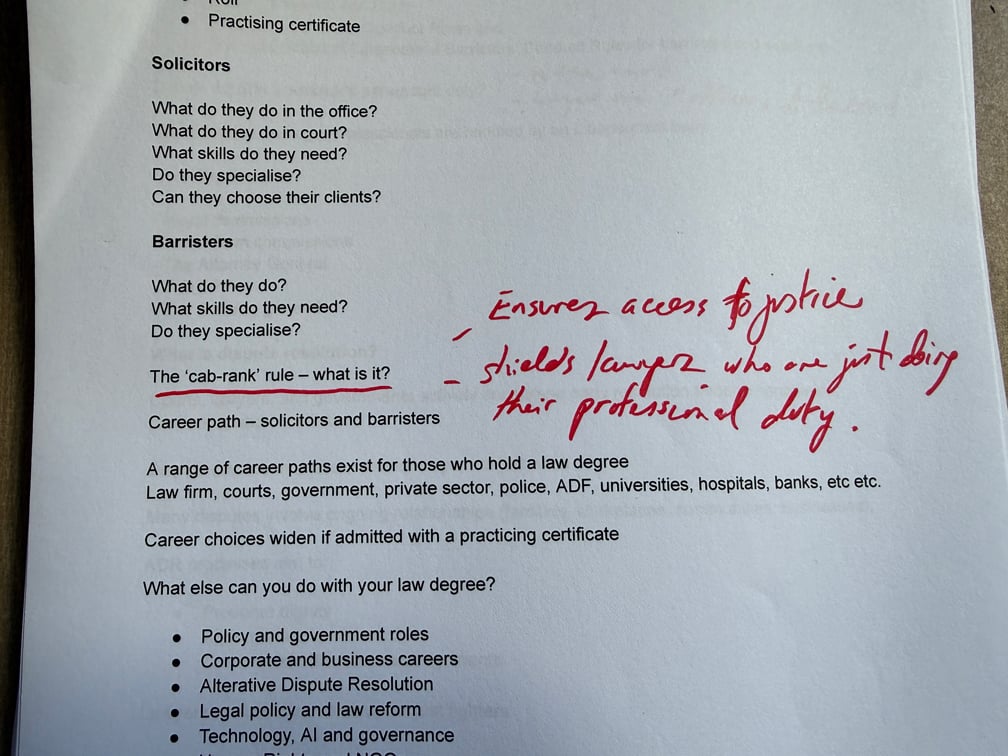
And I found some initial study exercises in the notes that I later answered with a red pen after doing further research.
For example, I extended my understanding of the “Cab-Rank rule” as you see here:
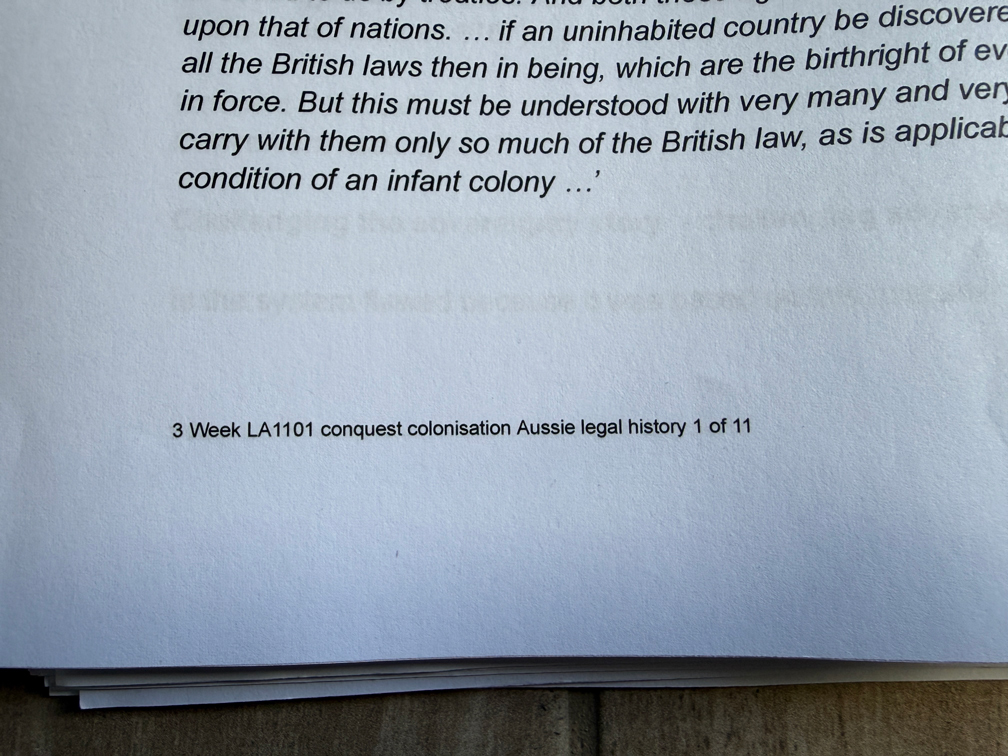
Additionally, I took a moment to set up the footer area.
As you can see in the example, this simple trick indicates:
- To which lecture slide the notes belong
- The page number
- The total number of pages for this set of notes
Although I felt a bit silly, and perhaps more like a secretary than a student doing this, the rewards were obvious as I was doing it.
Knowing that each set of notes was full and completed reduced my jitters. And because the pages were numbered and using the footer showed me at a glance that I wasn’t missing anything, I spared myself any and all mystery about the status of my notes during the testing hour.
Seriously.
I can imagine nothing worse than my mind seizing up with worry that a page of notes had gone missing.
Especially when the rules of the test required that I remain in front of the computer throughout.
Finally, I bound each set of notes together with a simple clip from the stationery store.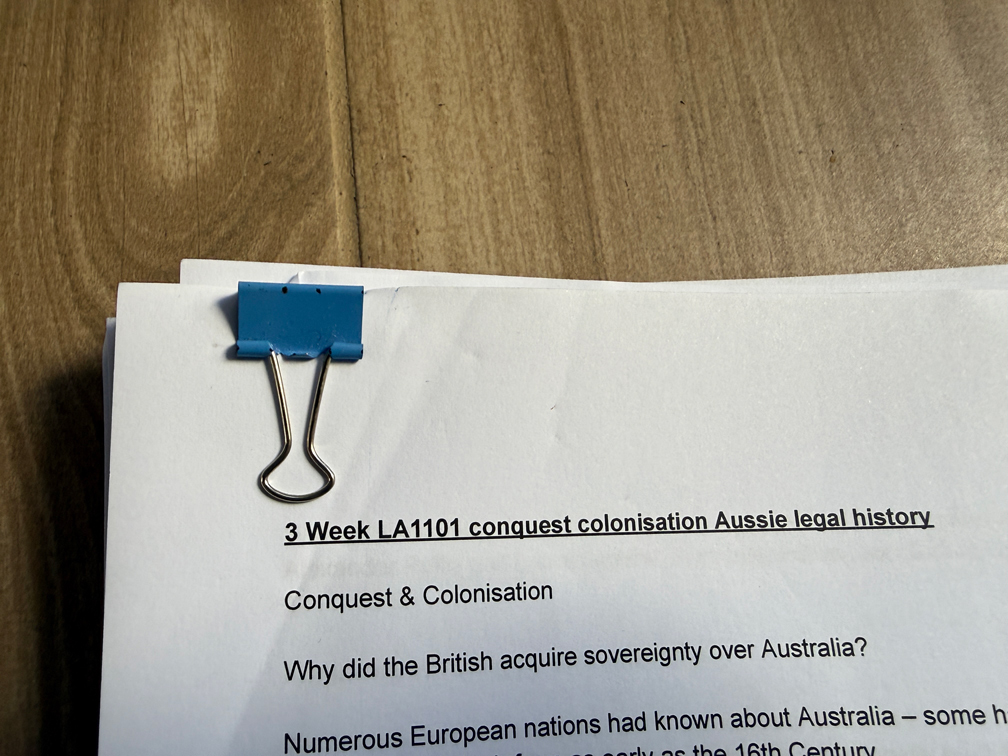
Again, it felt a bit secretarial, but it was really useful in making sure all of my notes were organized.
I did the same with my handwritten notes.
In this case, my handwritten notes were based entirely on key terms I thought would be important for the exam.
What I found interesting is that most of what I had written out from the online textbook was the same as on the lecture slides.
For more tips on dealing with your reading, check out how to take notes from a textbook.
Follow up with my how to memorize a textbook training for what to do with your notes once you’ve got them.
Take Deliberately Timed Breaks While Studying
Provided you’ve started reading early and expanded your reading to include a variety of sources, it’s important to rest.
Frankly, taking breaks is a weakness of mine. I love to plow forward.
But I made myself take entire days off leading up to the exam where I didn’t read anything related to the exam.
However, I did engage in reflective thinking about my studies.
This simple activity while taking time off helps with memory formation and comprehension.
Verify Your Sources Before Exam Day
As a final step, I went through everything again the day before the exam.
This included checking the file names of all my notes and various citations.
Plus, there were various names and dates that I had memorized that were not on my notes. So I checked those, such as for the Mabo decision, an important legal case in Australia.
Although I knew it was unlikely that a multiple choice question was going to confirm that I knew Mabo’s first name was Eddie, I checked my memory of the fact anyway.
This simple verification step not only made sure that other details of the case were clear to me. It’s also just fun to check for accuracy.
For Online Open Book Exams, Test All Software In Advance
Since I’m a remote student, I not only made sure I completed installing the Respondus software days in advance of the exam.
I also made sure all my software was up to date, from the browser to the operating system.
Not only is regularly updating software a best practice.
Knowing that everything is operational helps reduce exam anxiety.
Control Your Mind While the Clock is Ticking
Although I finished the exam quickly, it’s not that time wasn’t on my mind.
In fact, it was raining hard and I hadn’t slept well.
Both of these factors injected no small amount of misery into my mind.
In my case, I kept thinking about Peter of Ravenna and how disappointed he would be. There wasn’t much room for memory techniques to shine during the exam experience.
Then I started doubting that law school was such a great idea after all.
As soon as I caught myself doing that, I started running some of the mantras I memorized prior to writing The Victorious Mind.
Having this simple ritual focused my mind back on the task at hand by blowing the distracting thoughts away.
If mind wandering causes you issues while sitting for exams, it could be worth looking into various mental routines you can practice.
This complete guide contains multiple concentration meditations you might find useful as a learner.
Why Do Teachers Give Open Book Exams?
Although I passed with High Distinction, my first exam of this type felt alienating.
I can’t quite put my finger on what bothers me about it. But to use a critical thinking tactic, I’ll try to steelman the format by way of understanding the reason behind the testing scheme.
It’s clear that this kind of test is less about knowledge and more about how detail-oriented the student is.
I also suspect that the reason the teacher gave an open book exam is twofold:
One: Anti-Guessing Design
The open book format means that you will actually go through your learning material. There’s no incentive to guess when you can look at your study sources, leading to at least one more pass through the material.
Two: Blended Testing
This exam was only part of the grading for the course.
I still need to give an oral presentation and submit an essay.
By having an initial exam with the anti-guessing design optimized to generate an additional review of the study material, it does set the stage for stronger performance.
Summing up: A Plan for Your First Open Book Exam
Because time is always in short supply, I suggest that you:
- Start reading as soon as possible, ideally before the course even begins.
- Take extensive notes and give yourself time to verify them.
- Complete all of the available practice questions.
- Use ChatGPT as a sparring partner, not as a source of answers.
- Schedule plenty of breaks.
- If you’re a remote student, check that all of your software is updated.
If you would like access to the sparring partner I created for myself, it is called A.I.M.
As a study prompt, it’s simple and direct. But I found that it helped me identify a number of blind spots in my thinking.
Click or tap the image below to claim it:
I don’t know what Peter of Ravenna would have to say about exams like this.
But in my experience, the format rewards the prepared mind and the precise reader.
I expect my memory will be tested in future law courses and because of the amount of review this kind of testing promotes, I expect the experience has indeed helped my recall.
Even if in a different way than I’m used to when studying.
For more of my experience and teaching on that, check out my guide on How to Study Effectively next.
Above all, enjoy the learning process.
We sometimes forget what a blessing it is to be able to study at all.
Yet, here we all are, with more people on the planet studying than ever before.
Don’t forget to celebrate the opportunity you have and bring that awareness to the exam. Keeping a positive attitude is a major skill that promotes massive success in all of life’s many “tests.”

 Anthony Metivier is the founder of the Magnetic Memory Method, a systematic, 21st century approach to memorizing foreign language vocabulary, names, music, poetry and more in ways that are easy, elegant, effective and fun.
Dr. Metivier holds a Ph.D. in Humanities from York University and has been featured in Forbes, Viva Magazine, Fluent in 3 Months, Daily Stoic, Learning How to Learn and he has delivered one of the most popular TEDx Talks on memory improvement.
His most popular books include, The Victorious Mind and…
Anthony Metivier is the founder of the Magnetic Memory Method, a systematic, 21st century approach to memorizing foreign language vocabulary, names, music, poetry and more in ways that are easy, elegant, effective and fun.
Dr. Metivier holds a Ph.D. in Humanities from York University and has been featured in Forbes, Viva Magazine, Fluent in 3 Months, Daily Stoic, Learning How to Learn and he has delivered one of the most popular TEDx Talks on memory improvement.
His most popular books include, The Victorious Mind and… 



4 Responses
This is yet another reason why I go back to the proverbial drawing board OFTEN I have to do so-Professor Anthony Metivier is for sure The Most Thorough individual, at least for me personally that I have ever encountered. I am an ongoing MMM Student although at 72 years chronologically I don’t see myself in this particularly testing =open book environment as a University Student. However, long ago and far away when I was a college student, boy do I wish I had known all of this then-most beneficial. Thanks Dr. Anthony Metivier
Off to the “drawing board” for GB
Thanks as ever for your interest and support!
Enjoy being back at the drawing board. It’s a great place to be!
First of all, I applaud your effort to actually test your methods and theories with a real-world application: school. In my day it was very popular to give blue-book exams (in person), which amounted to written answers about a small page long. A couple of my professors stressed that reading must always take place before the lecture and not after. I can’t stress how helpful that is to absorbing the lecture. The other trick that we, my study friends and I, developed was to “play professor”. We would try to figure out what questions will actually be on the test. For each small topic what would this particular professor ask and what is the most concise complete answer.
Thanks so much for this.
Playing professor sounds like a great strategy.
Although I never did exactly that, I did participate in quite a few study groups that effectively created the same experience.
I think it’s very true that reading is best when it happens before the lecture.
Also anticipatory reading, where you guess what the professor might say. I didn’t always do this, but I had some profs who were such wonderful characters that it was almost impossible not to imagine what they were likely to cover.