
 Is medical terminology hard to learn?
Only if you keep trying to learn it through raw and repetitive rote learning.
When you’re facing the massive volumes of detail involved in anatomy, pathophysiology and pharmacology, rote repetition leads to burnout fast.
Worse, you can wind up making mistakes due to the similarity between terms like losartan and lisinopril.
As an award-winning professor who has helped thousands of students ace their medical exams, I can tell you there is a faster way. By using a specialized approach to the Memory Palace technique and other mnemonic strategies that belong to the Magnetic Memory Method, you can:
- Mentally organize complex medical prefixes and suffixes
- Remember drug classifications
- All aspects of anatomy
- And much, much more
The “Magnetic” approach you’re about to learn on this page isn’t about mere tips. It’s a proven system used by doctors, nurses and even people like three-time World Memory Champion Alex Mullen. He now works in medicine professionally.
So if you are ready to stop cramming and start developing a permanent mental database of medical knowledge, this page shows you the best way to study medical terminology with great speed and efficiency. They’re all based on the lessons covered in my book, How to Learn and Memorize Medical Terminology.
And they’ve led to lots of praise from successful medical students on my testimonials page.
So dive into the video below and read all of the detailed examples on this page so I can show you how this system works:
How to Learn and Remember Medical Terms: 10 Easy Steps
Let’s start by looking at how to remember medical terms from a big picture perspective. The key strategies are based on how mnemonists approach learning this kind of material.
And, as I mentioned, it’s not just a memory expert approach. Amongst many medical students I’ve helped, the physician Alex Mullen also happens to have won the World Memory Championship three times. He’s helped improve my own teaching immensely several times by giving interviews.
To help you see one of today’s main strategies you’re going to master, I’ve created an infographic for you below. It covers the use of flashcards in a particular way based on my full flashcard optimization tutorial.
In brief, you need to:
- Categorize your flashcards in a way that creates logical associations
- Use them with spaced repetition principles to ensure long-term retention
- Incorporate colorful visual images that transform dry terminology into vibrant associations that are impossible to forget
As you can see from this study and this one, these memory techniques alone are highly effective. The only catch, one highlighted especially well by the second study, is that you have to use the techniques properly.
That’s why it’s important to pay attention to the initial steps highlighted on the graphic below.
Not only will following the exact steps optimally set the stage for learning and remembering. Using these techniques optimally will also help fend off the anxiety-induced memory loss medical school exams often create.
One: Organize the Medical Terms So You Can Use Medical Mnemonics Effectively
Now that you know organization of your study material is key, here’s a key problem you can quickly eliminate:
Many medical students try to memorize directly from textbooks or flash card decks that have been prepared for them by other people.
There are a few problems with this “borrowed” approach:
- You risk taking on too many terms at once
- You easily lose different terms
- You cannot easily reorganize the information
- You cannot personalize your list of terms
To combat this, I suggest you create your own flash cards by hand. And organize them according to categories that you find useful. For example, you can group your medical terms according to:
- Prefixes
- Suffixes
- Word roots
- Physical systems
- Symptoms
- Side effects, etc.
Two: Amplify Your Flashcards with Colorful Images
Once you’ve organized the terminology and definitions you need to study, incorporate colors and simple drawings on flashcards as much as possible.
Let me start with an example that might seem silly to you, but is just an entry point into some of the examples for more complex medical terminology I’ll share with you below.
When I needed to learn the term hypotension for low blood pressure, I drew a simple hypodermic needle on a flashcard. Here’s a photograph of it so you can learn some of the key encoding principles this kind of flashcard contains:
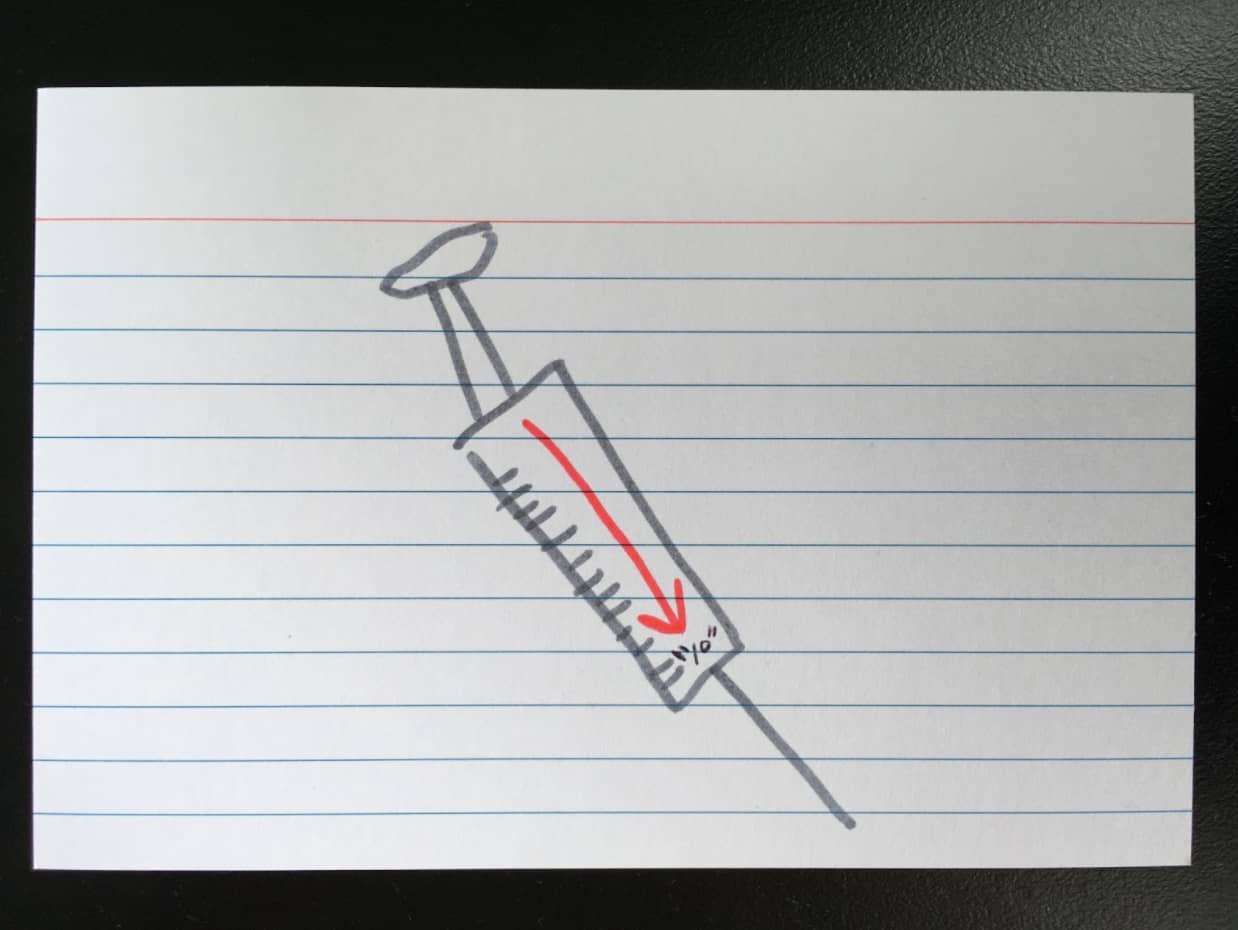
Notice how I placed a red arrow facing down to indicate the notion of “low.”
There’s a “10” in quotation marks to remind me of the “tension” part of this basic medical term.
This form of learning might seem counterintuitive, but it falls perfectly in line with the science of active recall.
This kind of quick sketch works as an alternative to rote learning because when you look at a drawing of your own design, you cause your mind to solve a puzzle.
As you look at the image and guess at what term it’s supposed to help you remember, your brain starts to form very strong memories.
There’s a lot more to say about extracting information onto cards in an optimized manner. Check out how to memorize a textbook for a full tutorial. And watch this video tutorial for more detail:
Three: Learn to Use Pegword Mnemonics with “Word Division”
To save time, it’s important to learn the pegword method, which essentially gives you an association for every letter and number.
I’ll give you an example below so that the technique quickly becomes fun and easy.
But rest assured: I know that to some people this technique can sound like a lot to learn when you’re focused on medical school. But if you take a step back to master it over a weekend or two, you’ll find that it saves you a ton of time on your medical studies.
Pegword Example for Adrenergic Agonists
The first task with any pharmacology term is to memorize the name. But many of them are quite long, so we need to break them down.
Word division, which is a mnemonic chunking strategy, works by helping your mind settle on just part of the word, such as “ad” in a term like “Adrenergic Agonists.”
Now that you’ve broken it down using Word Division, applying specific associations is much easier:
Adidas shoes come instantly to mind. This is a specific and concrete association.
For “rene” you might think of the concept of renewal and maybe a person you know named Renee or Ren and Stimpy.
Just imagine having Ren or Renee trading Adidas shoes for energy to help you remember the word Adrenergic. You could even use Kylo Ren from the Star Wars mythology.

You could even use the story and linking method to throw in ideas around addiction and being allergic to get more of the sounds of this term deep into your memory.
To understand how the story and linking method might work for this term, look at the example pictured above:
You see Adidas shoes balancing on Kylo Ren’s head as he’s talking about addiction to playing Sega Genesis with a person named Renee.
From there, you just add on more associations for the “agonist” part of the term. And if you were to use someone like Kylo Ren, he’s an “antagonist” in parts of the Star Wars stories he appears in.
Are you studying to see how medical mnemonics can work for you? Even if you have to come up with your own examples, this is again something you can set up for yourself in a weekend or two.
And everything gets even better when you combine optimized flashcards with the next technique.
Four: Use the Memory Palace Technique
As you study medical terminology from your cards, place each medical mnemonic into a Memory Palace.
This ancient technique involves using a familiar location to help you place and revisit associations so you can remember more information faster.
You can lay out medical-related information using imaginative associations in your home, classrooms and any place you’re familiar with.
This includes memorizing acronyms.
Memory Palace Example for CAPTOPRIL
Let’s look at CAPTOPRIL, a medical acronym that stands for:
- Cough
- Angioneurotic oedema
- Proteinuria
- Taste disturbance/ Teratogenic in 1st trimester
- Other (fatigue, headache)
- Potassium increased
- Renal impairment
- Itch
- Low BP (1st dose)
Here’s an illustration of a wall to show you how you can combine the pegword method with a Memory Palace. Pretend that it’s a wall in your home and then read the description below:
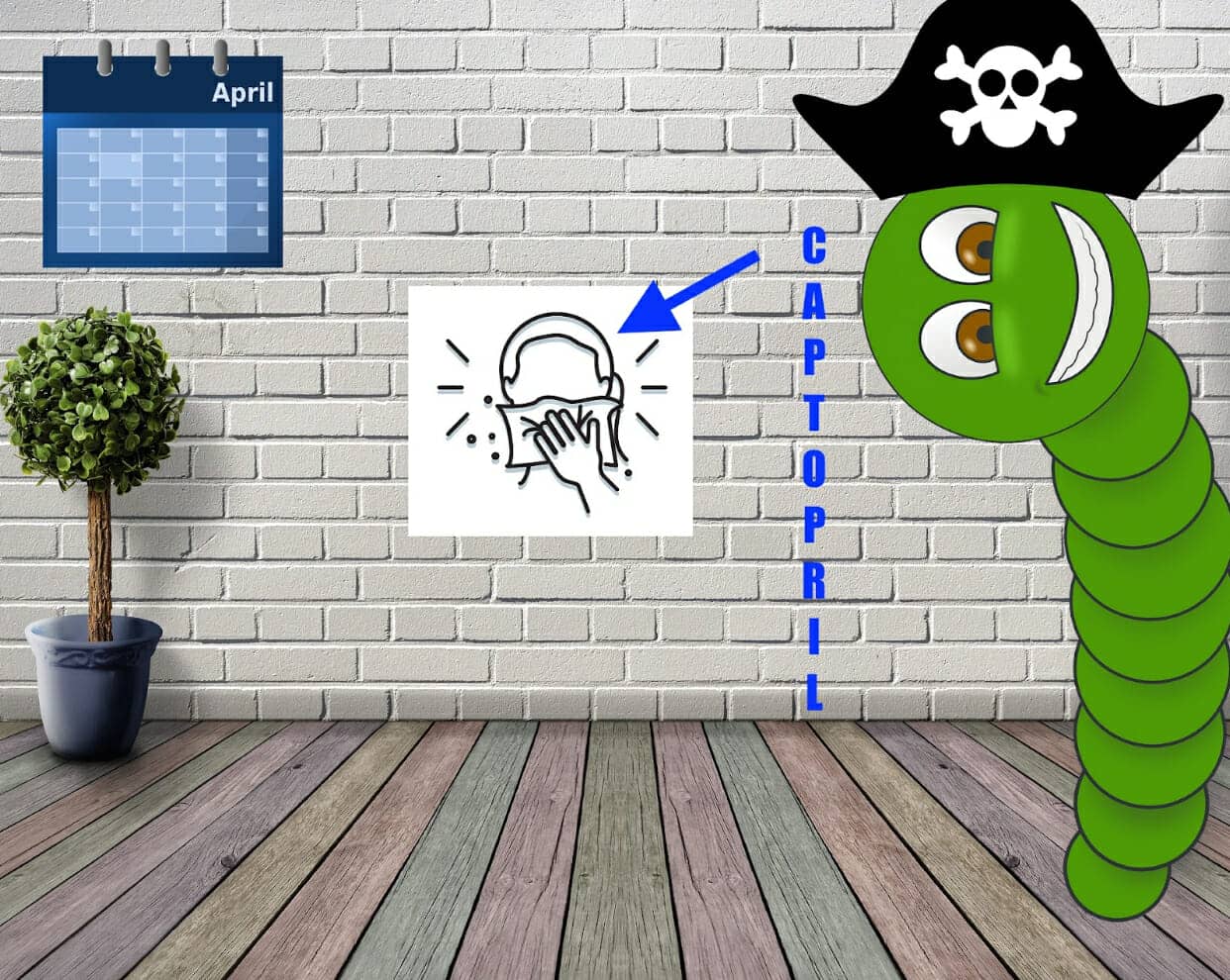
To make a medical acronym like CAPTOPRIL easier to memorize, you could imagine a caterpillar with a pirate captain’s hat crawling up a wall that has a calendar for April on it. (This calendar open to “April” will help you remember the “pril” sound in CAPTOPRIL).
This simple association already makes the strange acronym much more memorable. It helps you give it a sense of story as well.
From there, you just need to add more images for each part of the acronym. Since “C” is “cough,” you could imagine someone coughing, ideally someone with a name that starts with “C”.
You can even use your wrist as a Memory Palace, as I demonstrate in this detailed tutorial about how I memorized the carpal bones to help my students learn this technique for anatomy.
Will Combining Pegwords with Memory Palaces Really Work?
In a word, yes.
This approach has been well-studied and proven to help medical students in particular.
Both Dr. David Reser and Dr. Tyson Yunkaporta have been on the podcast to explain more about their experiences with helping medical students use this approach to rapidly absorb terminology, including anatomy.
Of course, just because we know this mnemonic device works, does not mean you’ll master it straight out of the gate. As one of my students shared in this podcast about how she mastered difficult nursing knowledge, you might need to troubleshoot your approach from time to time.
To help you avoid issues in advance, however, I created this powerful tutorial on removing all problems you might have with the Memory Palace technique.
Five: Deepen Your Medical Mnemonics with Multiple Sensations
As you practice the Memory Palace technique, it’s important to include rich and vibrant associations.
Instead of placing a generic hypodermic needle in the corner of a room to remind you of hypotension, you’ll want to make the association specific.
For example, you can put in the hands of a famous doctor, like Hannibal Lecter. The more specific your association, the more it will leap out at you as you review your Memory Palace.
Also, be sure to add multisensory levels of visualization. For example, add these elements:
- Kinesthetic (how heavy is it?)
- Auditory (what sounds does it produce?)
- Visual (what colors and shapes do you see?)
- Emotional (what do you and your associative characters feel?)
- Conceptual (what other ideas come to mind?)
- Olfactory (can you add a sense of taste?)
- Gustatory (can you add a sense of smell?)
- Spatial (can you exaggerate the sizes involved in your association?)
Thyroid Drug Example of adding Multi-sensory Elements
Now that you have a model for adding multisensory associations, let’s have a look at how to apply it when you need to memorize what different kinds of drugs do.
Thyroid drugs, for example, speed up metabolism. They may give energy or increase body temperature.
So if you needed to remember that sodium ipodate might be used in the management of hyperthyroidism in subacute thyroiditis, here’s an example mnemonic:

Now, you can default to just imagining Superman asking Wonder Woman out on a date to eat some sodium.
But notice how I have her yelling her answer in the image above.
If she just blandly responds that she suffers from hyperthyroid issues and prefers to eat potatoes on a date, that will help.
But taking a second to amplify the mnemonic in your mind takes things to a much more memorable level.
As you focus on how the sound of “I” “potatoes” and “date” will help you recall this term, add the feeling of eating them as if you were Wonder Woman. The more multi-sensory you make the story, the more it will help you remember why the drug is given.
To review, here are the best practices for elaborating each and every medical mnemonic you use in the form of a handy infographic:
Six: Contextualize the Information to Make it “Stickier”
No information exists in isolation.
As you memorize each term, think about one or more ways that it connects to something else you’ve learned.
To stick with our example of hypotension, an obvious connection is hypertension, its direct opposite.

But you can also go further and think about related issues, such as dizziness and other problems that might cause such a symptom.
Literally visualize someone suffering from dizziness and make as many connections as you can, such as to someone whose name starts with the letter ‘D’. Dracula, for example.
The more time you spend making mental connections, the more you’ll benefit from active recall. And the “stickier” the images and the target information will become.
You can perform this kind of mental contextualization all day long while completing random tasks. But for best results, always set time aside for this type of deliberate practice.
Seven: Recall Your Medical Mnemonics Mentally & Physically
As you use a Memory Palace, it’s important to recall the information you’ve encoded very quickly after you first layer them in.
Moving relatively quickly to review is important because the associations and the target information will initially reside only in your working memory.
How to best practice recalling each association?
Simply think about the exact location for each medical term. Then you ask, “What was happening there?”
You then allow your associations to come to mind as you work your way back to the target information.
I suggest you practice this mentally at least five times the first day.
But I also highly recommend that you write out the answer with pen and paper as well. Do the writing even if you prefer digital programs like Anki. (You can always photograph and upload your flashcards into the program anyway, like I suggest in this tutorial about remembering insulin types.)
You should also speak it out loud to get the benefits of hearing yourself speak it and involving the muscles in your mouth.
Also read a few different articles about the term, even if only very quickly. Try to also dig up a few podcasts so you can hear other people talking about it.
Is medical terminology hard?
Only if you’re robbing yourself of this incredibly powerful way of learning. It’s related to a principle called levels of processing and following it will make everything much, much easier.

Eight: Complete Practice Tests Frequently
Why sweat your next exam when you can practice in advance?
At many schools, you can actually request example exams. Often, they are the exact exams that were administered in previous years.
Failing that, you can look back at your textbooks and design your own. They often supply questions you can use.
You also don’t have to test yourself alone. Find other people who are similarly success oriented and test each other.
Another powerful way to test yourself is to find out where your exams will take place. Visit the room. Get used to it. Complete a practice exam while sitting in it or at least near it.
This will help you manage any nervousness you feel about the exam. It will also remove the hassle of finding the location on the day of the exam itself – one less thing to worry about.
Nine: Learn From Doctors Who Have Mastered Medical Mnemonics Memory Techniques
On this page, I’ve given you a powerful introductory overview of how to learn medical terminology.
Many of my students have used them, and I’m delighted whenever they send their success stories. Like Dr. Joe Riffe:
And I’m a doctor myself – just not the medical kind. My PhD is in Humanities.
But the good news is that everything I’ve suggested on this page is not only scientifically valid.
It also relates directly to how actual doctors have used memory techniques to succeed.
For example, Alex Mullen and his partner, Cathy Chen, are incredible teachers of these techniques. Alex is a memory champion who is also a medical professional. Along with his wife, he focuses specifically on applying mnemonics to all kinds of information related to medicine.
As they advise, it’s a good idea to master your memory before you start medical school.
Another great person to follow is Chase DiMarco who presents the Med 360 Podcast, formerly called the Medical Mnemonist podcast.
You simply cannot go wrong by diving in as deeply into the memory arts as you can. And if you’d like more help based on my book, How to Learn and Memorize Medical Terminology is available in the second edition as an ebook right now. It includes more examples than the first edition, including tips on how to use mind mapping in combination with the Memory Palace technique.
Ten: Learn a Mnemonic Number System for Different Kinds of “High Stakes” Medical Data
Sometimes you need to remember medical information that has multiple parts.
This is where you can use a strategy like number rhymes to help.

Let’s say that you want to remember that magnesium hydroxide is a common part of antacids.
You could place this fact on the esophagus as your first fact.
Since the number rhyme method tells us that 1 is a bun, you could imagine Magnum PI is trying to hide a bunch of Magnum .44 magnums inside of buns in this area. The word “hyde” sounds like hydroxide, so this action helps you remember that part of the term.
Next, you can use a pair of shoes to memorize facts about omeprazole and proton pump inhibitors. Because two rhymes with shoes, you can imagine a gas pump filling shoes with gastric fluid.
Whenever you come across numbers or numbered parts, this mnemonic system is great. You can learn more about how to use this technique by reading this number rhymes tutorial.
A More Advanced Number System for Dosages
Often, you’ll need to learn about dosages and how they apply to different age groups.
For this learning task, it’s useful to have the Major System and a PAO System.
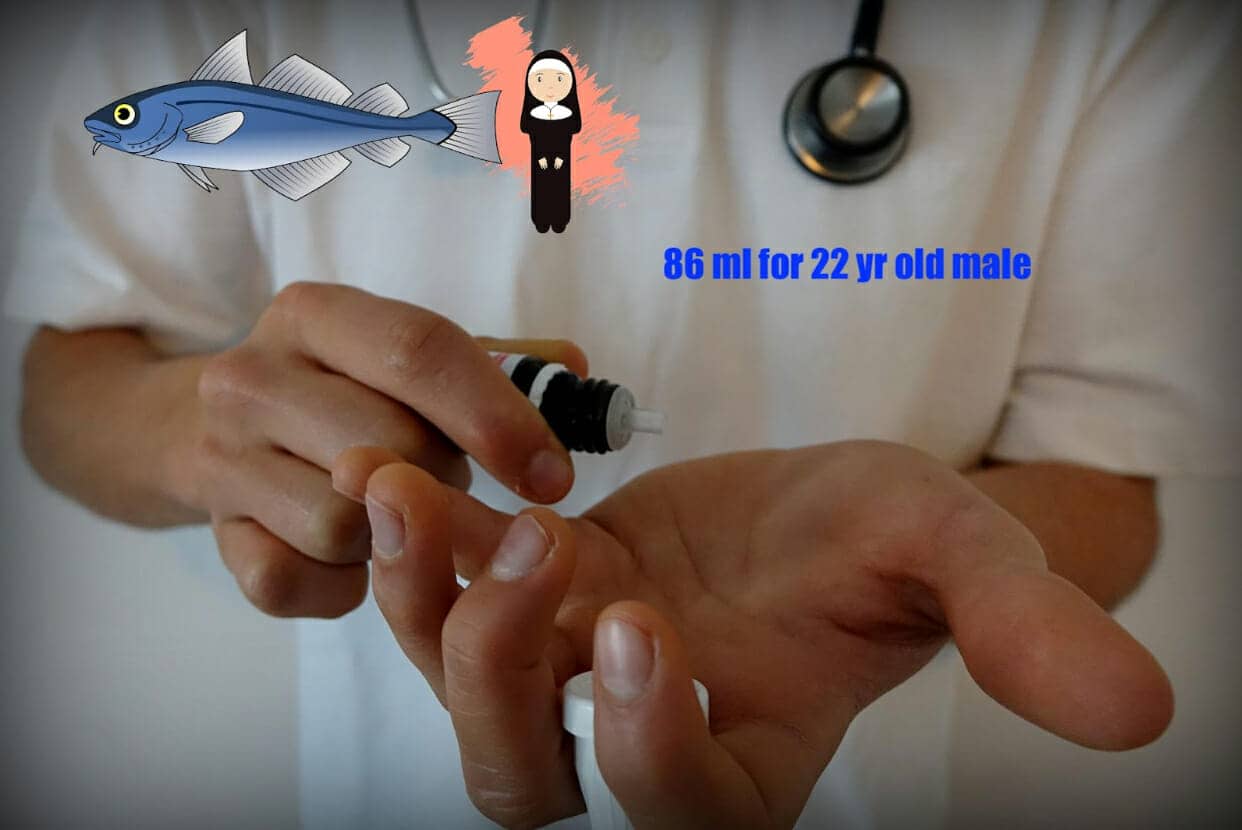
These memory systems are helpful because they help you have image associations for every number.
For example, if you have to give 86 ml to a 22 year old male, you can readily memorize those numbers by using images like fish and a nun.
This is because in the Major System, 8=f, 6=sh and 2=n. The PAO system helps you combine those into highly memorable words like fish and nun.
There are a few nuances to developing these mnemonic systems, so I encourage you to check out my tutorials on them. Combined with what you’ve already learned about flashcards, multi-sensory association and the Memory Palace technique, you’ll soon be memorizing thousands of data points before you know it.
Best Way To Learn Medical Terminology
We’ve covered a lot of ground today. All of it will help make sure you dodge the long term memory loss others face. Quite the opposite: you’ll remember as much medical terminology as you wish for the long term.
But there’s one principle we’ve glossed over.
It’s been lurking in each and every word, but hasn’t yet been explicitly spelled out.
That word is:
Action.
In order to optimize your learning, you need to get started and keep moving.
Rest assured, I’ve seen incredible feats of memory. For example, during one afternoon at a competition event with memory expert Dave Farrow, I saw real miracles unfold.
People who had never heard of memory techniques before gave Dave a run for his money – and he holds two Guinness World Records for his memorization feats!
But without some level of devoting yourself to these skills, I’m afraid the truth is rather bleak.
So let’s get it out of the way quick:
You do need to spend a bit of time learning to use memory techniques if you want them to work for you.
I don’t see that as a problem in the same way I don’t see building an airport a problem if you want to help people travel the world.
And learning these techniques is WAY easier than that.
So what do you say?
Are you ready to let the magic of memory work help you study as fast as you’d like?
If you’d like even more help, register now for my FREE Memory Improvement Kit right here:

It will teach you how to create a full Memory Palace Network that expands to accommodate as much medical terminology as you’ll need to succeed.
And the best part is that later you’ll be able to pass tests like the MCAT, memorize the names of your colleagues and patients and accomplish many other learning tasks. You can even pick up knowledge from other professions and learn at least one other language too.
And that will be especially great if you eventually want to travel and practice medicine in other countries.
You absolutely can, and all you need is to make sure you’ve got memory on your side.
And now you do!






2 Responses
Excellent.
Thanks so much for stopping by and for taking a moment to say so!