

If you keep forgetting things at work, the solution begins when you start writing tasks down and break complex information into manageable, well-organized parts.
You also want to start prioritizing the knowledge that will make you more effective at work.
These steps are important because forgetting things at work isn’t always a memory issue.
Of course, I will teach you how to use memory techniques that are useful for work on this page. But you’ll also enjoy a detailed tutorial on exactly how to use effective note-taking and organization.
This combination of tactics is important for a few reason. I’ve coached professionals who need their memories for demanding goals, including lawyers, programmers, professors and doctors who want faster access to complex details and processes. We never make their strategy just about memory techniques.
My own work has required the same kinds of memory skills.
During my years teaching at universities, for example, remembering student names and delivering lectures from memory helped enormously. As a writer and business owner, being able to remember names, numbers, details and ideas continues to save me time.
But here’s something important:
I don’t try to memorize everything.
Even though I’ve spent years researching, practicing and teaching memory techniques, I still write important things down.
My basic rule for remembering things at work is:
Capture first. Organize second. Memorize selectively. Retrieve deliberately.
So that’s what we’re going to work through on this page.
If you’re looking for a much broader collection of techniques for everyday learning, see my guide on how to remember things. But on this page, we’re going to stay focused on using memory effectively at work.
How to Remember Things at Work: Start With the Right Memory Problem
Before reaching for another productivity app or blaming yourself for having a “bad memory,” identify exactly what you’re trying to remember.
In my experience, most workplace memory problems fall into at least four categories:
- Things you need to do: tasks, deadlines, follow-ups, meetings and promises you’ve made.
- Things you need to know: terminology, procedures, technical information, programming concepts, legal material, languages, product details and numbers.
- People you need to remember: colleagues, clients, customers, students, industry professionals and details connected with them.
- Tasks you need to perform: presentations, courtroom arguments, lectures, sales explanations and other situations where you need information available without constantly consulting notes.
There may be more categories in your profession. But the point is to think through what you need to remember at work categorically because different outcomes call for different kinds of memory techniques.
For example, remembering to email a client tomorrow is not the same memory task as remembering ten SKU numbers.
Likewise, memorizing a presentation calls for a different approach than remembering the names of six people you just met.
Once you know which problem you’re solving, remembering more at work becomes much easier.
1. Capture Tasks and Deadlines Before You Try to Memorize Them
If you keep forgetting tasks at work, don’t immediately assume you need a stronger memory.
You may need a stronger capture system.
Remembering that you need to perform an action in the future involves prospective memory. That includes remembering to send a follow-up, attend a meeting, submit a report or complete something you promised a customer.
For these kinds of tasks, I don’t believe in taking unnecessary risks just because I know memory techniques.
I write things down.
In fact, research on prospective memory has repeatedly explored how external reminders can improve our ability to carry out intended actions. One study on prospective-memory reminders found improved performance when reminders were available.
That’s why, if you finish a client call and promise to send something, my first suggestion is simple:
Write it down immediately.
Don’t tell yourself you’ll remember later.
This is also why learning effective note-taking matters. Your memory techniques should work alongside your written systems, not compete with them.
Use Checklists for Work That Cannot Afford Mistakes
I sometimes hear from people who want to remember everything without referring to notes or checklists.
That’s possible in many situations.
But it doesn’t mean it’s wise.
Pilots use checklists for a reason. When the consequences of forgetting something are important, redundancy is good.
I suggest writing out mission-critical tasks and referring to the list until the process becomes familiar. Repetition may eventually make parts of the procedure automatic, but that doesn’t mean you need to throw the checklist away.
Memory skill should reduce unnecessary friction in your working life, not encourage unnecessary risk.
Why I Combine a Printed Calendar With a Digital Backup
I personally use a dedicated printed calendar and maintain a digital calendar as backup.
That’s deliberate.
I want important commitments represented from multiple angles rather than relying completely on either biological memory or software.
I also sometimes practice a mnemonic calendar system involving number-shape associations and the Major System.
But I wouldn’t suggest learning an elaborate mnemonic calendar simply to remember that you have a meeting at 2:30 tomorrow.
- Write the meeting down.
- Use your calendar.
- Then reserve deliberate memorization for information that will become more valuable when you can recall it without looking anything up.
Use Time Tracking When You Keep Misjudging Your Work
Sometimes the problem isn’t forgetting what to do. It’s forgetting how long your regular tasks actually take.
One habit that helped me develop a better intuitive sense of my own work was descriptive time tracking.
Researchers have found that effective time management has meaningful connections with well-being, not merely job performance. You can read the research here.
This is what descriptive time tracking looks like in one of my journals:
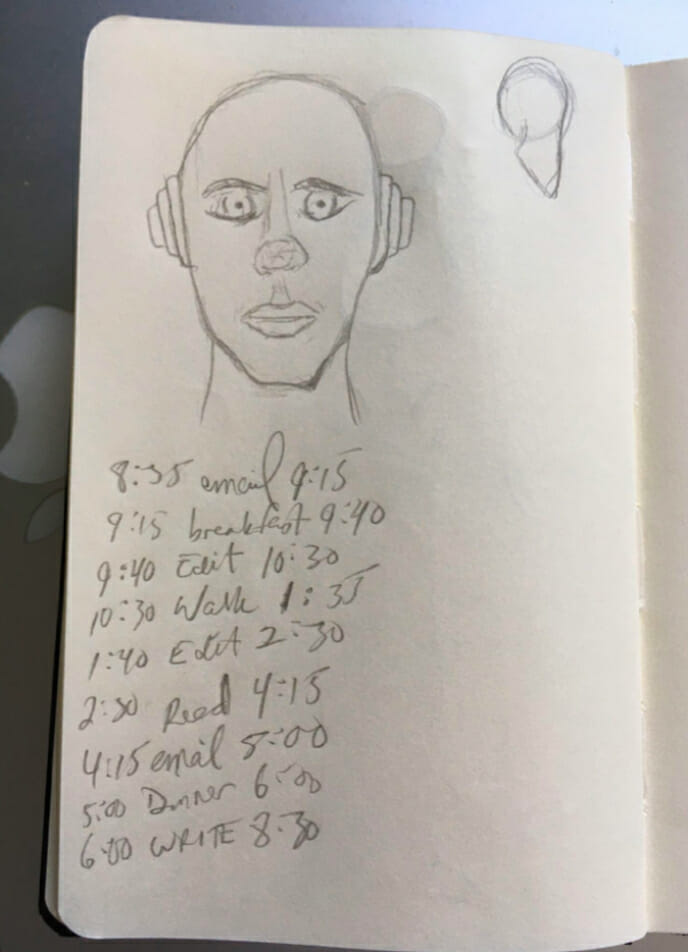
Keeping this list helped me build familiarity with the patterns of my own work.
Over time, this kind of tracking has made me more accurate when estimating how long a project will take or deciding what I can realistically accomplish in a day.
Keep Important Goals Visible
I also use physical journals as environmental reminders.
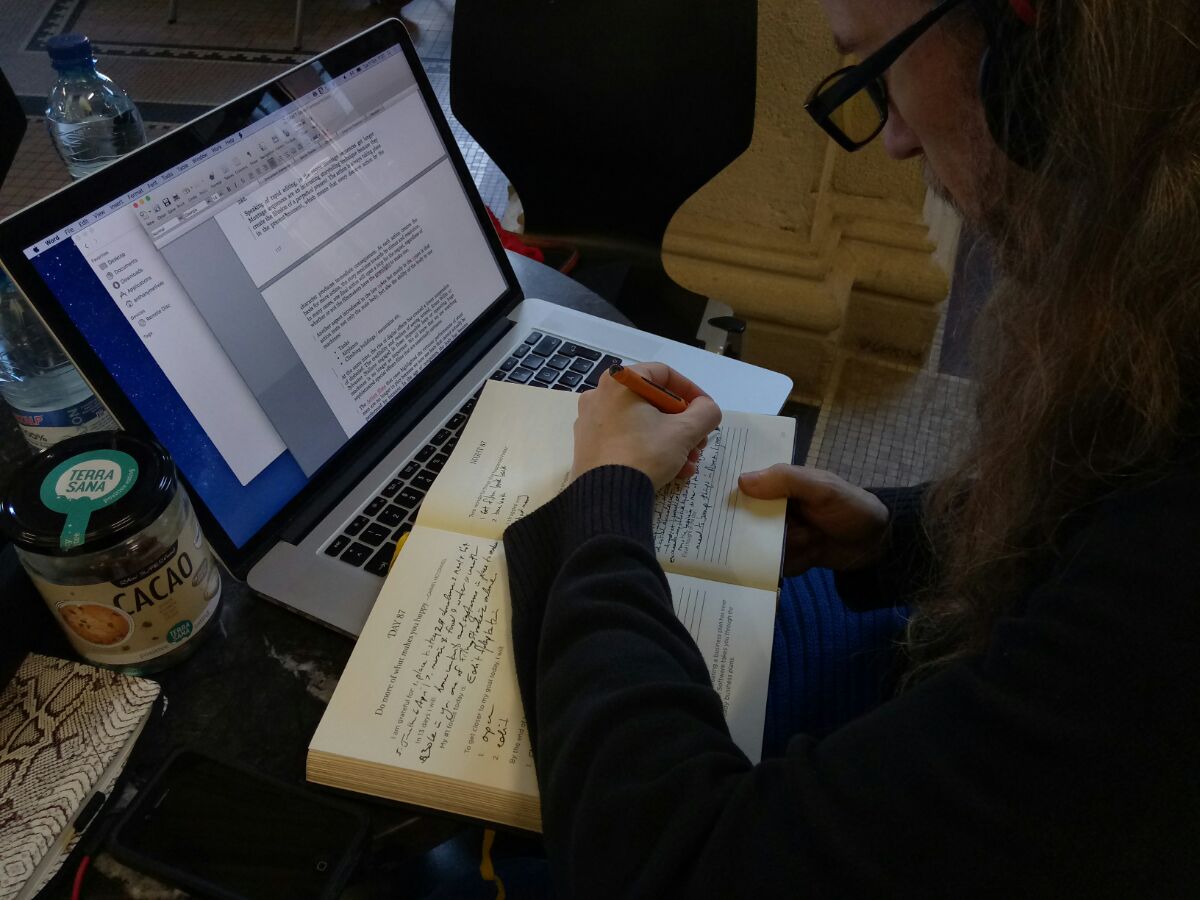
Keeping a journal visible on my desk means that long-term projects stay represented in my environment instead of disappearing beneath whatever seems urgent today.
The principle here is not “paper good, technology bad.”
I use both.
What I question is total reliance on apps and software without getting information out of your head and working with it deliberately.
If you’d like to explore the writing side of this approach further, I’ve put together a separate tutorial on how to journal for better memory.
2. Organize Complex Work Information Before You Memorize It
What if your problem isn’t remembering to do something?
Maybe your job requires learning a lot, and you’re struggling to retain the information.
My first step would still not be memorization.
I would gather the information and organize it.
Then I would identify the items that appear most important.
If I’m uncertain, I ask.
If there’s nobody to ask, I’ll research the issue myself.
And when I genuinely have to make a best guess, I think through the likelihood that each piece of information will matter and start somewhere.
Taking useful action beats getting paralyzed while trying to identify the perfect thing to memorize.
Use Chunking and Mind Maps to Reduce Information Overload
Large bodies of information become easier to work with when you break them into smaller units.
This is one reason chunking can be so useful.
Mind mapping takes the idea further by letting you see relationships between those chunks.
I’ve used mind maps extensively in my own research and business. Here’s one example:
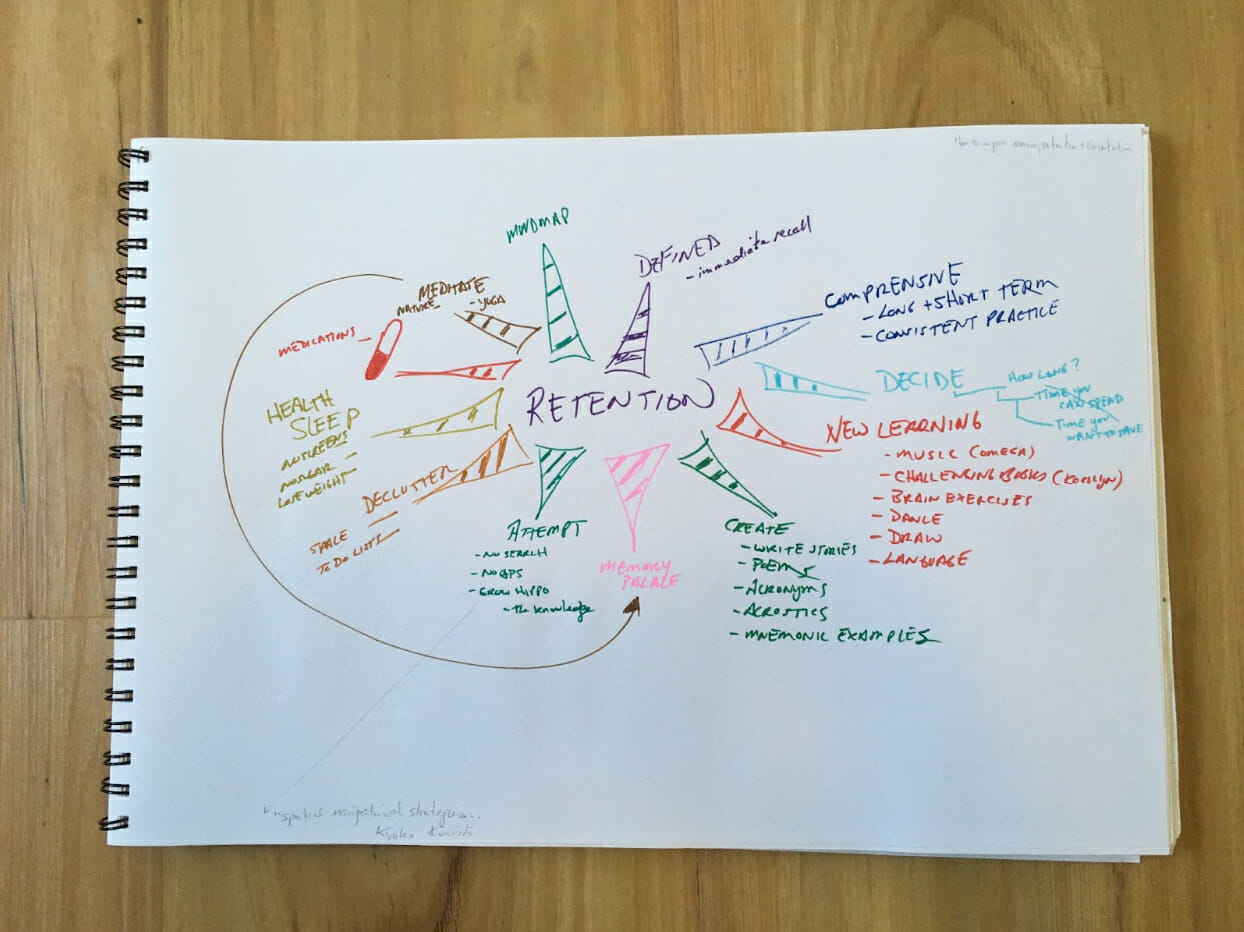
Suppose you’ve just been given a complicated procedure.
Instead of trying to memorize an undifferentiated wall of information, you might map out:
- The major stages
- The decision points
- Important terminology
- Exceptions
- Numbers or codes
- The items that need immediate recall
Now you have something structured enough to memorize intelligently.
For more work-specific examples, see my detailed guide to mind mapping for business. Even if you work for someone else, it will help you support them better.
3. Memorize the Information That Gives You an Advantage at Work
Once you’ve captured and organized the information, you can decide what deserves to be committed to memory.
This distinction is critical.
You don’t need to memorize everything simply because your job contains lots of information.
Good memory training involves selection.
Turn Important Information Into a List
If possible, I like to turn important material into a list.
That creates a clear memorization target.
From there, I can combine:
- A prepared Memory Palace
- Mnemonic associations
- Recall Rehearsal
I’m deliberately not going to turn this page into another enormous tutorial on those techniques.
That’s what links are for.
If list learning is your problem, follow my complete tutorial on how to memorize a list.
If you haven’t learned the Memory Palace technique yet, learn that first and then return to your workplace material.
Example: How I Would Approach 10 SKU Numbers
Let’s say knowing ten SKU numbers would allow you to serve customers faster.
I would first prepare a Memory Palace containing at least ten usable stations.
Then I would create mnemonic associations for each SKU and place those associations at the corresponding stations.
If the SKUs contain numbers, a system such as the Major System can help convert otherwise abstract digits into memorable associations.
Finally, I would practice retrieving the SKUs without looking at the original list and check my accuracy.
A Raise and Promotion From Remembering Useful Work Information
One of my favorite examples of workplace success comes from my student Jesse Villalobos.
Jesse used memory techniques to learn information that helped him perform more effectively at work, including product-related numbers. His growing competence helped him stand out, and he ultimately earned both a raise and a promotion.
You can hear Jesse explain his experience in my interview with him on the Magnetic Memory Method Podcast.
I like his example because the goal wasn’t to develop an impressive memory for its own sake.
He remembered information that made him more useful.
That’s exactly how I suggest thinking about memory at work.
Different Professions Need Different Knowledge
The same principle shows up in many fields.
I’ve worked with a lawyer who has found it useful to practice memory techniques in the morning while working on several kinds of memorization, including verbatim material and language learning.
Legal professionals can also benefit from having key case details and sections readily available when they need to perform effectively.
Programmers face a different problem.
Trying to memorize everything in a programming language would be a poor use of time. The better question is: What information will actually become more useful if I know it without looking it up?
I discuss that distinction in my guide to using a Memory Palace for programming.
Language learning can also create professional value. One of my students, Eldon Clem, learned ancient Ethiopic, which supported his work as a professor.
Someone working in international business might have a completely different reason for learning a language: serving customers, working with colleagues or opening new markets.
The information changes.
The underlying question stays the same:
What would become disproportionately valuable if you could recall it reliably?
4. Remember Names at Work to Improve Rapport and Authority
Names deserve their own category because they matter in almost every profession.
When I taught university students, remembering their names improved my relationship with the room.
It also improves your authority.
If you’re able to remember colleagues, customers, clients and important people in your industry, you’re demonstrating that you’ve paid attention.
You’re also building a network of knowledge around the people who matter to your field.
That’s why I consider remembering names a must-have professional memory skill.
I have a complete step-by-step tutorial on how to remember names, so there’s no reason to duplicate the entire technique here.
The important workplace principle is this:
Don’t wait until someone’s name becomes important before deciding names are worth remembering.
Start practicing now.
5. Memorize Presentations and Key Points for Easier Delivery
Some workplace information isn’t there merely to be known.
You need to perform it.
This includes:
- Presentations
- Lectures
- Sales explanations
- Arguments
- Training material
- Key talking points
- Extemporaneous speaking
I’ve experienced the benefits personally.
Giving university lectures from memory made delivery easier. Memorizing my TEDx presentation allowed me to focus more on the message instead of constantly wondering what came next.
For me, the practical benefits include better eye contact, greater confidence, easier delivery and the ability to demonstrate authority over the material.
It also makes extemporaneous speaking easier because you’re not entering the conversation with an empty mind. You have well-organized knowledge available to draw upon.
If this is the workplace problem you’re trying to solve, see my complete tutorial on how I memorized a presentation for TEDx or my guide on how to memorize a speech.
6. Train Attention Alongside Your Memory
Sometimes people tell me they have a memory problem when part of what they’re experiencing is an attention problem.
If information never receives enough attention in the first place, there isn’t much for memory to retrieve later.
That’s one reason memory training itself can be valuable.
Using mnemonic techniques forces you to interact with information.
You need to identify it, organize it, make associations and practice retrieving it.
In other words, you’re not merely “trying to remember.”
You’re paying attention with a purpose.
Calm the Monkey Mind Before It Takes Over
If I started a demanding new job tomorrow and felt overwhelmed by everything I had to learn, my first move wouldn’t be to panic and start cramming.
I’d take a deep breath.
Then I would use a questioning process I discussed in my TEDx Talk:
- How are these thoughts behaving?
- Are they useful?
The point isn’t to pretend everything is fine.
It’s to stop anxious thinking from consuming the attention I need for the actual learning task.
Then I can gather what needs to be remembered, organize it and decide what deserves priority.
If you want to develop this ability further, I’ve shared additional exercises for concentration meditation.
Practice the Memory Skill Your Work Actually Requires
People often turn to crossword puzzles and other brain games when they want a stronger memory.
I would rather practice the actual skill my work requires.
Researchers studying cognitive-training games have often struggled to find broad transfer from game performance to unrelated real-world abilities. You can review one discussion of the evidence here.
The evidence thus suggestions that:
- If you need to remember names at work, practice remembering names.
- If you need technical terminology, practice that terminology.
- If you need to deliver information without notes, practice recalling that information.
In other words, make your memory training resemble the outcome you actually want.
7. Decide What Is Actually Worth Memorizing at Work
Before committing information to memory, ask whether having it available from memory would actually improve your work.
Here are the questions I suggest:
- How often will I use this information?
- What happens if I forget it?
- Would immediate recall make me faster or more effective?
- Is this awkward, slow or impossible to look up when I need it?
- Would knowing it help me serve a customer, colleague, client or audience better?
- Could mastering it distinguish me professionally?
Asking these questions frequently will help you discover what is worth committing to memory in your own career.
How to Stop Forgetting Things at Work: Pick One Goal for the Next 7 Days
You don’t need to overhaul your entire memory in one afternoon.
Choose one result you want over the next seven days.
For example:
- Fewer forgotten follow-ups: create a reliable written capture system and calendar routine.
- Better task recall: learn how prospective memory works and combine reminders with written checklists.
- Five important names remembered: practice the techniques in my name memorization tutorial.
- One work procedure recalled without checking: organize the procedure, turn its key points into a list and encode them using a Memory Palace.
- A useful body of technical knowledge memorized: identify what actually deserves recall, then use mnemonic associations and Recall Rehearsal.
- Important numbers remembered: learn the Major System and combine it with a Memory Palace.
- A presentation delivered with less dependence on notes: apply my presentation memorization process.
Notice that none of these goals is “develop a perfect memory.”
You want a measurable improvement that matters to your actual work.
Once you’ve achieved one outcome, pick another.
That’s how you’ll see your memory skills start helping you professionally.
Start Improving Your Memory at Work Today
If you’re worried because you keep forgetting things at work, I want you to leave this page with a clear plan rather than another collection of disconnected memory tips.
Start by identifying the kind of memory problem you actually have.
Then:
- Capture tasks and future commitments in writing
- Organize complicated information before attempting to memorize it
- Choose the knowledge that will genuinely improve your performance
- Apply the right mnemonic technique to that information
- Practice retrieving it until recall becomes reliable
I’ve used these principles throughout my own academic, teaching, writing and business career.
I’ve also seen students apply memory techniques to goals ranging from programming and language learning to product knowledge and professional performance.
The key isn’t trying to carry your entire working life inside your head.
Capture first. Memorize selectively.
Then train the information that deserves to become part of you.
If you’d like my help learning the Memory Palace and the core association techniques I use, get my free memory improvement course here:

The course includes four video lessons and worksheets designed to get you practicing rather than merely reading about memory improvement.
That’s especially important at work.
Knowing that memory techniques exist isn’t the same as having them available when a name, number, procedure, presentation or important piece of professional knowledge suddenly needs to come back.
Practice gives you that ability and will help you on your quest to stop forgetting things that matter.
So pick one useful goal, start training it and make your memory increasingly valuable to the people you serve.

 Anthony Metivier is the founder of the Magnetic Memory Method, a systematic, 21st century approach to memorizing foreign language vocabulary, names, music, poetry and more in ways that are easy, elegant, effective and fun.
Dr. Metivier holds a Ph.D. in Humanities from York University and has been featured in Forbes, Viva Magazine, Fluent in 3 Months, Daily Stoic, Learning How to Learn and he has delivered one of the most popular TEDx Talks on memory improvement.
His most popular books include, The Victorious Mind and…
Anthony Metivier is the founder of the Magnetic Memory Method, a systematic, 21st century approach to memorizing foreign language vocabulary, names, music, poetry and more in ways that are easy, elegant, effective and fun.
Dr. Metivier holds a Ph.D. in Humanities from York University and has been featured in Forbes, Viva Magazine, Fluent in 3 Months, Daily Stoic, Learning How to Learn and he has delivered one of the most popular TEDx Talks on memory improvement.
His most popular books include, The Victorious Mind and…