
 C’mon, admit it.
Part of you probably thinks improving your memory is going to involve tedious drills, strange brain games or hours of repetition.
I once thought the same thing.
When I first picked up a memory-improvement book, I became so frustrated by the vague instructions that I nearly tossed it across the room. I was already a serious student working toward my PhD, yet the promises in the book did not tell me what I was supposed to do.
Then I discovered mnemonic techniques like the Memory Palace.
Everything changed.
Since then, I’ve used memory techniques for languages, numbers, books, speeches and other learning projects. I used a Memory Palace when preparing my TEDx Talk. I went on to teach these techniques to people around the world, and Tony Buzan even awarded me his Warrior of the Mind emblem for contributions to mental literacy.
The interesting part is not the award, however. It’s what years of practice have taught me:
Memory improves when you stop expecting remembering to happen automatically and start encoding and retrieving information deliberately.
That is what this guide is all about.
We are going to improve your ability to learn and deliberately recall names, vocabulary, facts, numbers, presentations, conversations, books and other information you actually want to remember.
This is not a guide to diagnosing or treating memory loss caused by medical conditions. My PhD is in Humanities, and my field here is memory training and mnemonic education.
But try the suggestions and this page and you stand to better remember historical facts, names, birthdates, phone numbers and even be able to recall details of previous conversations, recite scripture, or get better results when studying a language.
We’re going beyond simple memory hacks, so watch the video below and enjoy the full written article below:

What Actually Improves Memory
Improving your memory comes down to getting better at four things:
- Paying attention to what you want to remember
- Encoding the target information with meaningful associations
- Organizing the information so you enjoy reliable retrieval cues
- Actively recalling what you’ve learned over time
One way to improve in all four areas at the same time is to learn to use memory techniques. Let me share with you the most important, with examples of how to use them.
Start With the Memory Palace Technique To Improve Your Memory For Learning
Over the fifteen years I’ve taught various approaches to memory improvement, many people have asked me for alternatives to one of the most powerful techniques: the Memory Palace.
Also known historically as the method of loci, the basic idea is wonderfully simple:
You mentally use a familiar location as an ordered structure for information.
For example, you can chart out your home and select these locations:
- front door
- entrance
- sofa
- television
- dining table
- refrigerator
- sink
Instead of trying to hold seven unrelated ideas in mental space, you associate each idea with one location.
When you want the information back, you mentally travel through the same route.
I have used Memory Palaces for years because they solve several practical problems at once. They:
- Help you give information an order.
- They provide retrieval cues.
- They encourage association.
And they make it immediately obvious when something you’ve studied is missing. In other words, if your fifth Memory Palace station is empty during recall, you know where the problem occurred.
Interested in building your first Memory Palace?
Get step-by-step instructions by reading my full guide, How to Build a Memory Palace.
It’s enhanced with:
- Multiple video walkthroughs
- Memory Palace illustrations
- Student examples
- Historical context that brings the technique to life
Memory Techniques to Use Inside Your Memory Palaces
To experience more recall as you use Memory Palaces, you’ll want to include a number of other memory techniques.
These techniques range from simple acronyms to advanced Magnetic Images like those taught during the Medieval and Renaissance eras.
Here are the major techniques I recommend focusing on.
Magnetic Imagery
In the Magnetic Memory Method, I use the term “Magnetic Imagery” instead of the more standard term from science.
Technically, we’re talking about mnemonic images that help you practice elaborative rehearsal.
As important as these scientific terms are, they’re not nearly as memorable as Magnetic Imagery.
So what is a Magnetic Image?
It’s any mental content that:
- Is deeply familiar to you, like a person, action or object that’s already in your memory
- Mental content that helps you harness similarities in sound, usually by referencing the alphabet
- Allows you to use mnemonic strategies like Bridging Figures and principles like Word Division
- Works with KAVE COGS for rapid elaboration that promotes “stickiness” in your Memory Palaces
I know that’s a mouthful, so let me give you a quick example.
I recently memorized the word Sheliak, the name for a binary-star system approximately 960 light-years from our planet.
My Magnetic Image was Mr. Sheeley, my grade 10 gym teacher. He also taught Social Studies.
Since Sheeley sounds like Sheliak, it was easy to place him in a Memory Palace with George Bush who reminds me of the number 96 using the PAO System.
Both of them are teaching a yak to help get the full sound of Sheliak into the Memory Palace.
Adding KAVE COGS
The KAVE COGS part comes in when I take a second to “elaborate” this scenario by adding a variety of sensations.
KAVE COGS stands for:
- Kinesthetic
- Auditory
- Visual
- Emotional
- Conceptual
- Olfactory
- Gustatory
- Spatial
In this example, I felt the chalk in Mr. Sheeley’s hand as if we were the same person. Then I heard his voice in my mind while watching the scene unfold.
For the concept, I thought about the meaning of the star’s name, which is tortoise.
Adding emotions, smells, tastes and exaggerating the sizes takes only an additional second.
Exactly how you’ll apply this multi-sensory model is something you need to explore.
You might need to study mental imagery in greater detail. Or, you might take to this method of making your images more memorable immediately.
There’s also Tony Buzan‘s model, which he called SMASHIN’ SCOPE in The Memory Book.
He was deeply influenced by much older models, as am I. You can find some of them in books by Giordano Bruno, Peter of Ravenna and Jacobus Publicius.
There are many more. But I’ve tried to make KAVE COGS much more direct. And I hope the acronym I came up with is much more memorable.
Personally, I find that I often only have to use the first 3-4 multi-sensory “Magnetic Modes” of KAVE COGS.
But if I don’t get the results I want, I just go back and add more from the model.
Mnemonic Number Systems
I mentioned that George Bush helps me remember the number 96. By extension, he also helps me remember that Sheliak is 960 light-years distant from earth.
My choice of this politician is not random.
The Major System for memorizing numbers helped me select him. Watch this video tutorial to learn how to use it:

Once you have the Major System down pat, the next step is to assign words for each two-digit pair from 00-99.
For many years, this mnemonic strategy has been called the 00-99 PAO System. This acronym stands for:
- Person
- Action
- Object
By always having a specific person performing an action with an object, the number they represent becomes much more memorable.
For example, George Bush bashing a bowl of borsch is strange and it’s easy to add KAVE COGS to the Magnetic Image because this former president is already in your memory.
If you don’t know politicians, no worries. You can use the painter Hieronymus Bosch or the Michael Connelly detective of the same name played by Titus Welliver.
There are more tips and tricks in my full PAO System guide.

Another, simpler approach you can explore is to use number-rhymes.
In sum, there are many mnemonic devices. The key is to use the right ones needed to establish long-term retention as quickly as possible.
Learning Names, Vocabulary & More
The core difference between using number mnemonics and memory techniques for words is that you need to assign associations that sound like or resemble the target information. The process is formally called elaborative encoding.
When it comes to memorizing words, my full tutorial on How to Memorize Vocabulary applies to multiple languages.
The technique shifts only a small amount when you want to remember names, the planets or even deliver a speech from memory.
A Simple Example
If you meet someone named Rose, you can directly associate her name with an exaggerated rose and connect that image with something distinctive about where you met her.
Vocabulary works similarly. You take a word, transform the unfamiliar sound into familiar images or ideas and then connect them with the word’s meaning.
More Advanced Examples
During my first trimester in law school, I memorized res ipsa loquitor (the thing speaks for itself) by imagining the movie character Ip Man with liquorice.
To enjoy a strong advantage, the key to using these techniques is to set up associations in advance by crafting a list of associations, ideally one per letter of the alphabet.
But whether you’re learning names, numbers, facts or vocabulary, it’s not just about encoding. You need to practice retrieving the information. Let’s look at how to do that next.
Practice Recall Instead of Just Reviewing
Encoding information is only half the job. If you want to remember something reliably, you also need to practise bringing it back without looking at the answer.
That might mean closing a book and explaining what you just read, covering a vocabulary translation and producing it from memory, or mentally walking through a Memory Palace before checking your notes.
In the Magnetic Memory Method, I call the Memory Palace version of this process Recall Rehearsal.
Developing well-formed Memory Palaces and using them in combination with the mnemonic strategies we discussed above is one part of the process.
To help information enter long-term memory without the tedium of rote learning, practice memory recall and retrieval, ideally across spaced intervals.
You ultimately have many options when it comes to using spaced learning. The Memory Palace patterns I teach in the Magnetic Memory Method Masterclass make the process fast, but you can also explore:
- Apps like Anki
- Leitner boxes
- Flashcards
No matter which approach you use, your mission is to revisit the information based on intervals.
Recall Rehearsal specifically involves revisiting your Memory Palaces according to these patterns:
- Forward and backward
- From the middle to the end
- From the middle to the beginning
- Skipping the stations
- Popping into your Memory Palaces to visit random stations
There is no “magic formula” for exactly how often to perform these patterns.
But generally, you should follow this basic schedule:
- First rehearsal within 5-10 minutes
- 2 hours later and more often if desired
- At least once for the next day for five days
- Once a week for five weeks
- Once a month for five months
Frankly, the better you get, the more flexibility you’ll enjoy.
But often I’m even more rigorous, such as when I need to learn a language, pick up a song or deliver a speech.
Overall, the point is to practice recall actively. That’s why my work with the Magnetic Memory Method promotes intentional retrieval, helping you build a reliable engine of retention.
It’s ultimately about reviewing as little as possible thanks to the power of practicing learning and recalling deliberately.
How to Strengthen Your Memory Through Practice
If you want to strengthen your memory, the most useful place to start is with the skills involved in remembering: attention, association, organization and active retrieval.
In my experience teaching memory techniques, improvement comes from actually practising these processes rather than simply reading about ways to improve memory.
A Simple Daily Practice for Improving Your Memory
To get started using these techniques for learning, here’s a recommended daily routine for the next week:
- Pick 5–10 pieces of information you want to remember.
- Place them in a small Memory Palace using associations.
- Recall them without looking at the source.
- Check any items you missed.
- Strengthen any weak associations.
- Revisit the information later using Recall Rehearsal for retrieval practice.
- Gradually increase the amount or difficulty of the information with which you work.
One way to help yourself achieve greater success is to practice with information you genuinely want to retain.
That way, when it comes to learning something because you have to for school or your vocation, you’ll be ready with these techniques.
What Can You Use These Memory Techniques For?
There are many ways to enjoy better recall. Use these techniques for:
Study material and facts
This category includes terminology, dates, concepts, and exam material.
Vocabulary and languages
I used to struggle with language learning. But since discovering these techniques, I’ve made strides with German, Mandarin, Latin and Sanskrit.
Books and ideas
Memory techniques can help retain key ideas. But please focus on the main points, rather than memorizing every sentence.
I mention this point because many people try to imagine entire textbooks. But as I discuss in my guide How to Memorize a Textbook, you need to extract the bare minimum. Then memorize only those points.
Speeches and presentations
Memory Palaces and related techniques are particularly useful when information has to be recalled in sequence. I used one when memorizing my TEDx Talk, which has now been viewed millions of times. If speaking without notes is your goal, I explain the full process in my guide to memorizing a speech.
Let’s turn next to a comprehensive FAQ based on hundreds of questions I’ve received over the years.
Frequently Asked Questions About Using Memory Techniques to Improve Memory
I’ve received many questions over the years.
Here is a list of the most commonly received questions answered for you in rapid-fire format.
What is the best way to improve your memory?
The most reliable approach is to improve how you pay attention, encode information, organize it and retrieve it.
I recommend learning association and the Memory Palace technique first while using it to assist active recall as you learn.
How can I remember what I read?
It’s important that you test what you read, rather than rely on rereading alone.
Identify the key ideas, connect them with knowledge you already have, encode important details when needed, then close the book and retrieve what you remember before checking.
Revisit the material later to strengthen recall.
How can I improve my memory for studying?
Start by tackling the material to identify what actually needs to be remembered.
Use associations and Memory Palaces for facts, terminology, sequences and other information requiring reliable recall.
Test yourself without looking and revisit the material at spaced intervals.
How long does it take to see results when seeking to improve memory in this way?
Each person is different.
I’ve seen people pick up the core techniques in just two hours and memorize over twenty digits of pi.
But I’ve also seen people try to learn these techniques in bits and pieces. As a result, it takes them longer.
Ultimately, how long it takes is up to your interest in using these techniques and the time you can spend.
Will these techniques help older adults?
Yes. Memory Palaces, associative imagery and other mnemonic techniques are learned skills, and there is no requirement that you begin practising them at a particular age.
What matters is learning the techniques progressively and practising with information that matters to you. I’ve taught adults across a wide range of ages to use these methods for practical learning goals.
Can I use these techniques to learn a language or pass an exam?
Yes, and passing tests is one of my personal favorite use cases for mnemonics.
The key is to set up your mnemonic tools in advance. I’ve discussed all the major mental tools you need on this page.
Develop your mnemonic systems and your skills with using them before you need them. When you do, studying and sitting for exams will be more enjoyable and your outcomes stronger.
Language learning is different in the sense that you can’t just make the learning process about memorizing vocabulary and phrases.
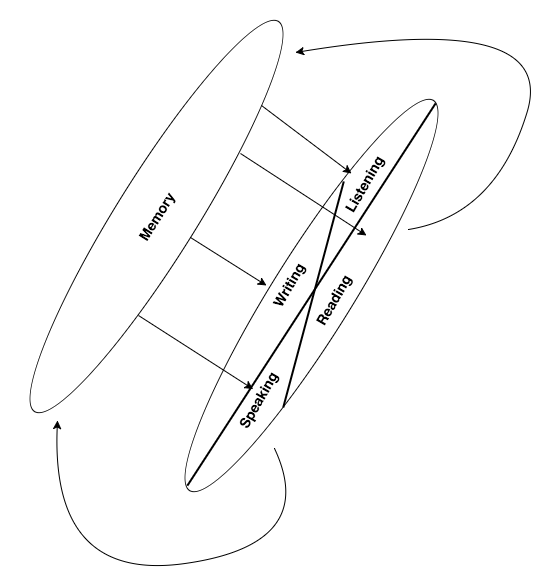
You need to also read, write, speak and listen within your target language. When rotated, these core activities will give you plenty of spaced repetition and also produce the levels of processing effect for better recall.
This illustration shows how all five of these learning activities work together to help you reach your language learning goals:
Your Next Step to a Better Memory
As I hope you’ve seen, improving your memory for learning is not about hoping information sticks.
It comes from paying attention to what matters, encoding it deliberately, organizing it with reliable cues and then practicing retrieval over time.
The good news is that you do not need to master every technique on this page before you begin.
- Start small.
- Build one simple Memory Palace.
- Choose five or ten pieces of information you genuinely want to remember.
- Turn them into memorable associations, place them along your route and then test yourself without looking at the original material.
- Later, return to the same information and practice recalling it again.
That’s what memory training looks like.
And as you become more comfortable with the process, you can expand into larger Memory Palaces, stronger Magnetic Images, number systems and more advanced forms of Recall Rehearsal.
But knowing how these techniques work is only the beginning.
You need to use them.
If you’d like some guidance with your first steps, start with my free memory improvement course.
It’s a short, focused training delivered by email over four days. It will help you:
- Build your first Memory Palace
- Create memorable associations using mnemonic associations
- Practice Recall Rehearsal so you can retrieve what you’ve learned
Just click the image below to get started:

It’s completely free.
And most importantly, you’ll finish with something more useful than another collection of memory tips:
You’ll have actually practiced remembering something on purpose.

 Anthony Metivier is the founder of the Magnetic Memory Method, a systematic, 21st century approach to memorizing foreign language vocabulary, names, music, poetry and more in ways that are easy, elegant, effective and fun.
Dr. Metivier holds a Ph.D. in Humanities from York University and has been featured in Forbes, Viva Magazine, Fluent in 3 Months, Daily Stoic, Learning How to Learn and he has delivered one of the most popular TEDx Talks on memory improvement.
His most popular books include, The Victorious Mind and…
Anthony Metivier is the founder of the Magnetic Memory Method, a systematic, 21st century approach to memorizing foreign language vocabulary, names, music, poetry and more in ways that are easy, elegant, effective and fun.
Dr. Metivier holds a Ph.D. in Humanities from York University and has been featured in Forbes, Viva Magazine, Fluent in 3 Months, Daily Stoic, Learning How to Learn and he has delivered one of the most popular TEDx Talks on memory improvement.
His most popular books include, The Victorious Mind and… 


6 Responses
Very helpful. This motivates my learning career.
I’ve been using some of these techniques sometimes but what about more motivation and the will to learn?
Thank you.
Thanks for your post and I’m glad you found it helpful.
Motivation is a tricky thing because we need to be able to move forward even if we’re not motivated.
A lot of science shows that just taking action consistently will help the brain will build the chemicals involved in habit formation.
Journaling will help as well, and if you can, I recommend adding in some meditation.
Finally, we live in a time of distraction. I highly recommend that people treat the courses they take like weekend seminars.
It’s really important to fend off distractions and the most beautiful thing is because only we as individuals can show up to do it, we get to benefit from all the growth.
Hi there, here are some questions I have regarding memory.
What memory techniques do you use? And how long have you been using them?
To what extent has your ability to memorise information improved since implementing these strategies?
How quickly did you notice change when you implemented memory techniques and what were these changes?
What inspired you to start using memory techniques?
What advice would you give to people who want to improve their memory?
Thanks for your questions, Hannah.
I use a variety of techniques, ranging from the Memory Palace to linking and spaced repetition. In music I also use deliberate practice, which is sometimes called dedicated practice.
My ability to memorize information has improved immensely, both on the fly, and in a more slow and dedicated manner for my personal learning projects.
The initial change was very quick. I memorized my first deck of cards about 15 minutes after I created my first mnemonic system for that particular learning goal.
My advice to people who want to learn their memory is simple:
Become a devoted system of holistic memory training and memory improvement efforts. That means, taking care of diet, fitness, sleep and your social life. On top of this, spend time learning languages, reading challenging books and using memory techniques in a dedicated manner.
The memory techniques that are a must involve 5 components:
The Memory Palace technique
Alphabet Systems
Number Systems
Symbol Systems
Recall Rehearsal
It sounds intense, but it’s actually very simple. People should commit to at least 90-days of study and practice. After that, they stand a high chance of enjoying superior memory for life.
Please let me know if you have further questions and I’ll get back to you a.s.a.p.
This is now my official 2nd Full year of being a student of The Magnetic Memory Method online course.
I continue reviewing these excellent lessons, as so many of them are indeed applicable to myself, as a mentally challenged senior citizen. i.e. short term memory challenges just for one.
I know what his techniques are continuing to do for those issues, and have done for myself in so many other categories as well. So. I am raising a big thumbs! I highly recommend Dr. Metivier and ALL of his work to everyone.
Grandpa Bill
Thanks so much for stopping by for this one, Grandpa Bill.
Always a pleasure seeing your comments and an inspiration. You put the techniques and suggestions into consistent action and that’s why you get the results.
Keep up the great work and many additional mental treasures will follow!