
 If you’re wondering what to memorize for the MCAT and how to do it, you’re in the right place.
See, not only have many of my memory students passed the Medical College Admissions Test.
They’ve also become highly qualified medical professionals.
There are two reasons why:
- They mastered the MCAT memorization list
- They mastered medical mnemonics overall
How do I know?
I’m a memory training specialist with over 15 years of teaching students advanced memorization techniques specifically for high‑stakes exams like the MCAT, USMLE, and other medical boards.
My students have consistently outperformed national averages, with many scoring in the top percentiles and gaining admission to competitive medical schools.
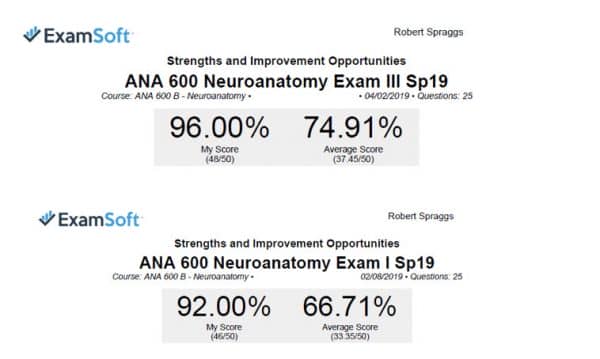
To take just one example, look at Robert Spraggs’ neuroanatomy scores compared to the class average:
On top of helping many students excel, I’ve presented memorization strategies at a TEDx event and coached thousands of learners to achieve lasting recall, not just short‑term test hacks.
So if you want to become a top-level medical student and enjoy greater success in your career, let’s get started with a powerful list of MCAT mnemonics you can use starting today.
Not only that, but you’ll learn what makes them work so well. That way, you can craft your own.
Things to Memorize for the MCAT
“Zillions of facts!”
That’s what one of my desperate students bemoaned when he told me about his issues with the MCAT.
Let me be blunt:
This kind of exaggeration is not useful. It overwhelms students who are otherwise very capable of success.
If you find yourself struggling with such unhelpful thoughts, I suggest giving my TEDx Talk a watch. It’s all about eliminating the kinds of thoughts that hold you back from rushing through the MCAT.
What the MCAT Test Covers
The MCAT involves four sections:
- Biological Foundations of Living Systems
- Chemical and Physical Foundations of Living Systems
- Psychological, Social and Biological Foundations of Behavior
- Critical Analysis and Reasoning Skills
Combined, you’re looking at 230 questions.
That’s hardly “zillions of facts.”
And it’s all very doable as many of these Magnetic Memory Method students have found.
What to Memorize for the MCAT
Within the exam itself, you will be responsible for names.
For example, you might need to give the name of the physiologist who discovered that all animals are made from cells, otherwise known as Cell Theory.
You may even need to know the date that this individual made the discovery. This means that you’ll want memory techniques for memorizing names and numbers.

The ability to memorize vocabulary will be important too, especially words related to anatomy.
MCAT Content You Must Memorize (By Section)
Memory skills in these areas will enable you to easily and strategically work your way through these categories:
- Biochemistry
- Evolution
- Classification systems for the Kingdoms (bacteria, fungi, protista, plantae, animalia)
- Locution
- Circulation
- Immunology
- Respiration and excretion
- Digestion
- The Nervous System
- Endocrinology
- Reproduction
- Growth and development
- Genetics
- Ecology
That’s an overview. More specifically, you’ll also need to commit the following sections to memory.
1. Biological and Biochemical Foundations of Living Systems
This section tests your knowledge of biology and biochemistry with a focus on processes within cells and organ systems.
- Enzyme structure, function, and kinetics
- Amino acid properties and metabolic pathways
- DNA replication, transcription, translation
- Cell structure, organelles, and division (mitosis/meiosis)
- Homeostasis and feedback mechanisms
- Genetics: Mendelian and non-Mendelian inheritance
- Hormonal regulation (e.g., insulin, glucagon)
2. Chemical and Physical Foundations of Biological Systems
This section mixes general chemistry, organic chemistry, and physics, each of which are tied to biological systems.
- Atomic structure, periodic trends, and bonding
- Thermodynamics and chemical kinetics
- Acids, bases, and buffer systems
- Solubility rules and equilibrium
- Circulatory system and fluid dynamics
- Electrochemical gradients and membrane potentials
- Organic functional groups and reaction mechanisms
3. Psychological, Social, and Biological Foundations of Behavior
This MCAT section emphasizes behavior, cognition, and the influence of social systems.
- Classical and operant conditioning
- Brain structures and their functions
- Psychological disorders (DSM-5 criteria)
- Identity, personality theories, and development
- Sociological theories (e.g., functionalism, conflict theory)
- Social stratification and inequality
- Research methods and ethical considerations in human studies
4. Critical Analysis and Reasoning Skills (CARS)
Though technically not content-based, you’ll need strong recall of analytical thinking tools and critical reasoning strategies. These skills include:
- Identifying tone, bias, and assumptions in passages
- Drawing inferences and applying logic under pressure
- Vocabulary in context and rhetorical strategy identification
- Comparing conflicting viewpoints and evaluating arguments
To master your memory for each section, it’s important to combine knowing what to study with how to encode this diverse array of information types so that it sticks.
15 MCAT Mnemonics That Work
To help you in the fullest manner possible, let’s briefly look at what the word “mnemonics” means.
It’s an umbrella term used to indicate any activity or device that helps improve learning and recall.
This means that mnemonics can include:
- Flashcards
- Anki (digital flashcards)
- Memory Palace
- Method of Loci
- Journey Method
- Story and linking methods
- Roman Room Method
- Pegword Method
- Memory Spaces
- Mnemonic Images
- Mind mapping
- Acronyms
- Rhymes
- Number rhymes
- Spaced repetition
If you want even more mnemonic approaches, check out my mnemonics dictionary.
Ultimately, you’ll find a lot of overlap between some of these memory techniques. That’s ultimately a good thing because you can use many of them in combination.
For example, the Memory Palace technique is kind of like having flashcards in your mind. Except instead of using cards or digital spaced repetition software, the reps are taking place solely in your mind.
But one thing a lot of people don’t know is that you can easily use physical flashcards and Memory Palaces in combination.
If you have any doubt that these techniques work, check out how these med students succeeded when using proper spaced repetition.

It gets even better, but we’ll look at more scientific proof after we examine a technique you might be using for the MCAT that isn’t serving you very well.
The Weakest MCAT Mnemonics
Although all of the above work, acronyms are the weakest.
For example, the so called flat peg mnemonic for:
FSH –>
LH –>
ACTH –>
TSH –>
Prolactin –>
Endorphin –>
Growth Hormone –>
Can this mnemonic approach work?
Sure.
But let’s look at a better way.
The Memory Palace Technique for Medical Terminology
The problem with acronyms is that you have to remember the acronym on top of the specific information to which it refers.
A much better way is to maximize how your memory already easily remembers information. To do this, start with space itself.
Let me ask you a question:
The last time you moved, did it involve a lot of hard work to remember the location of your bedroom in the house or apartment?

Probably not. And that’s because your memory encodes the location on autopilot.
When studying for the MCAT, using a Memory Palace will be your superpower. Especially with the most difficult electromagnetic MCAT information for which only the most high-powered mnemonics will do.
How do I know the approaches you’re discover now work so well?
Check out this study of using spatial mnemonics like the Memory Palace for medical terminology.
As Dr. Reser and I discussed, the Aboriginal techniques used in the study are very close to the Memory Palace technique.
Indeed, as Tyson Yunkaporta who confirmed when I asked about his work on the study, the approaches are virtually identical. Especially when it comes to memorizing medical terminology.
And the best part is that if you use all of the mnemonic strategies I’ve shared above, you’ll be able to get the best of both worlds.
Example of the Memory Palace for the MCAT
To get started, select a room you know well.
Taking something like the flat peg mnemonic, you would distribute the information throughout this room by placing it on or near walls, corners and furniture.
To make the information memorable, you just need to create simple associations.
Using the pegword method, you will have an image for each letter of the alphabet. This means that the FSH part of the flat peg mnemonic can readily become much more memorable.
Let me give you another visual example of how easy it is to remember things like this using a Memory Palace:

Instead of trying to remember FSH, you can use images like a frog, snake and hat.
By quickly creating a story about these objects, you’ll remember this target information much easier.
Then, you can move to another part of the room and layer on more images.
Finally, using a special process called Recall Rehearsal (a stronger version of spaced repetition), you can rapidly usher the information into long term memory.
MCAT Memorization FAQs
If you still have questions about how to prep for the MCAT, you’re not alone.
For years, my inbox has been regularly filled with queries from people prepping for med school and this test.
Here are answers to the most frequently asked questions I’ve received over the years.
1. What should I focus on memorizing for the MCAT first?
It’s best if you can start with core content that repeats across multiple sections.
Look for key information related to amino acids, hormones, and biological systems.
These are high yield study areas because they form the backbone of many questions you’ll be asked.
Once you’ve got this core information down, branch into more complex processes (like metabolic cycles or sociological theories).
And always remember: memorization without strategy is just busywork. Use tools like Memory Palaces from day one to lock in early wins.
2. Are mnemonics enough to succeed on the MCAT?
Not entirely.
You also need to set aside time for writing what you’ve learned from memory, getting in plenty of discussion with teachers and fellow students and rest also helps with memory consilidation.
But used correctly, mnemonics unlock faster understanding and deeper retention. Think of mnemonics as the scaffolding around your knowledge, not the knowledge itself.
My students combine mnemonics with comprehension and spaced repetition, and the results speak for themselves: confident recall, less burnout, and better scores.
3. How many Memory Palaces do I need for the MCAT?
Most students benefit from developing 26 Memory Palaces, one for each letter of the alphabet.
You can then assign these in a variety of ways. For example, you can have a cluster of Memory Palaces for each major subject area (like biochemistry, psychology/sociolgoy, etc.).
Ultimately, there’s no cookie-cutter, one-size-fits-all answer.
The more important point is that Memory Palaces give you space to organize facts by either spelling, sound, theme or even physical location on the body.
As a result, you keep the mental clutter low and optimize your recall practice. Just make sure that you Memory Palaces are well-formed, based on familiar spaces, logically organized, and rehearsed regularly.
4. Can I use Anki and Memory Palaces together?
Absolutely.
In fact, that’s one of the smartest combinations you can make.
Think of Anki as your rehearsal tool and the Memory Palace as your storage system. Instead of relying on digital cards alone, create mental locations for high-priority info, and then use Anki to reinforce the recall. The synergy is powerful.
Keep in mind that you can get the benefit of creating your own physical cards and then photograph them for import into Anki. For many students this combination is the best strategy.
Here’s an example of a photographed self-created flashcard that has been imported into Anki:

It takes just a minute or two and you can the benefits of deeply immersing yourself in mnemonics creation for learning and the technologically-assisted review benefits of Anki.
For more tips like this, check out my full guide on How to Remember Medical Terms.
5. What’s the best way to memorize complex MCAT pathways (like glycolysis or the nephron)?
Use mnemonic associations inside a Memory Palace.
For example, place each step of glycolysis along a hallway, assigning vivid images for each enzyme or substrate.
The story method can also help because it turn the steps into a mental “adventure” that unfolds logically. This method makes even the densest content easier to retrieve under pressure.
For more, see my tutorial on memorizing glycolysis pathways.
6. Is it better to memorize facts or understand concepts for the MCAT?
You need both.
But let’s be clear. Concepts are facts.
Try and write out the concept you’re trying to understand and memorize the wording.
For more help, see my full tutorial on memorizing concepts.
I know that the process of seeing concepts as nothing more than words can seem complex if you’re new to looking at information in this way.
But it can be learned. And it’s simple and fun once you’re set up.
If you’re interested in learning more about these techniques for beginners with a few advanced principles thrown in, check out my FREE Memory Improvement Kit:

It will show you how to create well-formed Memory Palace Networks that scale so you can easily remember everything related to the MCAT.
So what do you say?
Are you ready to master your exams with greater ease and efficiency thanks to MCAT mnemonics that really sing?
Dive in and enjoy this journey!