
Podcast: Download
Subscribe: Apple Podcasts | RSS
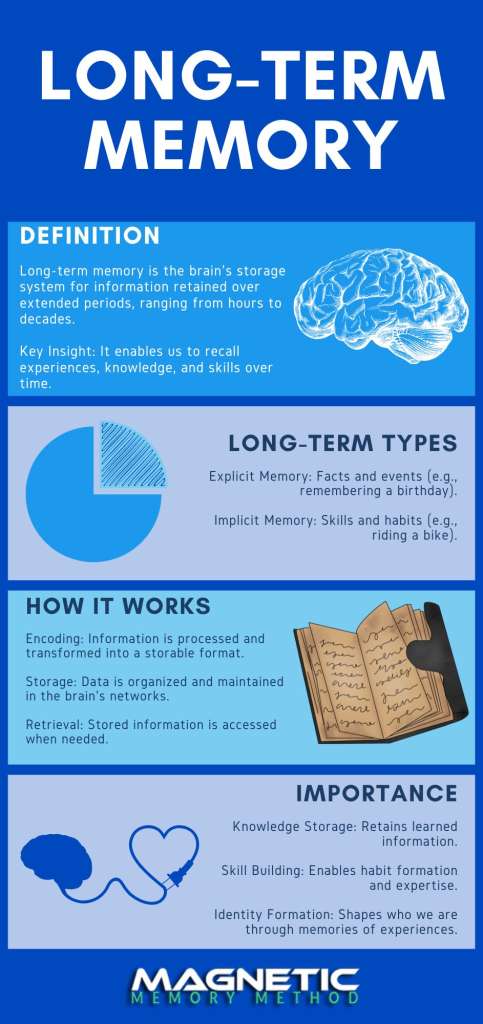
 Long-term memory is your ability to retain information beyond the few seconds or minutes of immediate awareness.
It includes facts you know, events you’ve experienced and skills you’ve learned.
If you want information to remain accessible for days, months or years, the basic process is straightforward:
- Encode the information with meaning
- Connect it with information you already know
- Retrieve it from memory instead of merely rereading it
- Review it again over spaced intervals
That’s where memory techniques like the Memory Palace become especially useful. They give you deliberate ways to encode information and create cues you can later use during recall.
On this page, you’ll learn what long-term memory is, how its major types differ and how to train your ability to retain and retrieve information.
You’ll also see why scientists distinguish long-term memory from short-term memory in the first place.
What Is Long-Term Memory?
Long-term memory refers to information that remains available after the brief period associated with short-term or working memory.
That information can include:
- The meaning of a word
- A childhood experience
- The route to a familiar location
- How to ride a bicycle
- A speech, formula or foreign-language word you’ve deliberately memorized
One useful way to think about long-term memory is in terms of persistence.
Do you remember your first day at school?
If you can bring back even a small sense of where or when it happened, some information from that experience has persisted.
Likewise, if you know what a word such as “justice” means, you are retrieving knowledge that has survived beyond the moment when you originally learned it.
That does not mean every long-term memory is permanent or equally accurate.
Some memories remain easy to retrieve. Others become difficult to access, change over time or require the right cue before they return.
Long-Term Memory vs. Working Memory
Working memory is involved when you temporarily hold and manipulate information, such as keeping a number in mind while solving a problem.
Long-term memory operates on a different timescale.
Researchers continue to debate exactly how different memory systems interact, but distinguishing temporary maintenance from more durable retention remains useful for understanding how memory works.
For a technical overview of long-term explicit and implicit memory systems, the NCBI Bookshelf provides a useful review.

How Categories Help Organize Visual Long-Term Memory
Here’s something particularly interesting about visual memory:
We can retain remarkably detailed information about scenes and objects.
Researchers from MIT and Harvard tested memory for thousands of scenes drawn from different categories. Even when participants had seen many examples from the same category, their later recognition remained surprisingly detailed.
You can read the study on visual long-term memory here.
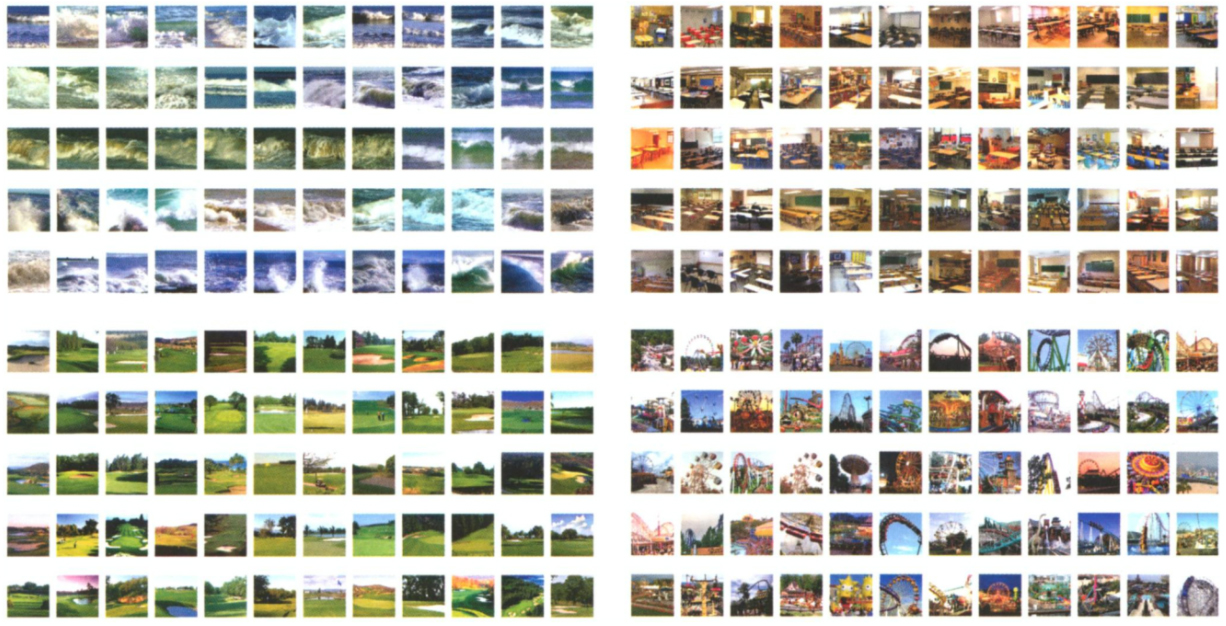
The important point is not that long-term memory is simply a collection of labels or categories.
Rather, prior knowledge and categories can help organize what we perceive and later distinguish.
This is one reason meaningful associations matter so much when you’re deliberately memorizing information.
You aren’t trying to create a mysterious form of photographic memory.
You’re giving your memory useful structures and cues.
What Are the Main Types of Long-Term Memory?
Long-term memory is not one single ability.
Researchers divide it into several related systems.
One of the broadest distinctions is between:
Explicit Memory
Explicit memory, also called declarative memory, involves information you can consciously bring to mind and report.
For example:
- Remembering what you ate yesterday
- Recalling the capital of Germany
- Remembering a person’s name
- Reciting material you’ve deliberately memorized
Two important forms of explicit long-term memory are episodic memory and semantic memory.
Episodic Memory
Episodic memory involves personally experienced events.
Examples include remembering:
- A birthday party
- A trip
- Your first day at a new job
- A conversation you had yesterday
These memories are connected with your experience of events unfolding in particular places and times.
Semantic Memory
Semantic memory involves knowledge about facts, concepts, words and the world.
Knowing that Berlin is the capital of Germany is semantic memory.
Remembering the afternoon you personally spent walking through Berlin is episodic memory.
The two systems interact constantly, which is why I’ve also written a detailed explanation of episodic vs. semantic memory.

Implicit and Procedural Memory
Implicit memory refers broadly to ways previous experience can influence behavior without requiring conscious recollection.
One particularly easy form to understand is procedural memory.
Whenever you:
- Ride a bicycle
- Type on a keyboard
- Use chopsticks
- Play a musical instrument
you’re drawing on learned skills that can become increasingly automatic through practice.
You don’t normally have to consciously describe every muscle movement involved before carrying it out.
That’s very different from deliberately recalling a name, date or definition.
Other Forms of Long-Term Memory
Researchers also study categories and phenomena including:
These categories are useful, but don’t think of them as completely isolated boxes.
Human memory is highly interconnected.
For a wider overview, see my guide to the major types of memory.
How Long Does Long-Term Memory Last?
Potentially, a very long time.
Some information can remain accessible for decades.
But there is no single expiration date for long-term memories.
How well you can retrieve something later depends on many factors, including:
- How well you encoded it in the first place
- How much prior knowledge it connected with
- How often you’ve retrieved or used it
- How much interference occurred after learning
- Whether useful retrieval cues are available
This is why “use it or lose it” contains a useful idea, even though it’s too simplistic to describe memory scientifically.
I experienced this firsthand with languages.
When I lived in Germany, I used German constantly and occasionally felt my English becoming less immediately accessible.
Now that I live in an English-speaking country again, it’s my German that requires deliberate use.
The knowledge hasn’t necessarily vanished.
What changes dramatically is how readily I can retrieve it.

How to Improve Long-Term Memory for Learning
If your goal is to remember information you’ve chosen to learn, there are four principles worth emphasizing.
1. Encode Information Meaningfully
Memory starts with encoding.
Simply looking at information repeatedly is often not enough.
You want to give the material meaning by:
- Connecting it with something you already know
- Creating associations
- Generating examples
- Explaining it in your own words
- Organizing related information together
This is one reason the more you know about a subject, the easier it often becomes to learn more.
You have more existing knowledge available for new information to connect with.
2. Use Mnemonics and Memory Palaces
When information is difficult to encode naturally, mnemonic associations can give you stronger retrieval cues.
The technique I rely on most is the Memory Palace.
You associate information with specific locations in a familiar environment and then mentally revisit those locations when you want to recall it.
This approach combines spatial structure with deliberate association.
Other systems, such as the Major System, can help when memorizing numbers.
If you’re new to these methods, start with my overview of memory strategies rather than trying to learn every mnemonic system at once.
3. Practice Active Recall
Encoding is only the beginning.
You also need to practice bringing information back without looking at the answer.
That’s active recall.
Instead of rereading a page five times, close the book and try to reconstruct the main ideas.
Rather than staring at your Memory Palace, travel through it mentally and decode the associations.
Then check your answer and correct errors.
This matters because retrieval isn’t merely a way to measure learning.
A substantial body of research shows that retrieval practice can improve long-term retention compared with additional study alone.
4. Space Your Reviews
You don’t need to retrieve everything continuously.
In fact, allowing some time to pass between reviews is useful.
That’s the basis of spaced repetition.
The goal isn’t endless repetition.
It’s to revisit information at useful intervals and actively attempt to retrieve it.
Research comparing different retrieval schedules has repeatedly found that the timing of retrieval matters for longer-term retention. Here’s one study on spaced retrieval and long-term retention.
Put these ideas together and you have a much stronger learning process:
Meaningful encoding → mnemonic cues when needed → active recall → spaced review.
6 Long-Term Memory Exercises You Can Actually Practice
The following exercises aren’t treatments for memory disorders.
They’re practical ways to exercise encoding, retrieval and learned memory skills.
1. Keep a Memory Training Journal
I’ve kept memory journals for years because they give me one place to track what I’m learning and how I’m practicing.
You can use yours to:
- Sketch your Memory Palaces
- Record what you’ve memorized
- Write down retrieval errors
- Schedule later reviews
- Track which associations worked and which failed

This isn’t about journaling as a medical intervention.
It’s simply a useful way to make your memory practice visible.
Instead of vaguely thinking, “I should work on my memory,” you can see exactly what you’ve encoded, recalled and reviewed.
2. Memorize a Meaningful Text
This is a practice I’ve used extensively since 2017.
Using Memory Palaces, I started committing long-form texts in Sanskrit to memory. Here are some Memory Palace examples you can review to see the different kinds that are useful.
My basic process is simple:
- Understand the passage
- Break it into manageable units
- Encode those units using associations
- Place the associations in a Memory Palace
- Recall the material without looking
- Check accuracy
- Return to it later
Over time, I’ve added line after line while continuing to retrieve material learned earlier.
You don’t have to memorize Sanskrit.
You might choose:
- A poem
- A speech
- A philosophical passage
- Foreign-language vocabulary
- A passage from a book important to you
The point is to work with material meaningful enough that you’ll actually want to retrieve it later.
3. Turn Reading Into Retrieval Practice
A lot of people spend hours reading without testing what survived the reading session.
Try something different.
After a section or chapter:
- Close the book
- Write down the major points from memory
- Explain the argument in your own words
- List anything you couldn’t retrieve
- Open the book and check your accuracy

This kind of exercise is more useful to me than playing a generic “brain game” because I’m retrieving information I actually want to know.
It’s also a simple way to integrate deliberate practice into your learning.
4. Exercise Episodic and Semantic Memory Together
Remember the distinction between an event and the facts associated with it?
You can explore both forms of memory together.
Choose a birthday, trip or other event from your life.
First, write what you remember about the episode:
- What happened?
- Who was there?
- What stands out?
Then list semantic information associated with the period:
- The year
- The city
- Names of people
- Popular music
- Movies or television programs
- Other facts you can independently verify
For example, I remember one birthday where we stayed up all night and had an ice cream cake from Dairy Queen.
That’s part of my episodic recollection.

Then I can retrieve semantic details such as the names of my friends, the year 1987 and the fact that Kiss released Crazy Nights that year.
One caution:
Autobiographical memory is reconstructive.
The purpose of this exercise is not to prove that every remembered detail is historically accurate. It’s to become more aware of the different kinds of information you’re attempting to retrieve.
5. Take On a Large Learning Project
One of my favorite ways to exercise long-term learning is to go deeply into a subject.
Pick something you’re genuinely curious about and read several serious books on it.
As you progress:
- Compare the authors
- Identify recurring concepts
- Retrieve earlier ideas before reviewing them
- Connect new material with what you’ve already learned
I’ve done this with subjects that initially intimidated me.
Computation was one example.
At first, I didn’t think I’d be able to wrap my mind around it.
But I kept reading.
Gradually, unfamiliar concepts became reference points for understanding new ones.
That’s an important feature of learning:
As your knowledge grows, you gain more structures for interpreting and remembering additional information.

6. Develop a Procedural Skill
Long-term memory isn’t only about names, facts and passages.
You can also deliberately develop procedural skills.
Drawing, painting, typing and playing musical instruments are good examples because improvement requires repeated practice over time.
I’ve experienced this personally through jazz bass.
Getting the instrument in my hands teaches one kind of information.
Reading about chord tones, arpeggios and the history of jazz gives me another.
The two forms of learning complement one another.
The important distinction is that learning bass doesn’t magically improve every other form of memory.
It develops knowledge and procedural skill related to the activity you’re practicing.
A Note About Memory Training and Memory Problems
There’s an important boundary to keep in mind.
Memory techniques are methods for learning, encoding and retrieving information.
They are not a way to diagnose or treat an unexplained change in memory or thinking.
Occasionally forgetting a name or misplacing something happens to everyone.
But if you or someone you know is experiencing noticeable memory changes that interfere with everyday activities, that’s a different issue from wanting to become better at memorizing vocabulary, speeches or study material.

For the purposes of this page, we’re talking about something much more specific:
How to become better at retaining and retrieving information you deliberately choose to learn.
That’s exactly where memory training belongs.
Build Your Own Long-Term Memory System
If you want better long-term retention, don’t depend on repetition alone.
Give information meaning.
Create strong associations.
Use a Memory Palace when the material calls for one.
Then retrieve the information and revisit it over time.
That’s essentially how I’ve approached memory training for years, whether I’m learning languages, memorizing long-form material or preparing information I need to deliver accurately.
You can explore the complete process in my guide to how to remember things.
And if you want to go deeper into where these methods came from, study the ancient art of memory.
People were developing sophisticated mnemonic systems long before anyone could carry an entire library in a pocket.
The technologies have changed.
The need to encode and retrieve information hasn’t.
If you’d like to learn the core techniques step-by-step, register for my free Memory Improvement Course:

You’ll get worksheets and four videos designed to give you a practical foundation in these techniques.
Most importantly, practice with information you actually care about remembering.
That’s where long-term memory stops being an abstract topic and becomes a skill you can work with directly.

 Anthony Metivier is the founder of the Magnetic Memory Method, a systematic, 21st century approach to memorizing foreign language vocabulary, names, music, poetry and more in ways that are easy, elegant, effective and fun.
Dr. Metivier holds a Ph.D. in Humanities from York University and has been featured in Forbes, Viva Magazine, Fluent in 3 Months, Daily Stoic, Learning How to Learn and he has delivered one of the most popular TEDx Talks on memory improvement.
His most popular books include, The Victorious Mind and…
Anthony Metivier is the founder of the Magnetic Memory Method, a systematic, 21st century approach to memorizing foreign language vocabulary, names, music, poetry and more in ways that are easy, elegant, effective and fun.
Dr. Metivier holds a Ph.D. in Humanities from York University and has been featured in Forbes, Viva Magazine, Fluent in 3 Months, Daily Stoic, Learning How to Learn and he has delivered one of the most popular TEDx Talks on memory improvement.
His most popular books include, The Victorious Mind and…