
Podcast: Download
Subscribe: Apple Podcasts | RSS

Memento mori sounds morbid. It may even conjure up images of people contemplating skulls.
But the ancient practice of “remembering that you will die” will not depress you when used as a memory exercise.
Far from it. When done using the exercises you’re about to discover, a variety of memento mori practices can help wake you up to the present moment.
And this awareness will help ensure that today (and every day) matters to your life.
That’s just one reason to practice the memento mori exercises you’re about to discover today.
They are powerful and have been throughout history.
Why?
For one thing, when you hold the fact that you are going to pass away in your mind for even a minute, mental junk that obscures the miracle of existence can start to lose its grip.
Petty worries shrink.
Procrastination fades. And you start choosing the conversation, the walk, the work and take more risks.
And that’s important because those are things you’ll actually be glad you did. As opposed to doom scrolling on your phone, which is usually an utter waste of time.
The Truth of Memento Mori Exercises Hidden in Plain Sight
Here’s the link between memento mori and memory training you might have missed:
I’ve taught memory training techniques for years, and the engine behind developing great recall isn’t “talent.”
It’s cultivating your attention in ways that you associate with meaning that is worth remembering.
Well-constructed memento mori exercises force meaning to the surface, which makes attention sharper automatically.
And as memory expert Harry Lorayne often pointed out, when attention sharpens, better memory follows.

That’s one reason why I keep an Amor Fati medallion from The Daily Stoic on my desk. In fact, I keep it right beside a “Mr. Death” pin that says “Catch you later.” I wore that pin on tour when I played bass with The Outside as a private reminder:
Do not sleepwalk through this rehearsal, and definitely not during this concert. You’re only going to get to do this one.
Finally, these two memento mori are kept with the Warrior of the Mind Emblem Tony Buzan awarded me for Outstanding Contributions to Global Mental Literacy. As you can imagine, it took on even more significance for me after he unexpectedly passed away.
It sounds ridiculously simple, but having visual reminders like this constantly in your environment makes a big difference to your quality of life.
And in the next few minutes, I’ll show you three more simple memento mori exercises you can do today to live a more memorable life. As a side effect, these will train the exact mental skill that makes your memory stronger overall.
One: Imagine Your Funeral
The exercise I’m about to share sounds grim, I know.
But it’s actually quite positive.
I adapted it from psychologist Richard Wiseman’s 59 Seconds, where he discusses brief, evidence-informed writing prompts that can shift perspective and behavior.
As Wiseman explains based on a study he cites, the imaginative act of seeing and hearing your friends, family and colleagues acknowledge your passing creates perspective and insight that can improve your happiness.
I’ve upped the ante and turned it into a brain game by not just imagining the scenario mentally, but by involving pen and paper.
Make a list of two friends, two family members and two colleagues (or fellow students if you’re still in school).
Next, write down one positive memory each person will share about you at your funeral. It could be a story or just a description of a personal attribute. Pretend that you can hear their voices as you complete the exercise.
This point is important:
Focus on the positive.
Don’t invite haters to your funeral. Really feel the upbeat sentiments people share about you and enjoy the warmth they create.
Then follow-up by imagining what you could do starting today to increase the praise you’ll receive. This simple additional step will help ensure you live a much more interesting life.
Two: The Monty Hall Memento Mori Exercise
If you’ve heard about The Monty Hall Problem, you likely have only heard it talked about as a quirky mathematical riddle. But for our purposes today, it’s really about why we humans cling to our first decision when changing our minds is the smarter move.
Here’s the Monty Hall Problem in simple terms, followed by an exercise:
Imagine that you’re on a game show.
There are three doors and behind one of them is a prize. Behind the other two, either absolutely nothing or undesirable objects.
The host, who knows the location of the prize, opens one of the two doors you didn’t pick and reveals either nothing. Or a dud prize, like a goat.
Then he gives you a choice:
Do you want to stick with the door you originally selected? Or switch to the remaining unopened door?
Here’s what makes The Monty Hall problem interesting:
Although you’ve already decided on a door, many analysts of the problem believe that switching at this critical moment gives you better odds of winning the prize.
This means that changing your mind is the better and more rational choice. But many people do not perceive the benefits and wind up sticking with their original choice.
What Makes This Problem A Great Memento Mori Exercise
The reasons behind why people don’t switch makes this fodder for a memento mori exercise you can run entirely in your mind.
But before I give it to you, let’s explore the relationship between the problem and the memory exercise of remembering the impermanence of life.
Most explanations suggest that people won’t change their minds due to psychological biases. Myself, I think it comes down to a combination of memory biases and unconscious fears.
Memory biases, for example, can lock the first decision in place. The mind may even start editing the past or resort to mystical explanations to justify sticking with original choice. You might think:
- I must have made this choice for a reason.
- I had a good feeling (which may or may not be true).
- I’ll look foolish if I change my mind and lose.
Then there’s psychoanalytic theory:
Switching can feel like a small symbolic death: death of the self-image that “gets it right,” death of certainty, death of the plan, death of other people’s approval. And when death anxiety is in the background, people prefer a familiar loss to an unfamiliar risk.
This is one of the insights I took from my experiences with Dr. Robert Langs. As I shared in The Victorious Mind based on my time in his office, he thought that death anxiety isn’t something that waits to show up when you’re dying. He thought that it shows up in ordinary life as “reasonable” stories and invisible defenses that keep you inside a frame that feels safe.
In Langs’ view, a decision is a frame. And inside that frame, staying put often masquerades as virtue when it’s really functioning as a form of protection. The only problem is that the protection is potentially weakening your mental strength or preventing you from seizing opportunities.
The Exercise
Think back to a time when you made a decision, had the opportunity to change your mind, but didn’t take it. It doesn’t really matter if you later regretted your decision or not, though that kind of scenario is ideal for this memory exercise.
Once you have found an example, use a journal to explore in writing the following questions:
- What stories did you tell yourself?
- What would you have had to symbolically “kill” about yourself in order to take action?
- An image you held about yourself?
- Risks to your reputation?
- Potential losses?
There are many ways you can go with this exercise. Just knowing about The Monty Hall Problem has helped me countless times in life.
Three: Premeditatio Malorum
It’s been over a year since I acquired a unit I’ve been slowly turning into a Physical Memory Palace.
Because I’m hugely risk averse, I had to use an exercise called premeditatio malorum which means “pre-rehearsing the bad things.”
The modern version is called “prepare to fail” in the WRAP technique discussed by Dan and Chip Heath in their book, Decisive.
Basically, you spend a bit of time imagining what it will be like if everything goes wrong.
And it’s a memory exercise because you draw upon knowledge of other examples, images, emotions and concepts related to failure.
Now, the point of playing this memento mori game is not to feed your inner pessimist.
No, when done correctly, this exercise operates like a mental fire drill.
You don’t run such drills because you actually want a fire.
You run the exercise so that if one ever happens, you don’t freeze, fumble or wind up burned.
Here’s a quick protocol you can use to run this exercise yourself:
Step One: Set a timer for five minutes
Keep it short and sharp. This isn’t an exercise in wallowing.
Step Two: Pick one decision you’re worried about or work with something from your past
It’s really important you pick just one thing. This exercise is not about engaging in fantasies about the apocalypse.
Step Three: Run a “real world scenario” in writing
On a piece of paper, answer these questions:
- What specifically could go wrong?
- What will the consequences be?
- What messes will problems create for my loved ones?
- What strategies will I be able to pursue to fix these problems?
- What would the future version of myself facing these problems urge me to fix now?
Step Four: End with gratitude
The beauty of running this simulation is that the problem you’ve just worked with actually hasn’t happened.
You can then write a few statements that express your gratitude that you’ve had this conversation with yourself.
Just remember that this exercise is supposed to be a scalpel, not a wrecking ball.
If you find yourself ruminating over the potential for doom, return to the exercise and focus on ending it with a positive outcome.
When everything is working as it should, you’ll start noticing that you’re living like your time matters more than ever before.
At least, that’s been my experience.
Four: The Book Cover Test (Memento Mori for Finishers)
Wayne Dyer shared a strategy in one of his talks I immediately adopted.
When working on one of his books, he had a mock book cover printed up and kept it on his desk until the manuscript was done.
Not as a manifestation.
But as a quiet, daily confrontation with the only question that matters:
Will this project be realized…? Or will it die as little more than an idea?
Not only did I keep an image of my very challenging Vitamin X Memory Detective book in my view during the years I worked on it. I’ve kept the mind map that guides my business since I created it years ago with Tony Buzan’s guidance.
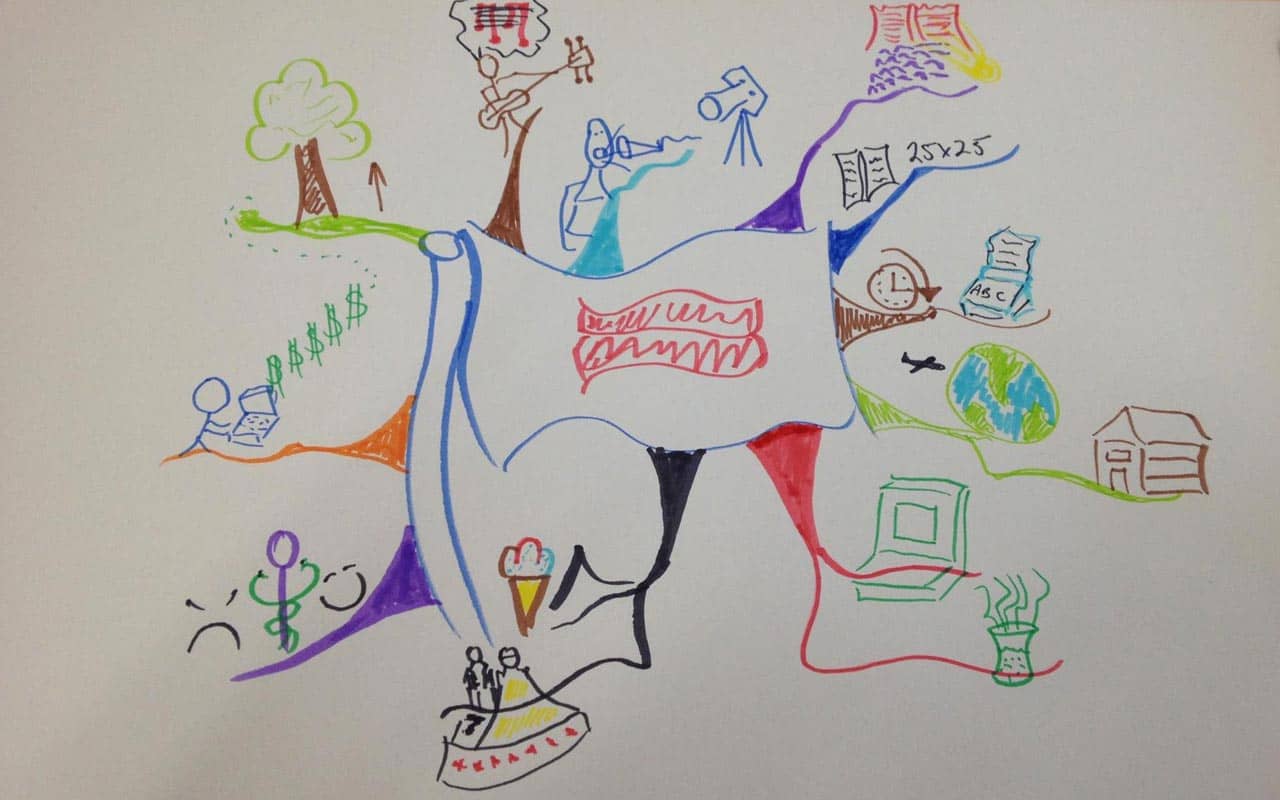
These aren’t decorations.
They’re reminders of both the live-giving properties of completing projects. And the death-related anxieties we create by giving up.
Even better, they help prevent life’s many problems from thought blocking, which is one of the scientific terms for losing your train of thought.
How to Complete this Exercise
- If your project is a book, create a mock cover. Otherwise, create a mind map that visually depicts the steps involved in completing the project.
- Place it on your desk. Not tucked away. Always in your line of sight.
- Every day, ask this question:
- If I died before this project is done, what would this image mean to the people who I leave behind? And to the people who never got to benefit from the completed work?
This kind of exercise is not melodramatic.
Rather, you’re testing the truth of your conviction by continually exercising the memory of your commitment.
If you want to supplement this memento mori part with some journaling, which I highly recommend, experiment with statements like:
Because I’m here today, I will:
- Draft the next chapter
- Revise part one
- Outline the ending
- Send out queries to agents, etc.
Journaling in this way creates daily decisions that tip completion in your favor.
This is exactly what helped me finally finish Vitamin X despite many challenges. It’s the same activity behind most of the videos I put out on my YouTube channel, articles on this site and the audio podcast.
Five: The Black Dog of Memento Mori Meditation
Although I don’t personally follow any particular belief system, I’ve studied various teachers and methods as intensively as possible.
Twenty years ago, I found the abundance of meditations offered by Michael Roach quite impressive, if only in terms of volume.
Although I’ve seem some people warning that he’s running some kind of cult, he certainly does seem to have quite a memory for maintaining and sharing dozens of meditations. In this video he says he knows over 100, which is not at all impractical in my view.
Indeed, I have memorized approximately 2000 words of Sanskrit, and would argue that each Sanskrit phrase is its own meditation. It’s just more fun for me to group a bunch together, rather than repeat the same one and wind up suffering the deleterious boredom of rote repetition.
In any case, of all the Roach meditations I followed, my favorite involved him describing various scenarios playing out in a Buddhist temple. It was essentially an example of the method of loci combined with the story method.
I won’t go through all the parts, even though they all involved images and situations of threat.
The third part struck me the most because it involved imagining yourself at the third station of the temple and suddenly becoming aware of a little black dog nipping at your heels.
The purpose of the meditation?
To remind yourself that death is always behind you. And its potential as an event is continually as close as the faithful companion pet dogs symbolize.
You can easily practice it by picking a location you’re familiar with and imagining yourself walking when you suddenly notice this presence with you.
Then submit the sensations that arise to inquiry. You can use reflective thinking to post questions like:
- Why does this meditation use a small puppy as a symbol for death?
- In what ways does death influence my life?
- What happens if I embrace the reality of death rather than fear it?
- What exactly is it that we fear when we fear death?
Although these questions might sound strange, they will potentially create what the psychotherapist Monica Khosla calls “memory reconsolidation” in her book, The First and Last Belief: Liberation and the Sense of Self in the Age of Neuroscience.
The idea is that we can now identify what she calls “neuropatterns of belief.”
By questioning them and using other mental practices, we can change those patterns. Or at least change the ways the brain prioritizes attention to various ideas implicit memory has helped usher into our brains.
Our thoughts and ideas about death are perhaps the most pernicious when it comes to creating anxiety-induced memory loss. I’m sure glad I found practices like these to ease up my own anxiety. My mind has been much more open and my memory stronger ever since.
And many people who use the Magnetic Memory Method or have read The Victorious Mind report similar results.

A Better Life Is Rarely Built By “Motivation”
If you take nothing else from my adaptation of the memento mori concept in offering these exercises, please realize that the mental skill you desire is built by training.
That’s what memento mori does when you realize the role of our symbolic fears of death and use them as reminders to take action now. While you have a chance.
Over my years of experience, I’ve realized that Lorayne is perhaps more right than he ever imagined.
If you cannot train your attention, it will be very difficult to train your memory.
That’s why the exercises I shared with you today aren’t just philosophical.
They provide mental reps that keep you focused on what really matters.
And if you loved discovering these exercises, you’re really going to appreciate what I’m about to give you next.
I’ve put together a free course that teaches the most important foundation of memory. All without fluff, gimmicks, or needing photographic memory.
Grab this free memory improvement course now:
In four quick video lessons, you’ll discover how to:
- Encode information so it sticks
- Recall what you need on demand
- And build memory skills you can trust in real life
Now, if the idea of using memento mori sounded morbid at the start, now you know the truth:
It’s a wake-up call.
So what do you say?
Are you ready to develop a mind that actually holds onto the life you’re living and realizes the goals your beautiful imagination has placed in your mind?
Carpe diem!




10 Responses
Hello Anthony, an excellent topic for those old and young who wish to ponder life’s events both happy and less so. Robert Frost is one of my favourite poets. His style is simple and elegant yet so powerful and meaningful, and he has much to share with us about life.
You shared some interesting observations about preparing one’s demise; they are very well founded. People have enough on their minds when dealing with loss and emptiness after a loved one leaves. It is far more caring to arrange one’s affairs so those who are left may carry on.
Memory plays a large part after one leaves. We remember many whom we have not seen in years, and we recall much. The laugh he had. The perfume she wore. All of the emotions are present, even though the events occurred seasons ago.
Journaling is a gift that you can pass to your children’s children. You can share your memories through the ages. My grandfather left personal memoirs from before WWII, and it’s fascinating to read about life from his perspective.
Another fine poet of the English language is William Shakespeare, whose sonnet 18 is as follows:
Shall I compare thee to a summer’s day?
Thou art more lovely and more temperate:
Rough winds do shake the darling buds of May,
And summer’s lease hath all too short a date:
Sometime too hot the eye of heaven shines,
And often is his gold complexion dimmed,
And every fair from fair sometime declines,
By chance, or nature’s changing course untrimmed:
But thy eternal summer shall not fade,
Nor lose possession of that fair thou ow’st,
Nor shall death brag thou wander’st in his shade,
When in eternal lines to time thou grow’st,
So long as men can breathe, or eyes can see,
So long lives this, and this gives life to thee.
The sonnet, to me, alludes to the continuity of Life through Memory. The lines are beautiful, and the conclusion is truly powerful.
We are far wealthier for the memories and writings we leave and for those our ancestors leave us.
Well Anthony, thanks again for a splendid pod cast!
Kind regards.
Thanks for these thoughts, Alex. I did not think of it, but journaling certainly is a gift for the next generation and could even be written in that style.
Thanks too for sharing this poem. It is a delight to read and gives me the opportunity to share the 1609 Quarto version, where the spellings remind us of where English has been:
Shall I compare thee to a Summers day?
Thou art more louely and more temperate:
Rough windes do ſhake the darling buds of Maie,
And Sommers leaſe hath all too ſhorte a date:
Sometime too hot the eye of heauen ſhines,
And often is his gold complexion dimm’d,
And euery faire from faire ſome-time declines,
By chance,or natures changing courſe vntrim’d:
But thy eternall Sommer ſhall not fade,
Nor looſe poſſeſſion of that faire thou ow’ſt,
Nor ſhall death brag thou wandr’ſt in his ſhade,
When in eternall lines to time thou grow’ſt,
So long as men can breathe or eyes can ſee,
So long liues this,and this giues life to thee.
Let’s just hope Big Brother Google doesn’t penalize the Magnetic Memory Method site for sharing Shakespeare’s spelling! 😉
Anthony,
Is there an ASCII code or font for those Elizabethan s’s?
As to the Monty Hall problem, I’ve seen discussions on the matter, mostly from Marilyn Vos Savant’s column, and some very bright people, math professors even, considered it to be in effect a 50/50 situation once one of the doors was opened. Myself, I make it a policy never to disagree with beautiful women, so I believed Marilyn.
Do you know of any practical experiments that bear out the prediction that switching doors will get you the car, so to speak, two-thirds of the time?
And is there any evidence that the producers of “Let’s Make a Deal” understood the probabilities inherent in their own game? Is it basically a variation of the old pea under the shell game?
Thanks for this, Steve.
I don’t know if there’s a code for the Elizabethan font, but it would be cool if there were.
For the Monty Hall problem, I don’t think it’s likely that the show’s producers knew about this effect. The show certainly didn’t invent the term either, and magicians have been using this principle for a very long time.
The only material I found from Marilyn on the Monty Hall problem seems that she acknowledges the counterintuitive claim that it makes sense to change your mind. She seems to acknowledge this on her own website here. This is the part about the controversy on the Wikipedia page.
For our purposes, my point was to link it to Frost’s poetic principle and a life policy that doesn’t really require the mathematics in order to be valuable, even if not always valid. There’s no 100% in life and no guarantees. Still, the mathematics are interesting and do give compelling reason to believe that life will be more interesting and memorable if we go the other way.
Above all, it’s excellent that you mentioned Marilyn Vos Savant. I’d not looked into her story more deeply than the Wikipedia article and it’s quite fascinating. Thanks and looking forward to your next discussion post here on the Magnetic Memory Method site. 🙂
Anthony,
As usual, I wrote prematurely with questions that were nicely answered with the link to Wikipedia. Never mind.
Yes, the Wiki link is quite good.
Here’s a Derren Brown video where you can see the principle (more or less) in play.
As I mentioned in the podcast, I’ve done versions of this in my magic routines a lot over the years and people overwhelmingly tend not to change their minds. It’s a bizarre phenomenon, but interesting and useful to know about. 🙂
Hey Anthony.. interesting Podcast.
It’s not Shakepeare ( It’s from Brian Molko, Placebo ) but I like the lyrics:
Run away from all your boredom
Run away from all your whoredom and wave
Your worries, and cares, goodbye
All it takes is one decision
A lot of guts, a little vision to wave
Your worries, and cares goodbye
(Slave to the Wage, 2001 or so)
I’m actually moving to a new place.. Let’s see what Monty has next for me behind the doors…;-)
bye
Björn
Song lyrics are great to memorize too.
Look forward to hearing how your new place serves as a Memory Palace and what life in it brings! 🙂
Definitely i´m going to start coming back more often to your website Anthony!
So much value!
Awesome – Glad to hear it and look forward to your next comment! 🙂