
Podcast: Download
Subscribe: Apple Podcasts | RSS
 If you need to memorize the 27 Amendments to the American Constitution, the Memory Palace technique is the best strategy.
It works in combination with mnemonic associations that you’re about to learn.
And for thousands of years, people have been using memory techniques to commit far more than just these 27 pieces of information to memory.
In fact, there are people alive today who have committed entire books to memory — including the entire Constitution itself!
So if you’d like an easy way to memorize the amendments, today’s your lucky day. There are at least three ways to do it, and I’ll reveal all on this page by covering these mnemonic strategies:
1. The number rhyme system
2. The pegword system
3. The Memory Palace technique
1. How to Memorize the Amendments Using a Number Rhyme System
Because the amendments are numbered, you’ll want to use a mnemonic number system.
Number Rhymes is the easiest to pick up quickly. That’s because it’s basic, visual and intuitive. To get started, associate each number from 0-10 with a rhyme.
For example:
- 0 is a hero
- 1 is a bun
- 2 is a shoe
- 3 is a bee
- 4 is a door
- 5 is a hive
- 6 is sticks
- 7 is heaven
- 8 is a gate
- 9 is wine
- 10 is a hen
You can go higher, of course.
But here’s an additional trick from my full tutorial on number rhymes:
Make each rhyme and image much more specific than an abstract old bun.
For example, I think of the buns you used to get with Kentucky Fried Chicken when I was a kid. I then mentally arrange those buns into the shape of the numeral one to reinforce the association.

Likewise for two, think about a specific pair of shoes. To help in the process, I suggest you develop your rhymes by writing them down on paper.
Associating Number Rhymes to the Amendments
Next, when you start to memorize the first amendment, which discusses “Freedom of Religion, Assembly, Petition, Press, Opinion, and Speech,” imagine that specific bun you’re thinking of with a gag on it while it’s trying to give its opinion.
If “one is a bun” doesn’t work for you, try RhymeZone for other possible rhymes. You might choose the sun, or combine a bun with the sun. For the first amendment, you could imagine your opinionated bun having his rights burned up in the sun.
Let’s try the second amendment: “The freedom to bear arms.” You have to admit that it’s pretty unforgettable to imagine your favorite pair of shoes signing its application forms to purchase a new handgun.
What about something a bit more abstract, such as the third amendment?
It states, “No military in your home except in wartime.” Provided you have some specific bee or bees in mind to rhyme with three, committing this part of the amendment to memory should be no problem.
For example, I think of The Bee Movie, starring Jerry Seinfeld to make the number rhyme more concrete and specific. I have this character and a swarm of bees dressed as soldiers trying to enter my home. I meet them at the door with the third amendment to remind them they’re not allowed here.

Is this method the best?
It certainly is effective because it tells you the number of the amendment, but it’s also a bit random. It’s also relying solely on the strength of two levels of association: a rhyme and an object or cartoon character.
But what if you have to memorize the exact amendment word for word?
We’ll get to that with the Memory Palace technique, but first, let’s consider a similar alternative to the number-rhyme approach.
2. How to Remember the Amendments Using a Pegword System
Pegwords are very similar to number-rhymes. It’s just that there’s no rhyme and people tend to use the alphabet.
For example, let’s say you’re memorizing the fourth amendment, “No unreasonable searches or seizures.”
Let’s use the letter D and assume that we’ve covered the first three amendments with A, B, and C. With this approach, you assign a person or object to each letter.
For example:
A = Al Pacino (insisting he has the right to speak freely)
B = Ben Kingsley (registering for a firearm)
C = Cookie Monster (refusing the military entrance into his home.

For the fourth amendment, you might assign Dracula to the letter D and imagine him explaining to a cop that he has the right to be free from search and seizure without good reason.
If we assign E and Ernie from Sesame Street to the fifth amendment, you could have him almost incriminating himself and then catching himself just in time.
Can you spot the weakness with this technique? It has all the same problems as the number-rhyme approach — but in this case, you have to know the number of each letter of the alphabet.
That said, you could combine the two. In fact, if you did, you would quickly learn the number of each letter of the alphabet.
For example, if you decide that six is drumsticks, you could have a philosopher like Michel Foucault for the letter F in your association. He could be pounding away on drums and chanting that he has “the right to a speedy and public trial.”
If you would like lists of all my images for number-rhymes and the alphabet, please see my full post on using the pegword method.
3. Using The Memory Palace Technique to Remember the Amendments
A Memory Palace is probably your best bet. It will allow for a few things:
- It helps you have a “canvas” for leaving your images so you can find them later
- You can remember the number of each station by using a number-rhyme
- You can use Recall Rehearsal to harness the serial-position, primacy, and recency effect to get all of the amendments into long term memory rapidly
To create a Memory Palace, draw a home or office where you have space for more than 27 different items. This is important in case you need more space.
For example, if you want to memorize the amendments verbatim, you’ll notice that some are much longer than others.
Personally, I would probably link together two or more Memory Palaces for this task, as I have done in this illustration of one of my favorites.
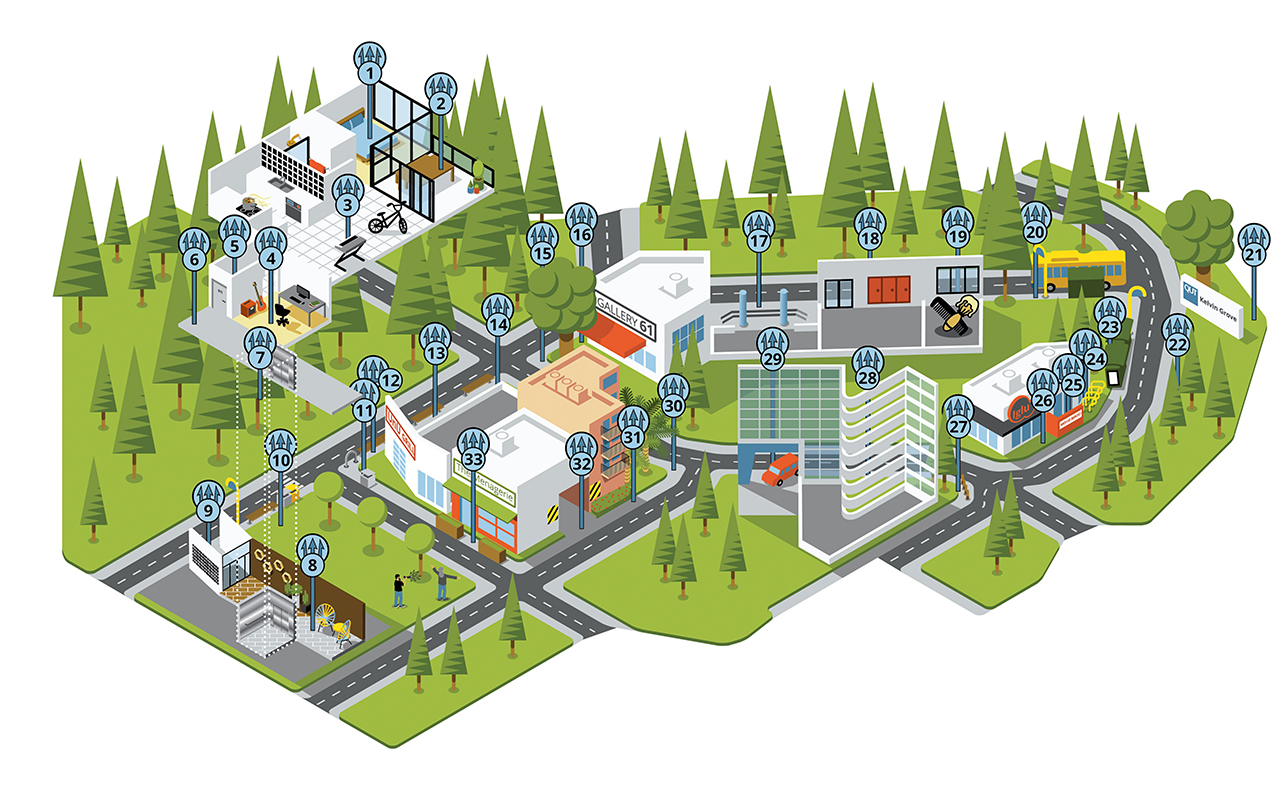
This Memory Palace has more than enough room for all the amendments. I actually think of it as three separate Memory Palaces that just happen to be linked. Magnetic Stations 1-9 are one Memory Palace, 10-20 another, and 21-33 the final MP.
Now that you’ve got a few strategies to work with, let’s take a look at a few more examples using the Memory Palace technique in combination with various pegwords and number mnemonics.
Memory Palace Example for the Amendments
We’ve already covered the first six in this tutorial, so let’s imagine that we’ve got them covered and start with the seventh amendment on station seven.
Station seven is the elevator in a building. It says that Americans have “the right to a trial by jury in civil matters of $20 and over.”
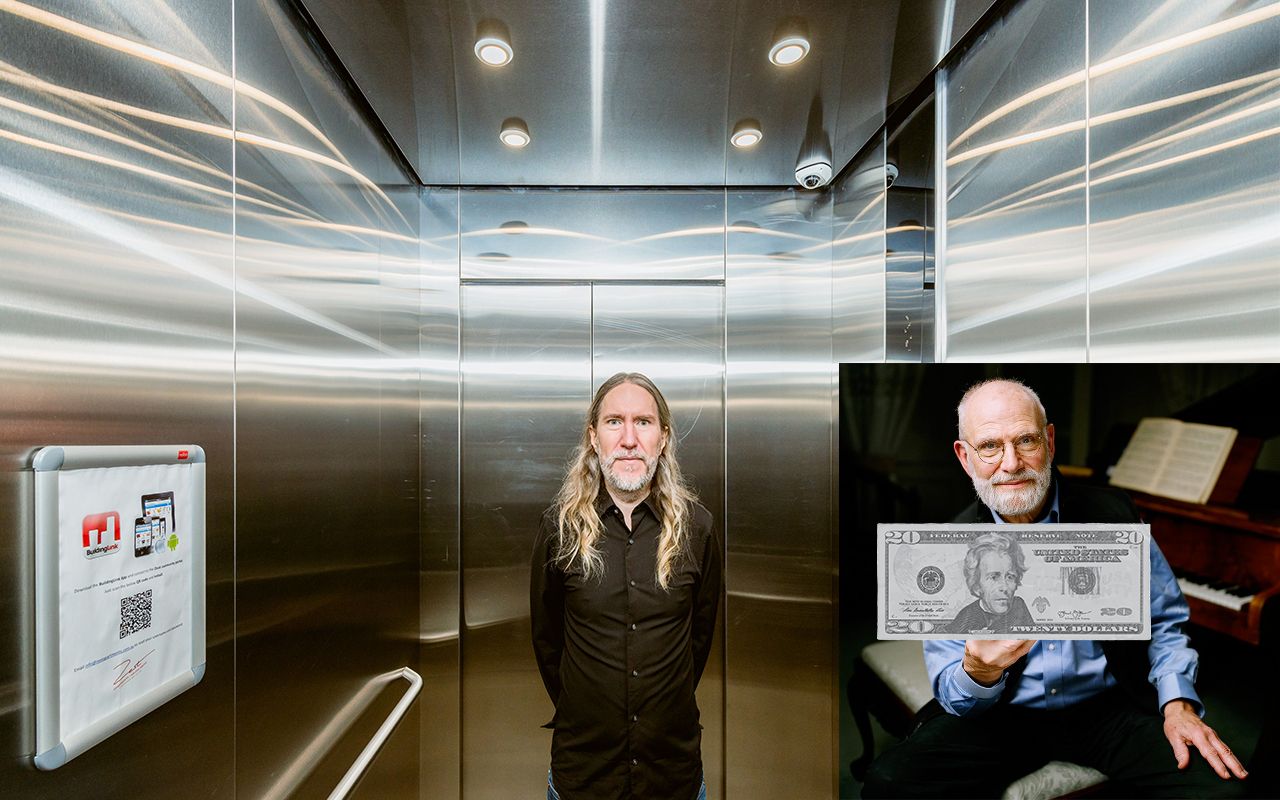
In this elevator, I would imagine Oliver Sacks handing a twenty-dollar bill to a jury of my peers.
Why Oliver Sacks? Because he’s my symbol for 07 using a 00-99 PAO (Person Action Object) system. It’s a bit more advanced than number-rhyme and alphabet memory systems.
It’s built from something called the Major System. Basically, you pair every digit from 0-9 with a consonant. Then when you put two digits together, you make a word.
Here’s a handy chart that lays out the system:
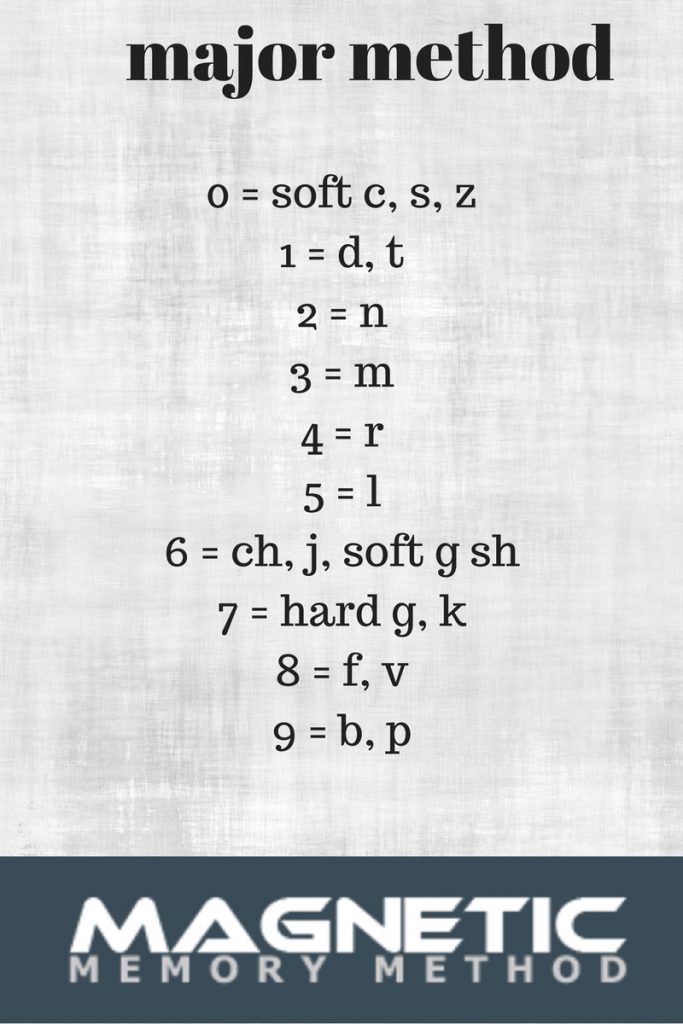
Since 0 = s and 7 = k, I chose the word “sack.” Since that’s a bit limp and lame without an actual reference, I landed upon Oliver Sacks to make the association more concrete.
Then, when I needed to memorize the eighth amendment, I would simply proceed to the next station in the Memory Palace and use the symbol for 08 to memorize “The right to fair fines and bail. No cruel and unusual punishment.”
(08 = Shiva in my system, but you can explore many other options.)
But what if you need ways to remember the amendments line for line?
How to Memorize The Amendments Verbatim
So far, I’ve described ways to memorize the amendments that will give you the gist of each one. But what if you need an easy way to remember the amendments all word-for-word?
No problem!
In fact, it’s with verbatim memorization that the Memory Palace technique really shines. Because you have a lot of space, you can make an image for each and every word.
For example, my image for 09 is memory expert Brad Zupp. The ninth amendment is “Individual Rights. Rights that are not in the constitution are still rights delegated to citizens.”

I might imagine that Brad is a Star Wars character who feels “individual” about his rights. To remember specifically that the next sentence starts with “rights,” I would imagine the Wright brothers from a band called NoMeansNo performing on a knot instead of a stage to remember the words “Rights not…”
Then I would have the Dell computer logo crashing down on a poster for the movie, Citizen Kane.
Listen, these images might make zero sense to you. Your mind is probably filled with a completely unique set of popular culture images.
But the principles behind these techniques are the same: You make a word-by-word association and lay out the mental imagery on a wall or along some kind of journey.
How to Remember The 27 Amendments For the Long-Term
Now you might be thinking, “Hang on, memory man! All that associating… it’s going to take forever!”
Actually, it won’t.
Studies have shown that using flashcards will get you about a 44% retention rate, whereas using the elaborative encoding process I’ve just shared should get you a rate of 85%.
That rate will go up or down depending on your willingness to experiment with the techniques.
But it’s not just about making these funny associations. You also need to actively recall each of the amendments. For that, the Memory Palace helps you do this in a highly refined way.
First, I suggest you encode only 5-10 at a time. Then, visit each one in a strategic pattern:
- Forward and backward
- Start at the end and move to the beginning
- Start in the middle and move to the end
- Start in the middle and move to the beginning
- Skip the stations (i.e. recall 1, 3, 5, 7, then 8, 6, 4, 2, etc)
Why go to all this trouble? Because this harnesses the power of serial positioning, the primacy effect and the recency effect. Without it, you’re likely to only remember the first and last amendments you place in the Memory Palace.
FAQ: What About Flash Cards and Spaced Repetition Software?
You certainly can use these, but I would recommend you still have a Memory Palace and the association process in the mix.
One way or the other, the brain needs active recall to learn and it’s so much easier when you have a Memory Palace and associative imagery in the mix.
You don’t have to take my word for it either. Memory expert, neuroscientist, and memory athlete Boris Konrad will offer you similar setup steps.
Now, we know from his autobiography that Benjamin Franklin sought out better forms of memory. And we also know that he was a staunch defender of the freedom to speak your mind.
And he also wrote this about how he committed certain styles of writing to memory:
“I took some of the papers, and, making short hints of the sentiment in each sentence, laid them by a few days, and then, without looking at the book, try’d to compleat the papers again, by expressing each hinted sentiment at length, and as fully as it had been expressed before, in any suitable words that should come to hand.”
This is an important clue to our final lesson:
If you really want to get all 27 amendments locked permanently in your memory, write them down from memory. Literally test yourself and use active recall.
- First, call the Memory Palace back to mind.
- Then call back the association you made.
- Finally, allow the association to bring back the target information.
- Then write it down.
You don’t have to recall it in order. If you can’t think of one immediately, simply move on to the next that you can and troubleshoot later.
Troubleshooting All The Ways To Memorize the Amendments
It’s very unlikely you’ll get through the process without making a mistake.
The trick is to learn from our mistakes.
If you miss a word, or an entire amendment, calmly assess the situation.
Were your associations concrete enough? Again, I suggest you always push yourself to make it more specific.
For example, if you use heaven for seven, ask yourself:
Is “heaven” really a concrete image in your mind? Can you use characters from Highway to Heaven to make it more immediate? Or do you know a friend or celebrity named Evan you can use?
Likewise when it comes to a Memory Palace. If you can’t remember which spot comes next, you need to remove the self-criticism and dispassionately assess the situation.
Have you spent enough time creating a proper Memory Palace? Have you completed the free course offered on this site to help you through it?
Is Any Of This Really Quick And Easy?
Yes!
I’ve seen people memorize far more than this amount of information in just days. It just comes down to a willingness to learn the techniques in a spirit of experimentation.
Of course, some people get the knack for it faster than others. But anyone with skills enough to read this page can also memorize as much information if they want. You can even go on to memorize other important documents, such as by following my how to memorize the preamble tutorial.
In sum, it’s an incredible journey to memorize a list so central to the freedoms promised by one of the greatest nations on earth. My hat’s off to you for committing yourself to it and if you have any questions, just post them below.

 Anthony Metivier is the founder of the Magnetic Memory Method, a systematic, 21st century approach to memorizing foreign language vocabulary, names, music, poetry and more in ways that are easy, elegant, effective and fun.
Dr. Metivier holds a Ph.D. in Humanities from York University and has been featured in Forbes, Viva Magazine, Fluent in 3 Months, Daily Stoic, Learning How to Learn and he has delivered one of the most popular TEDx Talks on memory improvement.
His most popular books include, The Victorious Mind and…
Anthony Metivier is the founder of the Magnetic Memory Method, a systematic, 21st century approach to memorizing foreign language vocabulary, names, music, poetry and more in ways that are easy, elegant, effective and fun.
Dr. Metivier holds a Ph.D. in Humanities from York University and has been featured in Forbes, Viva Magazine, Fluent in 3 Months, Daily Stoic, Learning How to Learn and he has delivered one of the most popular TEDx Talks on memory improvement.
His most popular books include, The Victorious Mind and…