
Podcast: Download
Subscribe: Apple Podcasts | RSS
 The most productive study habits help you understand what you’re learning, remember it accurately and retrieve it when you need it.
In practice, that means starting early, reviewing more than once, testing yourself without looking, checking your recall for accuracy and protecting your attention while you study.
I learned the importance of these habits the hard way after failing an exam during my undergraduate years.
The problem wasn’t that I studied too little. I had misunderstood what the questions were asking.
After that experience, I started studying earlier, scheduled more review sessions, joined a study group and visited professors to make sure I understood the requirements.
Those habits stayed with me through a BA, two MAs, a PhD, university teaching and, more recently, law school.
Today, I think about productive studying in terms of a simple cycle:
- Understand what you need to learn
- Encode the important information
- Recall it without looking
- Check your recall for accuracy
- Review it again later
Here are the nine study habits I use to make that process work.

9 Productive Study Habits That Improve Memory and Recall
The best study habits create conditions for learning that lasts.
That means going beyond repeated exposure.
Reading something again can feel productive because the material becomes familiar. Familiarity, however, is not the same thing as being able to produce the information when you need it.
Researchers have demonstrated the importance of retrieval practice for long-term learning. In one influential experiment, repeated testing produced substantially better delayed recall than repeated studying after material had been learned. You can read the research on retrieval and learning here.
My own experience leads me to a similar conclusion.
Strong study habits should repeatedly move you through a cycle:
- Understand what you need to learn
- Encode the important information
- Try to recall it without looking
- Check your recall for accuracy
- Return to the information later
You don’t need to perform this cycle perfectly.
You do need to practice it consistently. And that’s where deliberate practice comes in.
Let’s look at how I build these principles into my own studying.
One: Understand What You’re Being Asked To Learn
Before trying to memorize anything, make sure you understand the task.
This sounds obvious.
Yet misunderstanding the requirements was one of the main reasons I failed that undergraduate exam.
Afterwards, I became much more willing to speak with professors and ask questions.
Study groups helped too. Hearing how other students interpreted an assignment or exam often revealed assumptions I hadn’t noticed.
That habit stayed with me.
During law school, I spent extra time reviewing the wording of questions before answering them. Instead of rushing into what I thought the question meant, I checked the wording again.
The same principle applies long before exam day.
Ask yourself:
- What am I actually expected to know?
- Do I need to recognize this information or produce it from memory?
- Am I expected to explain, compare, analyze or apply it?
- What would an accurate answer need to include?
- Which parts of my understanding still need clarification?
When you don’t know, ask.
Professors, instructors and tutors exist partly to help clarify expectations.
I learned another version of this lesson when I overloaded myself during my first degree.
At one point, I asked Professor Derek Cohen whether I could complete an alternative assignment. He agreed, which allowed me to give the work the attention it deserved.
I ultimately received an A+.
That experience taught me something useful:
Good students don’t merely work harder. They communicate when something is unclear and make sure their effort is aimed at the right target.
Two: Start Early And Schedule Multiple Encounters With The Material
After failing that exam, I stopped treating studying as something that happens shortly before a deadline.
Starting earlier gave me something cramming could not:
More opportunities to discover what I didn’t understand.
My solution was simple.
I wrote out my work commitments and assigned specific periods to studying.
When I had to commute, I even decided in advance what I would read on the journey.
Later, while teaching at Rutgers and finishing my PhD, I used the same approach.
I might grade papers on the train into university and read a particular book on the way home.
Scheduling didn’t magically create more hours.
Instead, it protected the hours I already had.
The system also helped me finish assignments ahead of time. As that became habitual, I had room for other projects, including starting a small press with my friend Rob Read, doing some film work, performing at cultural events and writing books.
More importantly, early starts created time for repeated retrieval.
Rather than facing material once and hoping it stayed available, I could study it, leave it alone, return later and discover what remained.
That’s much closer to how durable learning actually develops.

Place matters too.
During my degrees in Toronto, I developed a network of libraries at York University and the University of Toronto. Certain floors worked better for me at particular times of day.
I still think in terms of reliable study locations.
Having familiar places and times reduces the number of decisions you need to make before beginning. Here’s my tutorial on the best places to study if you need more help in this regard.
Three: Take Notes, Then Reconstruct What You Learned
Good notes are useful.
However, copying information into a notebook does not guarantee that you’ll remember it.
I’ve experimented with many forms of note-taking, from ordinary notebooks to micro-cassette recordings and structured knowledge systems.
For reading and research, I particularly like the Zettelkasten method.
The important point is what happens after the notes exist.
My preferred process looks like this:
- Read or listen carefully
- Take notes on the important material
- Encode the information I want to remember using the best possible memory skills
- Put the source material away
- Write a summary from memory
- Compare my summary with the original material
- Correct anything I misunderstood or omitted
Comparing your summary against the original materials matters a great deal because a summary can sound convincing while still being wrong.
For this reason, I don’t want merely to produce something from memory. I want to verify the accuracy of what I produced.
This process is especially useful when memorizing information from textbooks.
You’re no longer just looking at the material.
You’re forcing yourself to discover what your memory can actually produce.
Four: Self-Test Before Looking At The Answer
I didn’t fully appreciate the power of deliberate retrieval until my first year of graduate school.
That’s when I discovered the Memory Palace technique.
Suddenly, I understood how useful it could be to encode information deliberately and then stretch to bring it back.
That stretch matters.
It is very easy to look at a page and think:
“Yes, I know this.”
Close the book and things can look very different.
That’s why I recommend some form of active recall during your review sessions.
Try to produce the answer first.
Only then should you look.
Sometimes you’ll succeed.
At other times, you’ll remember only part of the information. You might also discover that what you remembered was inaccurate.
All three outcomes give you useful feedback.
The Bjork Learning and Forgetting Lab uses the term desirable difficulties for learning conditions that can make practice feel harder while improving longer-term learning.
That idea matches something I’ve observed repeatedly in memory training.
Ease can create an illusion of competence.
Useful struggle reveals what your memory can actually do.
The goal isn’t to make studying painfully difficult.
Instead, introduce enough challenge that you have to participate actively in remembering.
Five: Use Multiple Channels To Strengthen Your Understanding
Studying doesn’t have to mean sitting alone and silently reading.
I like to encounter important material through multiple activities.
For example, I might:
- Read the source material
- Take handwritten notes
- Write a summary from memory
- Discuss the topic with someone else
- Listen to an interview with the author or an expert
- Watch relevant lectures or demonstrations
- Test myself again later
This is not about matching information to a supposed “learning style.”
Instead, each activity asks you to engage with the material differently.
Writing forces one kind of processing.
Explaining a concept aloud creates another challenge.
A study-group discussion may expose gaps that remained invisible while you were studying alone.
Related audio or video can also give you another opportunity to recognize ideas in a different context.
During university, study groups were especially useful after I failed that undergraduate exam.
They didn’t replace individual study.
Rather, they gave me another way to check whether I understood the material and the requirements.
I also recommend strategically mixing related topics rather than endlessly drilling one thing. This approach is called interleaving.
Used well, these different forms of study keep you working with the material rather than merely exposing yourself to it again.
Six: Protect Your Attention With A “Not Now” System
Distraction isn’t only about social media.
Sometimes the most dangerous distraction looks academically responsible.
You’re reading a book.
A name appears that you don’t recognize.
You search for it.
Then another reference appears.
Twenty minutes later, you’re researching something interesting that has almost nothing to do with the paragraph you were originally reading.
One of my professors at York University gave me an excellent solution.
He called it the “not now folder.”
Whenever something came up that needed further research, he recommended writing it on a slip of paper and putting it into a folder.
You could investigate it later.
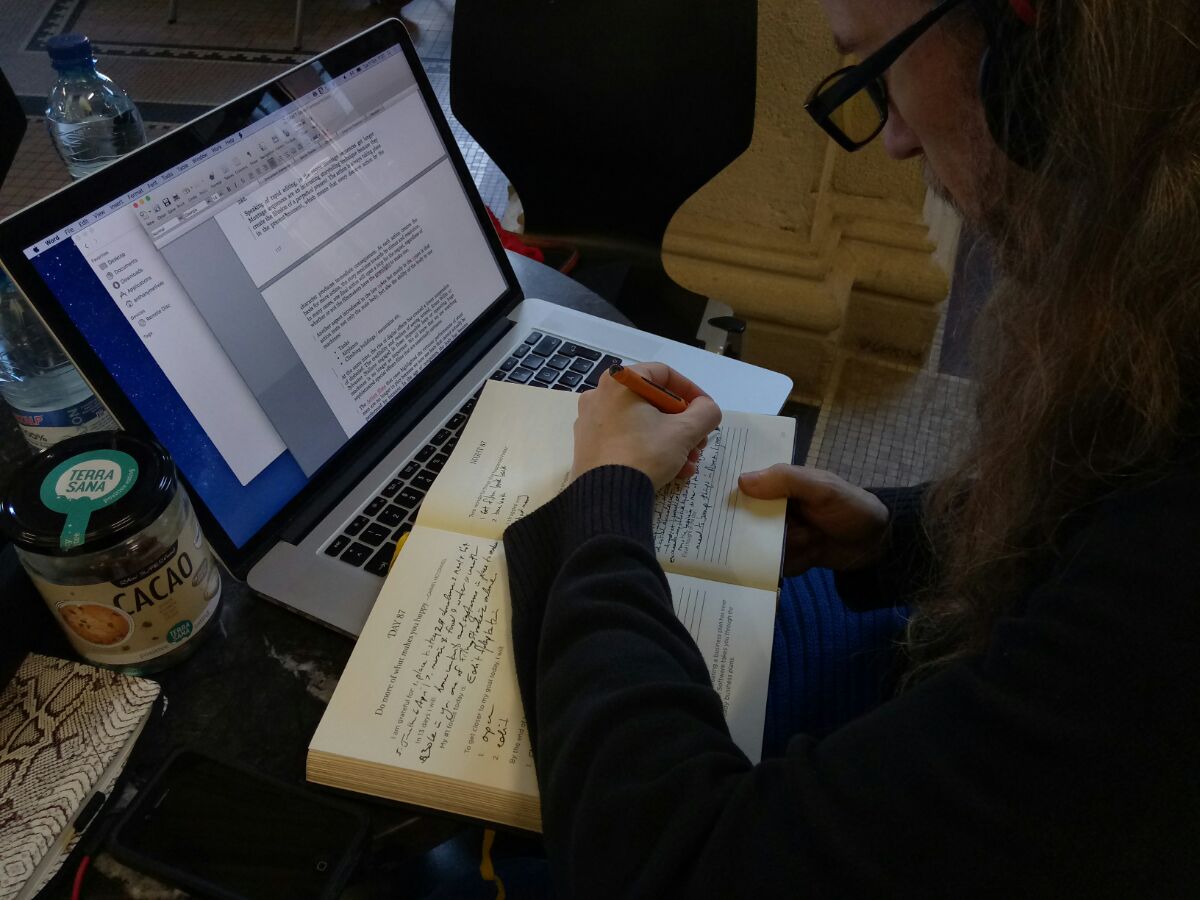
I still use this principle.
A notebook works just as well as a physical folder. But I love using notebooks with a folder at the back to get the best of both worlds.
Whenever something threatens to pull me away from the main task, I record it, tuck the paper into the “not now folder,” and continue studying.
Delaying looking up whatever interesting thing that caught my attention helps me preserve attention and remain firmly with the context of what I’m reading.
Later, I can research the outstanding questions with full attention.
Before a serious study session, I also use a simple preparation ritual:
- Clear away anything I don’t need
- Put the phone away
- Close unnecessary browser tabs
- Prepare my books, cards and writing materials
- Keep somewhere to record “not now” items
Sometimes I call the practice of staying away from my devices “digital fasting.”
The terminology doesn’t matter much.
Protecting your attention does.
Seven: Use Timers And Breaks Without Letting Them Control Your Studying
The Pomodoro Technique works well for many people because it involves focused work periods followed by short breaks.
However, my relationship with timers is more complicated.
See, I prefer getting deeply involved in what I’m studying.
When a timer interrupts me just as I’m settling into the material, I rarely find the interruption helpful.
For that reason, I use Pomodoro-style sessions selectively.
If I’m having trouble starting, a timer can create a useful starting point.
Once I’m focused, however, I often prefer to continue until I reach a natural stopping point.
There is no perfect signal that tells everyone when to stop studying.
That’s one reason I avoid turning any timer system into a law.
Switching activities can also provide a natural break.
You might move from reading to retrieval, from retrieval to writing, or from one subject to another.
My friend and exam study expert William Wadsworth has also spent years thinking about how students can make better use of their study time.
Our conversation goes into those issues in more detail:
Personally, I also prefer to finish serious studying the day before an exam.
By that point, I want the information already encoded and reviewed.
Then I give it some room to percolate rather than trying to cram more information into the final hours.
That’s my preference, not a universal rule.
The larger principle is to develop a study rhythm that gives you enough time to learn before the deadline arrives.
Eight: Use Spaced Repetition, Anki And AI As Support Tools
Technology can help you study. But it cannot perform the act of remembering for you.
Let’s take a moment to focus on this important distinction.
Spaced repetition gives you a structured way to revisit information over time.
Software such as Anki can help schedule those reviews.
AI can generate questions, vary their wording and challenge you from different angles.
None of those tools automatically solves the most important parts of the memory process.
You still have to encode the information.
Then you need to attempt retrieval on a schedule you devise for yourself.
Afterwards, you have to notice mistakes and correct them.
During my recent law school experience, I experimented with AI as a kind of sparring partner.
Instead of asking it to do the thinking for me, I used it to:
- Question me from different angles
- Generate hypotheticals
- Ask me to explain concepts in my own words
- Challenge assumptions
- Identify gaps in an answer
- Increase the difficulty of questions
- Check whether an answer actually addressed the question
I also use AI after doing substantial thinking myself.
For example, I can write a summary based on what I remember and then use my own prompt to “spar” with the AI.
The goal is not to outsource the summary.
Instead, I want another round of questioning that pushes me toward additional research and deeper reflective writing.
The same distinction applies to flashcards.
A program can show you a cue.
It cannot perform recall on your behalf.
Likewise, AI can generate hundreds of questions without making you remember the answers.
That’s why I still value the Memory Palace technique.
When I use a Memory Palace, I have to participate.
I choose locations, decide what matters, create associations, place the information, retrieve it and correct errors.
Technology can support that process.
It should not replace it.
My full video, Give Me 20 Minutes and I’ll Fix How You Use AI and Anki, goes much deeper into this distinction:

The basic lesson is simple:
Don’t let the interface determine your learning process.
Build a reliable process first, then make the technology serve it.
Nine: Build Recall Into A Rhythm You Can Actually Maintain
One problem with study software is that it can make review feel like something that happens whenever a notification appears.
I prefer a more deliberate rhythm.
That means having:
- Regular study periods
- Familiar study locations
- Established recall rituals
- Dedicated periods of self-testing
- A system for returning to information you’ve already encoded
In other words, remembering becomes part of your life.
Software can still remind you.
However, you don’t have to depend entirely on notifications to decide when serious learning happens.
My own memory practice often follows the natural shape of the day.
Morning, noon and night provide obvious opportunities to revisit information.
Do I hit every planned review perfectly?
Of course not.
Consistency does not require perfection.
What matters is establishing a rhythm strong enough that missed sessions don’t destroy the system.
This is also why I don’t recommend trying a serious learning technique once or twice and declaring that it failed.
Memory skills develop through use.
Give yourself enough repetition to learn the technique itself, not just the material you’re applying it to.
How To Create A Study Habit Plan That Supports Memory
A useful study plan doesn’t need to become another complicated project.
Start with the important dates.
List your exams, assignments and other academic commitments.
Then work backwards.
Plan For Understanding, Encoding And Retrieval
For each subject, write down:
- What you need to learn
- What the instructor expects you to demonstrate
- When you’ll first study the material
- When you’ll return for review
- Where you’ll study
- How you’ll test yourself
- Who you’ll ask if something remains unclear
The final point is especially important.
One of my biggest improvements as a student came from becoming more willing to ask professors whether I understood the assignment correctly.
Don’t wait until exam day to discover that you’ve been solving the wrong problem.
Use A Simple Study Loop
You can also organize individual study sessions around a simple loop:
- Input: Read, listen or attend the lecture.
- Notes: Record the most important information.
- Encoding: Use appropriate memory techniques for material you need to retain.
- Retrieval: Put the source away and recall what you can.
- Output: Write or explain what you remember.
- Verification: Check your output against the source.
- Review: Return to the information later.
You don’t need to perform every step in exactly the same way.
Some subjects call for different kinds of practice, something I discuss in greater detail in my tutorial on how to study effectively.
Still, the suggested study loop above helps prevent one of the most common study problems I’ve seen:
Confusing exposure to your study material with actually learning it.
The Best Study Habits Train You For More Than Exams
After years as a student, professor and memory educator, I’ve come to see study habits differently.
They’re not just tricks for getting better grades.
Your performance at university matters partly because you’re developing the ability to learn throughout the rest of your life.
That includes learning how to:
- Understand complicated requirements
- Identify important information quickly
- Remember it accurately
- Test whether you really know it
- Correct yourself when you’re wrong
- Explain what you’ve learned clearly
Students don’t always see how much these habits can influence their future.
Grades matter.
Yet the deeper opportunity is to establish a reliable method for learning and retaining new information accurately.
That’s useful in practically every serious field.
For me, the transformation started with a failed undergraduate exam.
Later, memory techniques helped me enormously throughout graduate school.
Decades after that experience, I found myself applying many of the same principles again in law school.
The tools have changed.
AI didn’t exist when I started.
Anki wasn’t part of my undergraduate study routine either.
But one thing I noticed immediately after going back to school: the underlying responsibility hasn’t changed.
If you want to remember something, eventually you need to attempt to remember it.
No app can perform that part for you.
If you’d like to develop the memory techniques that support this kind of studying, my free course will help you get started:

The course includes video lessons and detiailed exercises that introduce you to practical memory training.
More importantly, you’ll practice the techniques yourself.
That’s ultimately what productive study habits are about.
Learn.
Recall.
Check.
Correct.
Then come back and do it again.

 Anthony Metivier is the founder of the Magnetic Memory Method, a systematic, 21st century approach to memorizing foreign language vocabulary, names, music, poetry and more in ways that are easy, elegant, effective and fun.
Dr. Metivier holds a Ph.D. in Humanities from York University and has been featured in Forbes, Viva Magazine, Fluent in 3 Months, Daily Stoic, Learning How to Learn and he has delivered one of the most popular TEDx Talks on memory improvement.
His most popular books include, The Victorious Mind and…
Anthony Metivier is the founder of the Magnetic Memory Method, a systematic, 21st century approach to memorizing foreign language vocabulary, names, music, poetry and more in ways that are easy, elegant, effective and fun.
Dr. Metivier holds a Ph.D. in Humanities from York University and has been featured in Forbes, Viva Magazine, Fluent in 3 Months, Daily Stoic, Learning How to Learn and he has delivered one of the most popular TEDx Talks on memory improvement.
His most popular books include, The Victorious Mind and…