
Podcast: Download
Subscribe: Apple Podcasts | RSS
 I have an uncle who used to sing the craziest (and often off-color songs).
He was a WWII vet and looked like the Canadian actor Lorne Greene. He would rip out the kinds of songs that sailors sang and I would rush to write down the lyrics so I could learn them.
And learn them I did.
The hard way.
It was irritating and frustrating.
Even though they say the hand builds the mind and it wasn’t the end of the world that I spent so much time writing them down and rewriting them, I was still relying on rote learning.
If only I knew then what I know today about memory techniques!
You see, I now memorize and regularly demonstrate poems I’ve committed to memory almost every month during my live memory training bootcamps.
I’ve memorized everything from ancient Sanskrit poems to some of the most inventive contemporary poetry.
And today I’m going to share a few case studies and key tips I know you’re going to love.
How to Memorize Poetry Fast
The fastest way I know to memorize poetry involves a combination of ancient memory techniques.
These are:
- The Memory Palace Technique
- Alphabetical association
- Numerical association (where relevant)
- Spaced repetition based on solid active recall principles
Now, I know that weaving together so many memory techniques to memorize poetry or even song lyrics, sounds like a lot. But if you want to memorize poems fast, stick with me. Bringing all of these strategies together is much easier than it might seem at first glance.
But first, let me demonstrate that I can actually memorize poetry. I believe proof is important because there are a lot of people out there who talk about skills they cannot do.
In the case of mnemonics, there are even entire forums filled with people giving advice about memory techniques when they clearly haven’t lifted a finger to memorize a poem. That, or they’ve used rote memorization and are only pretending they used mnemonics.
So with those issues in mind, here are a few examples. Please be sure to watch each example because I will refer back to these recitations to help you rapidly memorize poems of your own.
Example One: A Univocalic Poem
In this video, you’ll see me at the Memory Palace Bookshop I’m developing practicing the recitation of a univocalic poem by Christian Bök:
That’s from a fantastic book of poetry called Eunoia.
Example Two: Shakespeare
This video not only shows me reciting lines from Titus Andronicus. It includes a very important teaching point.
That’s because I also demonstrate reciting the lines forward and backward to help teach you how to more easily commit even the most difficult poem to memory using a process I call Recall Rehearsal:
Now, I regularly memorize Shakespeare.
But in the case of the example shared in the video above, I had a special purpose in mind.
I was doing it to reproduce the memory technique Anthony Hopkins describes in his autobiography. Here’s the full case study.
Example Three: Song Lyrics
In this video, you’ll see and hear me singing a famous song called The Moon Represents My Heart in Chinese:
The entire song took just over forty minutes to commit to long-term memory.
Even though it’s been a few years since I sang the whole song, I still remember most of the lyrics to this day. Every once and awhile, I whip it out and it always brings a smile to my wife’s face.
The reason this Chinese poem set to music took a bit longer to memorize other poems I’ve memorized is because it’s in a foreign language that I was only just beginning to study at the time.
Example Four: Poetry Quoted in a Speech
When I wrote my TEDx Talk, I incorporated lines from a Sanskrit piece called the Ribhu Gita.
This was an interesting challenge because it called me to recall the speech and the poetry that had already been memorized.
This particular performance was a lot of fun, but also challenging due to the combination of a live audience, cameras and the fact that the world was starting to go into lockdown at the beginning of Covid.
I had a lot on my mind, but thanks to the memory techniques you’re about to discover, I still think the talk came off fairly well. It’s been seen over four million times now, so I must have done something right.
Example Five: Real-Time Poetry Memorization
If you want to see me memorize in real time, check out this discussion with Guru Viking.
Steve, the host, throws Shakespeare at me and I memorize a few lines and discuss how I did it in real time:
Now let’s get into the steps, many of which come directly from my premium course on memorizing poetry.
Step one: Use the Memory Palace Technique
A Memory Palace is essential for memorizing poetry, or anything verbatim.
What is this technique?
A Memory Palace is a mental recreation of a familiar location.
For example, in the first video example above from the poem Eunoia, I used my mom’s home from where she lived years ago.
I moved from the master bedroom to the kitchen and living room, to a few other bedrooms and finally out the door and down the driveway in front of the house.
How to Memorize a Poem in an Hour (or Less) Using This Technique
Using the method of loci, you place mnemonic images along a mental journey.
As I just mentioned, I started in one room, then moved to the kitchen, the living room, and so forth. On each corner and wall, I placed an association.
For example, for the line, “Awkward grammar appals a craftsman,” I placed an image of Apollinaire in a state of awe changing into being appalled.
Now, what exactly it means to “place” an association along a journey in an imaginary version of a building can feel a bit abstract in the beginning.
But basically, you’re taking a corner, a wall or a piece of furniture and elaborating it with strange, exaggerated ideas and feelings that remind you of each word of the poem or song lyric.
You can do it in any language and if you look at the Guru Viking video above, you’ll see me demonstrate exactly how and why it works in any language. In that particular example, I use the wall behind me for Shakespeare in the same way I memorize Sanskrit phrases when memorizing ancient mantras.
To Speed Up The Process When You’re Just Starting Out, Do This
Learning to use the Memory Palace technique can feel challenging in the beginning.
To reduce the cognitive load, I suggest making a quick sketch of a familiar location that you will turn into a Memory Palace.
You don’t have to be artistic. I don’t try to make fine art of it at all.
To wit, here’s a quick sketch of a bookstore in the Zamalek area of Cairo I have used many times to memorize poetry and other types of information:
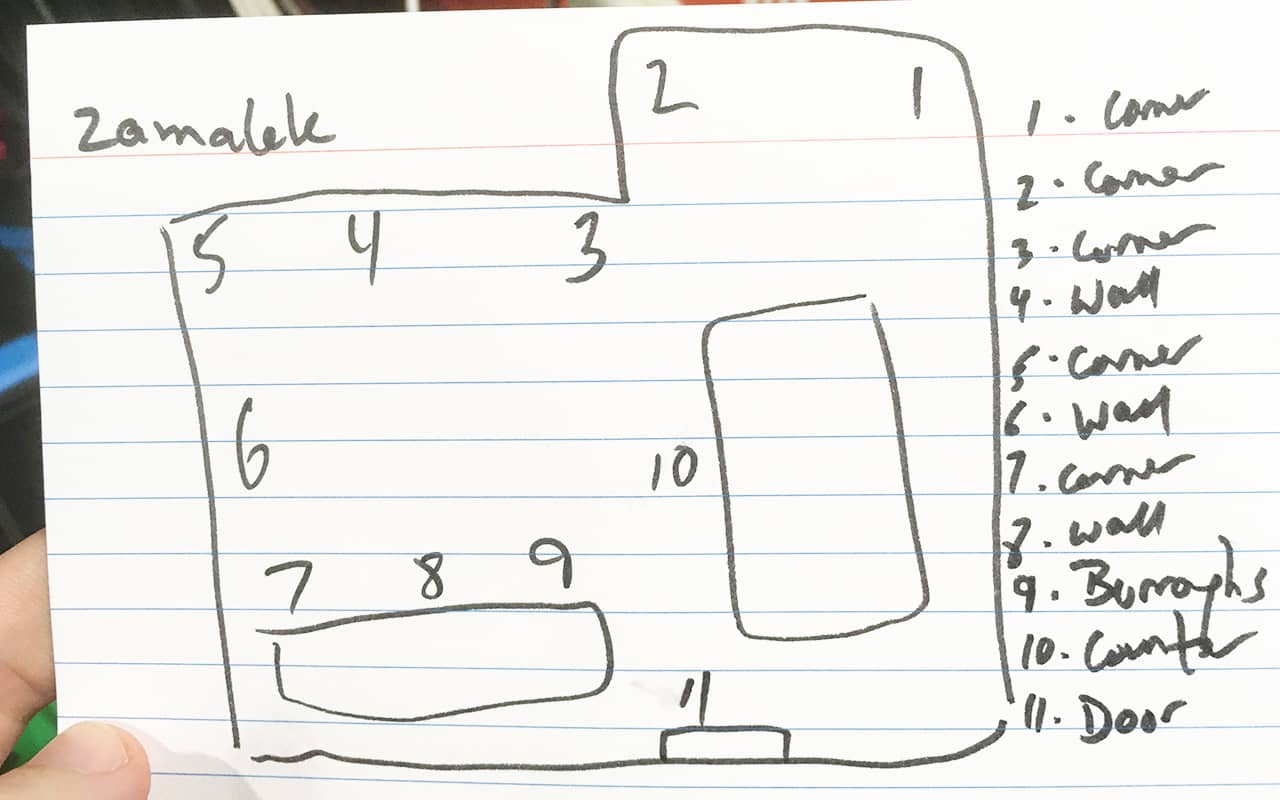
The reason for drawing out the journey is to get it clear in your mind.
That way, you can spend more time on the next step.
But failing to simply draw a Memory Palace in advance can lead to a lot of unnecessary frustration.
That’s because you will ultimately wind up trying to encode the poem while developing the Memory Palace at the same time. To memorize any poem as quickly as possible, you need to separate the two activities.
Step Two: Lay Down Your Associations One Word At A Time (Most Of The Time)
Shakespeare opens King Henry the Fifth like this:
O for a Muse of fire, that would ascend
The brightest heaven of invention,
A kingdom for a stage, princes to act
And monarchs to behold our swelling scene!
When I memorized these lines, I started at station one with an image of the constellation Orion over the Statue of Liberty.
Using the pegword method, I associated Orion with O. Then, using the general concept of a woman that inspires people, I placed the Statue of Liberty in the Memory Palace.
In this case, the Memory Palace was a workplace where I was writing curriculum in Vancouver, B.C., Canada.
You might choose a completely different image for the words “muse of fire.”
But the technical point is that you want to find a direct sound and spelling correspondence that is:
- Based on ideas and images already in your memory
- Makes sense to you
Making sure that the associations you choose are personal is part of what scientists call active recall.
For me personally, Lady Liberty is an especially apt choice not only because she represents inspiration, as the muses. She’s also holding a torch, which helps me encode the word “fire.”
But I also lived in both Manhattan and Brooklyn for awhile and often crossed the Manhattan Bridge. This makes the memory of the Statue of Liberty even stronger for me, and another reason why you need to think about the images that make most sense for you.
How to Associate “Little Words” for Rapid Memorization
What about a word like “that”? Tricky and abstract, right?
Not really. You just need to pick an association that makes sense to you while sounding or seeming as close as possible to the target information as you can get it.
In the case of the Henry the Fifth line, I just took “th” and linked it with Thor and then used rhyming to have him put on a hat in a dramatic way. Thor + hat = that.
When it comes to the Bök poem, there’s a part of the sequence (full poem here) where I used Thor with his hat again:
Awkward grammar appals a craftsman. A Dada bard
as daft as Tzara damns stagnant art and scrawls an
alpha (a slapdash arc and a backward zag) that mars
all stanzas and jams all ballads (what a scandal).
For a small word like “all,” I used the Punk Rock band All, but only in part. Drawing upon the mnemonic teaching of people like Peter of Ravenna, Jacobus Publicius and Giordano Bruno, I used the principle of reduction. Rather than imagine the entire band, or even an entire mascot, I just imagined the eyes of the mascot.
To memorize at speed, I suggest you practice this principle of reduction. Also develop what I call the Magnetic SRS in my full poetry course in the Magnetic Memory Method Masterclass. By taking an hour or so to assign association to all the pronouns and other “operator” words like “that,” you won’t have to stop and come up with associations ever again.
The Magnetic SRS training in my full program goes into further detail. It will help you develop dozens of images for words that seem like they’ll be tricky or repetitive. Done well, they can be used repeatedly, but never cause confusion.
Step Three: Memorize Multiple Words When You Can
Memorizing more than one word in a poem at a time is called mnemonic compression.
This term can mean more than one thing. But in this case, I’ve technically just given you a description of how compression works with the Statue of Liberty example. After Orion for O, she represents five words: “for a Muse of fire.”
In this case, it works because I’m familiar with the workings of English grammar.
But you can’t always get away with this kind of compression, especially when memorizing poetry in another language.
It’s just best to keep an eye out for compression opportunities as much you can.
When I memorized my TEDx talk using these techniques for speech memorization, thanks to compression, I loaded one station in my Memory Palace with up to 17 words using just 3-5 images (depending on how you count them).
Keep in mind that you don’t have to start with poems with long passages like the ones I included in my TEDx Talk.
A lot of people like to start with short Bible verses. I’ve put together a list of Bible verses to memorize that address the theme of memory if you’d like to select a few for practice.
Step Four: Use Intelligent, Creative Repetition
As I mentioned above, rote learning is a real problem.
What you want instead is something called spaced repetition. It provides a simple means of reviewing memorized material on a schedule that keeps it in memory.
Different poems and lyrics will require different amounts of repetition, and it’s not easy to predict in advance how much content will require how much repetition.
However, there’s something called context-dependent memory. Basically, it gives you a boost when you use a lot of content frequently. Or read continually within particular categories of information.
So if you read literature and quote it often, you’ll probably need less repetition than someone who doesn’t.
And if you memorize the sonnet form more than free verse, you’ll likely develop a stronger and faster reliability because you’ve internalized its rules.
Creative Repetition for Long-Term Maintenance
For most of us, poems will fade over time no matter what we do.
Fortunately, there are creative repetition strategies that can help make sure you maintain them.
One is to follow in the footsteps of geniuses.
For example, Anthony Hopkins keep common place books where they store and regularly revisit favorite poems. People like Thomas Jefferson used this strategy too.
Another strategy is to use reflective thinking to compare various poems you’ve memorized. You can do this from poem to poem or between poems and your favorite philosophy books, historical events, etc.
Finally, look for opportunities to recite the poems.
Even if you just quote isolated lines, this smaller recitation will help keep the full poem within your mental reach.
3 Alternative Ways To Memorize Poetry
You might be wondering if it’s possible to memorize poetry without using the Memory Palace technique.
Indeed, there are. Here are some options.
Rote Repetition
Although I personally don’t like how rote learning feels, it is an option you can explore.
It’s a slower option for most of us. But one simple way to get more mileage out of sheer repetition is to choose the time of day and location where you practice it strategically. You’ll need a lot of focus and concentration on top of sheer will power to keep repeating the same lines without the fun of mnemonics, so make sure you aren’t interrupted.
I’d also suggest focusing on shorter poems for use with rote. That way you can memorize more poems in their entirety and enjoy substantial accomplishments more often.
Cloze Methods
A cloze test involves showing yourself parts of a poem. As you read through the poem, you try and fill in the blanks. This activity can trigger some of the positive benefits of active recall.
Here’s an example of how you would apply the cloze test methodology to help yourself remember The Tyger by William Blake:
Tyger Tyger, burning _____,
In the _____ of the night;
What immortal ____ or ____,
Could _____ thy ______ ______?
Visual Flashcards
Finally, if you’re willing to make simple drawings, you can draw on flashcards.
This approach is kind of like a visual cloze test. Instead of hiding the word “bright” in the phrase “burning bright,” you would sketch an image that helps trigger the phrase.
I’ve done this a fair amount with memorizing the books of the Bible. It’s a fast and easy way to help the mind make connections without having to use a Memory Palace.
That said, drawing can take a lot of time. I would save this approach for when you feel like an experimental learning experience.
How to Practice Reciting Poetry from Memory
There are three key ways that I practice reciting poetry, not only to ensure that they’re locked in long-term memory.
The point is also to get the lines as fluid as possible and bring out various parts you want to emphasize.
After all, it’s not fun to sound robotic. The point of poetry is to convey meaning and beauty, humor or to stimulate some kind of emotion.
One: Write the Poetry from Memory
Another aspect of proper active recall practice is to call the information to mind by revisiting your associations in your Memory Palace, then write the words down.
When writing out what you’ve committed to memory, don’t worry about mistakes. If you catch yourself making a mistake, just scratch it out.
Then, once you’ve written as many lines as you can recall, test them against where the verse is written in a book or online.
Here’s an example of a test from another part of Eunoia I recently memorized:

At this point, I hadn’t memorized the entire poem and had to start a new journal. But the important point is to test in this exact manner so that you don’t fall into rote repetition.
Two: Recite Verbally
As demonstrated in several of the video examples above, I practice recalling the poetry verses from memory out loud.
This step is important because it gets the poetry into the muscle memory of the mouth.
And this is the best way to practice adding gravitas to your performance.
I suggest that you also recite the poetry out of order as you see in the Anthony Hopkins video above.
This will give each line primacy and recency using the serial positioning effect, as was codified by Hermann Ebbinghaus.
During the learning process, it can also be helpful to make up a little tune to go with the poetry.
Even if you don’t sing it later, there’s something to chanting and singsonging that aids memory. This is something Bruno notes in his memory guide, Cantus Circaeus (Song of Circe), available in this English translation.
Three: Recite Mentally
It’s also valuable to practice reciting what you’ve memorized purely in your mind.
You can do this solely by reciting the lines while moving through your Memory Palaces.
Or you can do it without thinking of the Memory Palace journey, which is a point you should practice as soon as possible.
If you are going to perform the poem live, it’s also helpful to imagine yourself delivering it live on camera or in front of an audience.
I’ve done all of these things and it has really helped make sure my performance is fluid. But it also creates that priceless feeling of preparation.
Your audience will appreciate your delivery much more as well.
Make Memorizing Poetry Part of Your Daily Life
Finally, I’d like to discuss how to make poetry memorization a daily activity.
We’re all different, but I personally prefer to encode new poems during the morning.
This is simply because my energy is highest. Then I practice reciting in the evening.
You might find that you prefer the opposite pattern.
The key is to experiment, all based on having developed your mnemonic tools.
That’s ultimately the key. To get fast with memorizing poetry, you need to have your mnemonics prepped in advance.
If you’d like more help on how the Memory Palace technique and related mnemonic strategies will help you memorize poems of any length, please consider signing up for my FREE Memory Improvement Course:

It will take you through developing Memory Palaces for memorizing any poem at speed.
Those poems can be as short as a simple song or as long as the Bible (which as I discuss in this tutorial, is possible to memorize).
Or you can memorize songs from your weird uncle like I often did… even if I can’t always repeat them in polite company.
Frankly, I wish I’d known these techniques back when I was young. Not only because I’d remember more of the words to the songs he sang.
I’d remember more about him too.
And that’s ultimately the greatest thing about memorizing poetry.
We’re memorizing the ideas, feelings and images that impacted others, literally integrating ourselves with the stuff of life through memory.





4 Responses
Hello Anthony,
I am currenty working my way through your language vocab learning course. It is going well. When I finish I will enrole in your poetry memorizing course.
I very much appreciate what you are doing. Thanks.
Lionel
Thanks for letting me know that you’re progressing through the vocabulary course, Lionel. That’s fantastic. Please let me know if you have any questions as you go along. I look forward to seeing you inside How to Learn and Memorize Poetry once you’ve enrolled. 🙂
What is the difference between your book- How to memorize poetry – and this course. In your book exists Telesynoptic technique ?
Great question, Mihai.
The differences are enormous, ranging from personalized instruction to a copy of the book itself included with the training.
Please not that I will eventually create a second edition of this book and possibly remove the Telesynoptic Memory Palace technique. It is perhaps too advanced for beginners that haven’t covered the basics and may be leading to more activity than accomplishment. Master the basics first and memorize at least one poem and reproducing that outcome 5-10 times before moving on to more advanced concepts. One needs to be equipped with the basics to extract value from intermediate and advanced approaches. Yes, you can begin anywhere when it comes to understanding, but mastery always begins with covering the fundamentals.
Thanks for the question and look forward to hearing from you again soon.