
 Interleaving is a learning technique that can help you remember more and solve problems better.
But there’s a catch.
Interleaving often makes practice feel harder.
That’s one reason learners tend to prefer blocked practice, even when interleaving produces better results on a later test.
I’ve been using different forms of interleaved practice for decades while studying, using memory techniques, learning languages and practicing music.
Over the years, I’ve come to appreciate the difficulty.
However, there’s an important distinction to make before you try interleaving for yourself.
Researchers generally use the term to describe mixing related skills, problem types or categories during practice. Simply bouncing randomly between unrelated activities is something different.
Once you understand that distinction, interleaving becomes much easier to use strategically.
Ready to discover how the interleaving study method works and how I combine it with memory techniques?
Let’s dive in!

What Is Interleaving?
Interleaving is a practice schedule that mixes different types of related material instead of completing one type before moving to the next.
Suppose you’re learning three kinds of problems: A, B and C.
Blocked practice might look like this:
AAA → BBB → CCC
Interleaved practice could look like this:
ABC → BCA → CAB
That difference is small on paper.
In practice, it can completely change what your memory has to do.
With blocked practice, you already know what kind of problem you’re solving because you’ve just completed several similar examples.
During interleaved practice, you have to determine which concept, strategy or procedure applies.
That extra decision can make studying more challenging.
It can also make the learning more useful.
Musicians provide a simple example. Instead of playing the same scale over and over, you might mix scales, chords and arpeggios during deliberate practice.
Likewise, a math student can mix several kinds of equations. A science student can alternate between related categories that are easy to confuse.
Researchers Robert and Elizabeth Bjork have described learning conditions that make practice harder while improving later retention as “desirable difficulties.”
Interleaving can create this kind of difficulty.
The important word is desirable.
Making your studies confusing for the sake of difficulty isn’t the goal. The challenge needs to make you retrieve, compare and discriminate between things you genuinely want to learn.
That’s why interleaving works particularly well alongside proven spaced repetition and retrieval practices.
Interleaved Practice vs. Blocked Practice
Blocked practice gives each topic or problem type its own uninterrupted period.
For example, you might solve ten examples of one equation before moving to ten examples of another.
This approach has an obvious advantage:
It can make initial practice easier.
Interleaving removes some of those cues.
Now you have to look at the problem and ask yourself:
- What kind of problem is this?
- Which method applies?
- What information do I need to retrieve?
Those questions matter because remembering involves more than recognizing something you’ve just seen.
You eventually need to retrieve the right information when the answer isn’t sitting directly in front of you.

I experience the same distinction in my own memory practice.
Sometimes I need a period of concentrated repetition to establish a skill.
At other times, mixing several related challenges forces me to retrieve the right response without relying on the momentum created by repetition.
That’s why I don’t treat blocking and interleaving as enemies.
Both can have a place in learning.
The skill lies in knowing when to move from concentrated practice into a more demanding mixture.
What Does the Research on Interleaving Say?
Interleaving has been studied in mathematics, science, category learning, language learning and other fields.
The results are promising.
They also contain some important limits.
For example, Joshua Samani and Steven Pan studied interleaved practice in undergraduate physics.
Over eight weeks, 350 students completed homework using both blocked and interleaved arrangements.
Here’s where things get interesting.
Students performed better while completing the blocked homework.
Yet when researchers later surprised them with harder tests, the students performed better on material they had practiced through interleaving.
The researchers also found improvements in recalling relevant information and producing correct solutions.
In other words, ease during practice did not necessarily predict later learning.
That’s a tremendously important lesson for anyone interested in remembering what you study.
What feels fluent today might not be what you can retrieve next week.
Similarity Seems to Matter
A major meta-analysis examined 59 studies of interleaved learning.
The researchers found an overall benefit, but the size and direction of the effect depended on the material.
Interleaving also produced positive results for mathematical tasks, although the effect was smaller.
For some other materials, the results were mixed.
That’s a useful warning.
You shouldn’t assume that everything becomes easier to learn merely because you interleave it.
Category Learning Shows Why Interleaving Can Help
One particularly interesting area involves visual categories.
Researchers studying rock classification found that interleaving helped people learn to distinguish categories of rocks.
This finding helps explain one of the practical strengths of the method.
When similar ideas appear next to each other, you get opportunities to notice the differences that matter.
Another line of research has found that an interleaved sequence can direct attention toward features that discriminate between related categories.
That’s useful when concepts are easy to confuse.
Think about:
- Similar mathematical formulas
- Closely related scientific concepts
- Grammar patterns in language learning
- Historical events with overlapping people and dates
- Technical terms that share similar characteristics
Those are situations where selecting the right answer matters just as much as remembering information.
Interleaving Does Not Mean Randomly Switching Between Subjects
This distinction is worth emphasizing because it’s easy to misunderstand interleaving.
Imagine that you’re studying anatomy and Indonesian vocabulary.
Alternating between the two subjects certainly creates variety. It also spaces repetitions apart.
However, a series of four experiments specifically tested this kind of mixing.
Mixing anatomy terms with Indonesian vocabulary did not reliably improve long-term learning compared with keeping the topics separate.
That finding doesn’t mean you should never change subjects during a study session.
I do it all the time.
Sometimes switching between books, writing, language learning and music gives me a useful change of pace.
But I distinguish that personal study routine from interleaving as researchers generally test it.
For learning purposes, the strongest use of interleaving often involves items that share enough similarity to force meaningful comparison.
That’s where the technique becomes much more interesting for memory.
Why Interleaving Can Improve Memory
Scientists have proposed several reasons interleaving can help.
No single explanation covers every study.
However, three ideas are particularly useful when you’re interested in successful learning outcomes.
One: Interleaving Encourages Retrieval
When you solve the same type of problem repeatedly, the previous example often tells you what to do next.
Mix the problems and that cue disappears.
Now your memory has to help you identify the appropriate strategy.
This is one reason I like combining interleaving with memory strategies based on active recall.
Retrieval gives you information about what you actually know.
Rereading mainly tells you what looks familiar.
Those aren’t the same thing.
Two: Interleaving Creates Useful Comparisons
Closely related ideas are often difficult to learn because they share many characteristics.
Placing them in proximity gives you repeated chances to compare them.
The contrast helps reveal which features distinguish one category, formula or concept from another.
This process is sometimes discussed in terms of discrimination learning.
Researchers have found that interleaved study can direct attention toward the characteristics that separate categories.
For students, that means the challenge becomes:
Which answer belongs here, and why?
That’s much more useful than merely remembering that you’ve seen the answer before.
Three: Interleaving Naturally Introduces Spacing
Suppose you practise problem A, then B and C before returning to A.
You’ve created a delay between repetitions of A.
That delay means you have to retrieve more of the previous information instead of simply carrying it forward in working memory.
Of course, spacing and interleaving aren’t identical techniques.
You can space learning without interleaving, and you can interleave material within a relatively short period.
Used intelligently, however, they complement each other very well.
How to Use the Interleaving Study Method
You don’t need an elaborate system.
In fact, too much complexity defeats the purpose.
Here’s the process I recommend.
One: Choose Related Material
Start with two to four skills, categories or problem types that belong to the same general learning project.
For example:
- Three kinds of algebra problems
- Several related grammar structures
- Different categories of historical dates
- Closely related scientific concepts
- A set of scales, chords and arpeggios
The relationship matters.
If the material is so different that there’s nothing meaningful to compare, switching may give you variety without providing the main advantages associated with interleaving.
Two: Establish the Basics First
Sometimes a little blocking makes sense at the beginning.
If you don’t understand the basic procedure at all, mixing several procedures immediately can introduce confusion.
Learn enough to recognize the basic components.
Then start mixing them.
I’ve used this approach throughout my own studies.
For example, when working with my textbook memorization process, I first make sure I understand what kind of information I’m dealing with.
Only then does it make sense to challenge myself with retrieval and comparison.
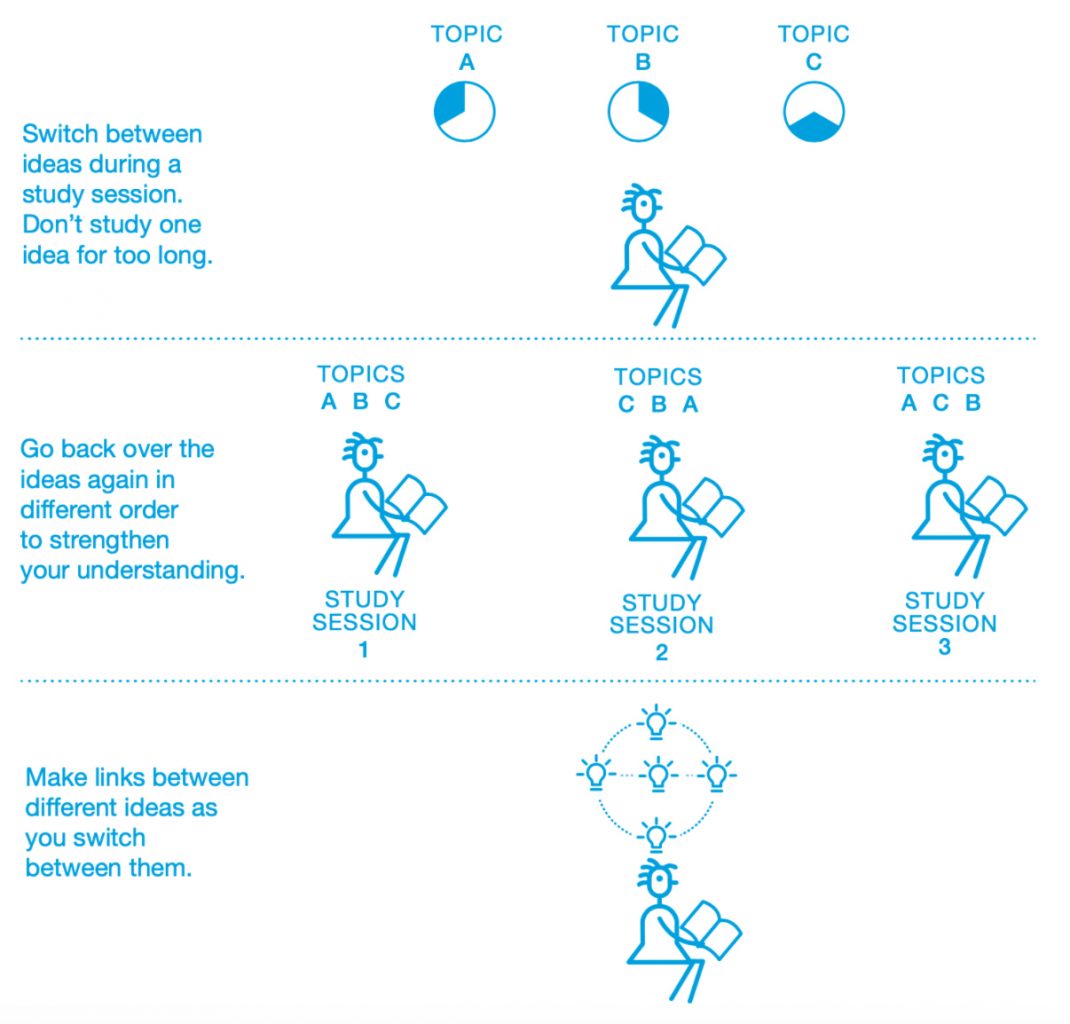
Three: Mix the Practice Order
Once you understand the basics, avoid completing every example of one kind before moving on.
Suppose you have problems A, B and C.
Instead of:
AAA BBB CCC
Try something closer to:
ABC BAC CBA
The exact sequence isn’t sacred.
Your goal is to prevent the order from giving away which method you’re supposed to use.
Four: Retrieve Before You Check
Interleaving becomes much more powerful when you actually test your memory.
Before checking a formula, definition or procedure, try to bring it back yourself.
Answer first.
Then check.
When your retrieval fails, correct the error immediately and revisit the material later.
This is where tools such as well-designed flashcards can support the process.
The cards themselves aren’t magic.
What matters is the retrieval they require.
Five: Pay Attention to Confusion
Confusion can contain valuable information.
If you repeatedly mix up two concepts, ask why.
Which features do they share?
What distinguishes them?
Can you explain the difference without looking?
This kind of comparison also prevents a common misuse of chunking as a memory strategy.
Chunking doesn’t mean vaguely grouping everything together.
Useful chunks depend on meaningful structure.
Interleaving can help expose that structure because you repeatedly have to distinguish one item from another.
Six: Return After a Delay
Don’t judge the success of interleaving solely by how you feel during practice.
Remember the physics students.
Blocked practice was easier while they were doing the homework.
Interleaving showed its strength later.
Build delayed self-tests into your learning schedule.
A technique that feels harder today may reveal its value when you can still retrieve the information tomorrow, next week or later.
How I Combine Interleaving With Memory Techniques
Interleaving becomes particularly useful for me when I combine it with mnemonic practice.
That’s because good memory training already asks you to do much more than reread information.
You encode.
You retrieve.
You discriminate.
You revisit material after delays.
Most importantly, you learn to produce an answer without depending on the original source.

The Memory Palace technique is particularly useful here.
Suppose I’m learning several related sets of information.
I can encode them in different Memory Palaces and then interleave my retrieval.
For example:
- Retrieve material from Memory Palace A
- Move to related material in Memory Palace B
- Test material from Memory Palace C
- Return to Memory Palace A without checking the source
The Memory Palaces provide structure.
Interleaving changes the retrieval order.
That combination can make it harder to depend on simple repetition.
It also gives you a practical way to test whether the information is genuinely available from memory.
I’ve used variations of this approach across many learning projects.
Sometimes I block a particular skill because concentrated attention is exactly what the project needs.
At other times, I deliberately move between related challenges.
Experience has taught me to care less about whether practice feels smooth and more about whether I can retrieve the information later.
That’s the outcome that matters.
When Should You Use Blocked Practice Instead?
Interleaving doesn’t need to replace everything.
Blocked practice can still be useful while you’re becoming familiar with a completely new procedure.
It can also make sense when you need uninterrupted concentration on a complex task.
When I’m writing a chapter, for example, stopping every few minutes to practise music would be ridiculous.
Likewise, some learning materials simply don’t show a strong interleaving advantage.
The research itself tells us this.
That’s why I treat interleaving as one tool among several rather than turning it into a universal rule.
A practical progression often looks like this:
- Understand a new concept
- Practise it enough to establish the basics
- Mix it with related concepts
- Retrieve without looking
- Return after a delay
- Correct your errors
This approach keeps the focus where it belongs:
On successful learning.
Interleaving Works Best as Part of a Complete Memory Strategy
The most important lesson I’ve learned after decades of studying memory is simple:
No single technique does everything.
Interleaving can make practice more demanding.
Spacing can separate retrieval attempts.
Mnemonic encoding can make abstract information more memorable.
A Memory Palace can give information an organized structure for recall.
Self-testing reveals what you can actually retrieve.
Together, these tools give you far more control over learning than passive review ever could.
That’s why I consider interleaving one useful component in a larger system of memory techniques for learning and recall.
If you’d like help putting those techniques into practice, get my FREE Memory Improvement Kit:

The training will show you how I approach memory improvement strategically so you can apply the techniques to information you genuinely want to learn.
Then experiment with interleaving for yourself.
Choose a few related skills or concepts.
Mix the order.
Retrieve before checking.
Come back later and test yourself again.
If the practice feels slightly harder than blocking, don’t automatically assume something has gone wrong.
The real question is much more useful:
Can you remember and use the information when you need it?
That’s what successful learning is ultimately about.

 Anthony Metivier is the founder of the Magnetic Memory Method, a systematic, 21st century approach to memorizing foreign language vocabulary, names, music, poetry and more in ways that are easy, elegant, effective and fun.
Dr. Metivier holds a Ph.D. in Humanities from York University and has been featured in Forbes, Viva Magazine, Fluent in 3 Months, Daily Stoic, Learning How to Learn and he has delivered one of the most popular TEDx Talks on memory improvement.
His most popular books include, The Victorious Mind and…
Anthony Metivier is the founder of the Magnetic Memory Method, a systematic, 21st century approach to memorizing foreign language vocabulary, names, music, poetry and more in ways that are easy, elegant, effective and fun.
Dr. Metivier holds a Ph.D. in Humanities from York University and has been featured in Forbes, Viva Magazine, Fluent in 3 Months, Daily Stoic, Learning How to Learn and he has delivered one of the most popular TEDx Talks on memory improvement.
His most popular books include, The Victorious Mind and…