
 If you want memory strategies that actually help you remember information, it helps to understand one thing first:
Memory works better when you give it something specific to do.
I’ve used the strategies on this page to memorize speeches, study books, learn foreign language vocabulary, remember names and work through my long-term study of the Art of Memory.
They’re not isolated tricks. They work together as a process for taking information from something you’ve merely encountered to something you can actually recall.
If you’re working on improving your memory, these are the nine strategies I suggest learning first.
Here’s what this post will cover:
1. Pay Attention to What You Want to Remember
2. Organize and Chunk the Information
3. Associate New Information With What You Already Know
5. Place Information in a Memory Palace
8. Elaborate Through Comparison, Explanation and Questions
9. Test Yourself and Correct Retrieval Failures

9 Memory Strategies for Better Learning and Recall
1. Pay Attention to What You Want to Remember
Before using any memory technique, identify exactly what you want to remember.
This sounds obvious, I know.
But I’ve seen how easy it is to read a book, attend a lecture or work through study material without ever making a clear decision about what should actually enter memory.
One way I deal with this problem is by working with long-term learning projects. For years, I’ve had an elaborate project involving the Art of Memory.  When you know what you’re studying and why, you can better notice which names matter and which ideas deserve further investigation.
I can notice which names matter.
Which ideas deserve further investigation.
In sum:
Attention becomes much easier when memory has a target.
Exercise: Choose the information first
Pick something you genuinely need to remember. Then identify the exact information you want to be able to recall later. Don’t start memorizing until you can answer that question.
2. Organize and Chunk the Information
Once you’ve chosen the material, give it structure. I sometimes describe this as becoming a “self-organizing structurer.” Think about a library.  A useful library doesn’t just contain thousands of books.
The information is organized so you can find your way around. You want to do something similar before asking your memory to deal with complicated material.
When I’m reading, I often use index cards because they let me separate information into moveable units.
Rather than copying everything from a book into one long set of notes, I can move the cards around, group related ideas and decide which information deserves to be memorized.
I call this flexibility an “index flex.” It’s one of the approaches I discuss in my guide on how to memorize a textbook.
Then comes chunking.
Instead of trying to deal with one enormous mass of information, divide it into useful groups.
For example: 9872380341 is harder to work with than: 987-238-0341.
The information hasn’t changed. But by using chunking, you create a structure that’s easier to remember.
- Chunking is widely applicable too. You can:
- Chunk a speech into sections.
- A chapter into concepts.
- A foreign language phrase into smaller units.
- A list into meaningful groups.
The key is to not ask your memory to handle a pile of information when you can give it an organized structure.
Exercise: Organize and chunk
Take the material you chose in the first step.
Separate it into meaningful categories or sections.
Then break those sections into units small enough to work with individually.
3. Associate New Information With What You Already Know
Now start making connections.
When you encounter new information, ask:
What does this remind me of?
If I think about Frances Yates, for example, I don’t encounter her name in isolation.
I remember the first time I read The Art of Memory.
Then other books about memory come to mind.
So do people, locations and experiences associated with my study of the subject. Those existing memories give new information somewhere to connect.  You can use this process deliberately yourself.
If you’re memorizing someone’s name, ask whether it reminds you of another person with that name.
If you’re learning vocabulary, listen for familiar sounds.
Or if you’re studying a concept, ask what you’ve encountered before that resembles it.
The connection doesn’t have to be profound. It just needs to give you something useful to work with.
This is one reason I don’t recommend treating information as a collection of isolated facts. The more relationships you create, the more ways you have to approach what you’re trying to remember.
Exercise: Find an existing connection
Take five pieces of information you want to remember. For each one, ask: What does this already remind me of? Write down the first useful connection that occurs to you.
4. Use Mnemonic Encoding
Association becomes much more powerful when you deliberately turn information into something memorable.
That’s where mnemonic strategies come in.
I’ve used mnemonic encoding for names, languages, books, playing cards, speeches and many other kinds of information.
Often, the raw information itself isn’t particularly memorable.
For example, names are often abstract. Numbers lack obvious meanings in many contexts. Foreign language vocabulary might initially sound like noise.
Mnemonic encoding gives you something concrete to remember instead. Depending on what you’re learning, you might use:
- A striking mental image
- A familiar person
- A sound association
- An action
- An object
- A more advanced mnemonic system
For numbers and cards, for example, you might eventually use systems such as the PAO System or Dominic System.
But the basic principle comes first.
Turn difficult-to-remember information into associations your memory can actually work with.
Don’t waste time waiting for the most clever image anyone has ever imagined.
Use an association. Test it. If it works, keep going. You can explore many more approaches in my complete guide to mnemonic devices.
Exercise: Encode five items
Choose five things you want to remember.
Create a specific mnemonic association for each one. Make the associations clear enough that you know exactly which piece of information each one represents.
5. Place Information in a Memory Palace
Now you need somewhere to put those associations.
That’s where the Memory Palace technique becomes incredibly useful.
A Memory Palace gives your mnemonic associations an ordered spatial structure.
Instead of creating a series of images and hoping you remember their sequence, you connect them with locations you already know.
For example:
- A doorway
- A hallway
- A chair
- A table
- A staircase
The specific locations aren’t important. What matters is that you know them well and can mentally move through them in a predictable order.
I’ve used this approach many times, including when memorizing my TEDx Talk.
A few years back, I walked out on the TEDx stage and delivered a talk that lasted 13 minutes and 22 seconds.

The sentences and quotations flowed without my having to mentally search for every word.
Then something happened I hadn’t expected. People laughed.
That reaction briefly interrupted the flow I had anticipated.
Thankfully, I had structure to fall back on. I could return to the sequence I’d memorized and continue.
That’s one of the practical reasons I value Memory Palaces so much.
You aren’t just trying to “remember harder.”
You’re giving the information locations that help you know where you are.
I’ve relied on the same basic approach while memorizing speeches and other substantial bodies of information.
And when I’ve walked into rooms and remembered people’s names, I’ve been grateful for having specific memory techniques available rather than hoping recall would simply happen.
Exercise: Build a small Memory Palace
Choose a familiar place.
Identify five to ten locations in a clear order.
Then place the mnemonic associations you created in the previous step along those locations.
Keep your first Memory Palace simple enough that you can mentally travel through it without confusion.
6. Practice Active Recall
Putting information into memory isn’t enough. You also need to practice getting it back.
That’s the purpose of active recall.
Instead of continually looking at the material, remove the answer and try to produce it yourself.
- Close the book.
- Turn over the index card.
- Hide the vocabulary list.
- Walk through the Memory Palace without checking your notes.
Then write out what you can remember from memory.
This is important because recognition can create the impression that you know something. You look at a word and think: Of course I know that. But can you produce it when the answer isn’t sitting in front of you? That’s the question. When I was preparing a speech, it wasn’t enough to recognize each sentence when I read the script. I needed to produce the material without the script. The same distinction applies to names, vocabulary, facts and anything else you want available on demand.
Exercise: Recall before checking
Go through the material you’ve encoded without looking at the answers. Try to retrieve each item. Only check your notes after making a genuine attempt.
7. Space Your Reviews
One recall session isn’t necessarily enough. Yet far too many people never even practice recalling what they want to remember once.
That’s why you need to come back to the material.
When I was preparing my TEDx Talk, for example, scheduling regular reviews mattered because trying to memorize it in one go does not work.
How often?
First, understand that you don’t have to turn the process into an elaborate mathematical system.
The important distinction is between: repeatedly looking at the information and returning later and trying to retrieve it again.
That’s the basic principle behind spaced repetition.
You can also combine spaced review with mind mapping.
For example, you might create a mind map of a topic and return to it during later study sessions.
One Magnetic Memory Method student, Ke Ko, combined ideas from Memory Palaces and mind mapping in this example:
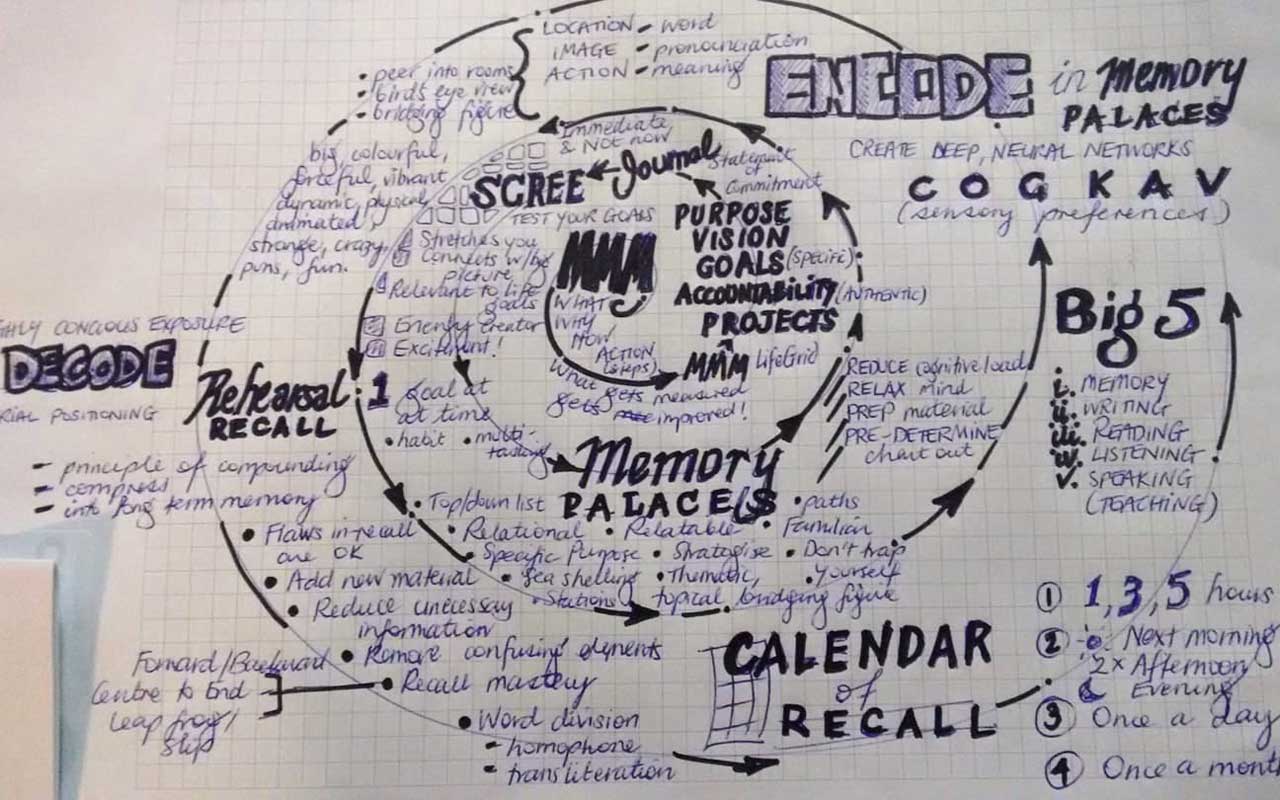
The map provides an overview. Retrieval practice tells you whether you can reproduce the information without relying on the overview.
Exercise: Schedule the next retrieval
Before finishing your current study session, decide when you’ll test yourself on the material again. When that time arrives, attempt recall before reviewing the source.
8. Elaborate Through Comparison, Explanation and Questions
Once you can recall basic information, do more with it. Compare it. Contrast it. Explain it. Ask questions. Suppose you’re learning two related theories.
Don’t merely memorize their names and definitions. Ask:
- How are they similar?
- Where do they differ?
- What example demonstrates each one?
- How would I explain the difference without looking at my notes?
- What don’t I understand yet?
- Who else has addressed this topic?
I use this kind of thinking constantly when working through books and ideas I read.
One author leads to another and one historical claim can be compared against another account.
The more deeply you work with information, the more relationships you can establish around it. And the act of explaining an idea can expose gaps that simple rereading hides.
Exercise: Explain one idea without notes
Choose one concept you’re studying. Without looking anything up:
- Explain it in your own words
- Compare it with something related
- Identify one important difference
- Give an example
- Write down one question you still have
Then check your source material and see what you missed.
9. Test Yourself and Correct Retrieval Failures
This last strategy ties everything together.
When recall fails, don’t treat the failure as the end of the process.
Use it as information. Suppose you walk through your Memory Palace and station number four is blank.
That’s useful feedback, not a mistake. And it’s an opportunity to go back and inspect what happened.
You can ask:
- Was the original association unclear?
- Did you put too much information in one location?
- Did two images become confused?
- Did you fail to understand the information before trying to encode it?
- Do you simply need another retrieval session?
This is why self-testing matters. It helps you locate the weak link.
When I’m working with index cards, I can separate material I recall easily from material that repeatedly causes trouble.
Or, when using a Memory Palace, I can identify which stations need stronger associations.
When I’m studying a book, testing myself helps reveal whether I understood the author’s point or merely recognized the passage while reading it.
That feedback lets you correct the strategy instead of blindly repeating the same thing.
My guide to memory recall and retrieval goes deeper into what happens when you’re trying to bring information back.
Exercise: Diagnose one retrieval failure
Test yourself on the material you’ve been learning. When you miss something, don’t immediately move on. Ask why. Then make one specific correction:
- Clarify the information
- Improve the mnemonic association
- Change the chunk
- Move it to a clearer Memory Palace station
- Create another connection
- Schedule another retrieval attempt
Then test it again.
How These Memory Strategies Work Together
You don’t need nine unrelated tricks.
You need a process:
- Start by deciding what you want to remember.
- Organize and chunk it.
- Connect it with what you already know.
- Encode it using mnemonic associations.
- When useful, place those associations in a Memory Palace.
- Then retrieve the information.
Then come back and retrieve it again later.
Explain it, compare it and ask questions about it.
When recall fails, find out why and correct the problem.
That’s the same general approach I’ve used across speeches, books, languages, names and my long-term study of memory techniques.
You can explore additional exercises in my guide to memory training techniques.
Or, if you want the broader picture, see my complete guide on how to improve memory.
And if you want to learn the Magnetic Memory Method step-by-step, sign up for my free memory improvement course here: 

 Anthony Metivier is the founder of the Magnetic Memory Method, a systematic, 21st century approach to memorizing foreign language vocabulary, names, music, poetry and more in ways that are easy, elegant, effective and fun.
Dr. Metivier holds a Ph.D. in Humanities from York University and has been featured in Forbes, Viva Magazine, Fluent in 3 Months, Daily Stoic, Learning How to Learn and he has delivered one of the most popular TEDx Talks on memory improvement.
His most popular books include, The Victorious Mind and…
Anthony Metivier is the founder of the Magnetic Memory Method, a systematic, 21st century approach to memorizing foreign language vocabulary, names, music, poetry and more in ways that are easy, elegant, effective and fun.
Dr. Metivier holds a Ph.D. in Humanities from York University and has been featured in Forbes, Viva Magazine, Fluent in 3 Months, Daily Stoic, Learning How to Learn and he has delivered one of the most popular TEDx Talks on memory improvement.
His most popular books include, The Victorious Mind and…