
Podcast: Download
Subscribe: Apple Podcasts | RSS
 Want to know how to keep a memory journal?
Here’s the short answer:
Get a notebook. Use it to develop your Memory Palaces and associations. Then write out what you’ve memorized without looking at the source.
Only after you’ve tested your memory should you check the original information.
Why?
Because that will ensure that you’re properly challenging your memory to produce what you’ve studied.
When you find errors, assess what went wrong and repair the mnemonic associations involved.
That’s the basic memory journaling process I’ve developed since 2008:
- Sketch the Memory Palaces and associations you’re developing.
- Memorize your target information in strategically divided amounts.
- Retrieve the information without looking.
- Check your accuracy.
- Repair errors and test again later.
Simple, right?
It is.
But there’s an important distinction to make before we go further.
A memory journal isn’t necessarily the same thing as a diary, a gratitude journal or even what I call a “snapshot journal.”
Used properly, it’s a tool for remembering things by deliberately training recall.
Let’s look at exactly how it works.
What Is A Memory Journal?
A memory journal is a working record of your memory practice.
I use mine to:
- Develop and sketch Memory Palaces.
- Record mnemonic associations.
- Write out information entirely from memory.
- Track errors in my recall.
- Think through why an association failed.
- Test repaired associations later.
- Notice situations where I should have used a memory technique but didn’t.
Sometimes I also “think aloud” on the page when working through a memory problem.
But here’s something that might surprise you:
The journal itself is also a memory aid.
Because I carry one with me, its physical presence reminds me to test my recall.
In other words, the notebook isn’t merely a container for information. It becomes a cue for taking action.
That’s one reason I personally continue using physical journals even though digital tools are everywhere.
Why I Started Memory Journaling In 2008
My memory journaling practice started in 2008 from an unexpected source.
At the time, I was learning how to draw using a course by Riven Phoenix.
One of his points was that artists benefit from keeping their earlier drawings. When they look back later, they can see how their abilities have developed over time.
I thought:
Why not apply the same principle to memory training?
So I did.
At the time, I was using BSB V-Books, specifically these solid color hardcover journals. I continued using them for years while developing my memory skills.
Looking back through those journals gave me a physical record of how my thinking changed, how my mnemonic systems developed and where I improved.
Interestingly, I used to draw human figures in them much more often than I do now.
Although I no longer find that necessary, drawing figures helped develop my spatial thinking. That skill became useful when working with the Memory Palace technique and other forms of mnemonic visualization.
I’ve kept as many of those old journals as possible.
One disappeared on public transit.
A few others have fallen victim to something you’ll understand if you’ve spent enough time in Australia:
Mold.
But most have survived, giving me years of memory training I can physically look back on.
How To Keep A Memory Journal
There isn’t one sacred way to journal your memory improvement journey.
After using memory journals for nearly two decades, I certainly have a system.
However, I’m not precious about it.
Bruce Lee’s famous advice to “be water” comes to mind. Learn the fundamentals and stay flexible enough to adapt them to your needs.
Many of my students have done exactly that. Over the years, people have sent me pictures of memory journals they’ve personalized in all kinds of ways.
The layout isn’t the important part.
The following principles are.
1. Choose A Journal You’ll Actually Use
Some people believe an expensive journal makes them more likely to write.
Perhaps.
Personally, I’ve used everything from higher-quality notebooks to fairly ordinary ones.
What matters more is whether the journal is available when you need it.
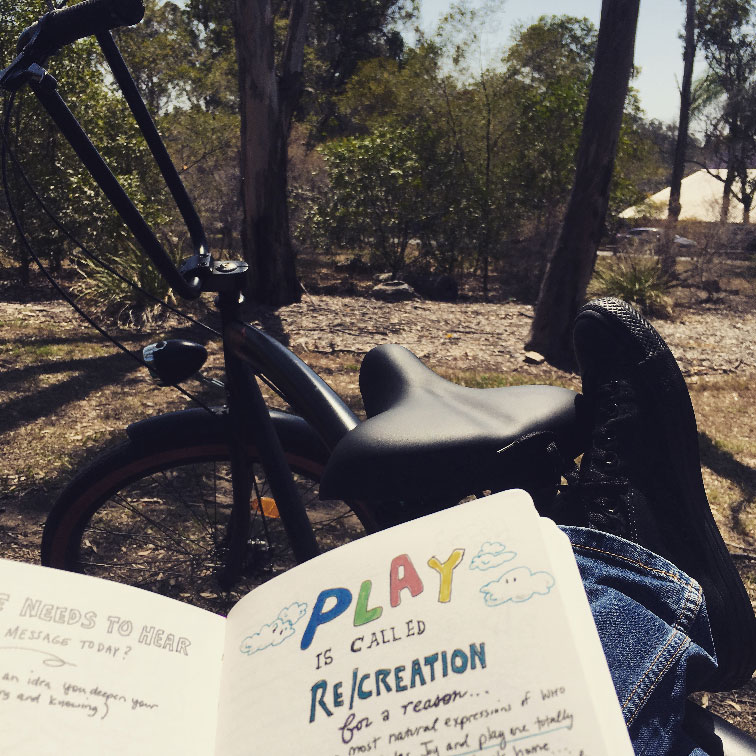
I like something I can carry around because seeing the physical object reminds me:
Test your memory.
Having the physical reminder alone makes the physical journal valuable. If I were to use an app in my phone, I doubt I would journal nearly as much.
2. Develop & Record Your Memory Palaces And Associations
Please don’t turn developing Memory Palaces into an art project.
When I sketch a Memory Palace, squares and simple lines are often enough.
The goal is not to make a beautiful drawing of your home, school or workplace.
You just need enough information to make the locations clear.
Do the same with your mnemonic associations.
Write down anything useful while building your systems, especially when an association works unusually well or gives you trouble.
If you’re still getting used to applying mnemonic techniques in daily life, my tutorial on how to remember to use memory techniques goes deeper into developing that habit.
3. Retrieve Before You Look At The Answer
This is probably the most important part of memory journaling.
Always give yourself a chance to be wrong.
When I’m testing information I’ve memorized, I write it out before checking the original source.
Why?
Because I need to know what my memory can actually produce.
Looking at the answer first contaminates the test.
Instead, I want an honest record of my recall, including the mistakes.
This is one place where my approach overlaps with what researchers call retrieval practice.
In a well-known study, Henry Roediger and Jeffrey Karpicke found that testing memory through retrieval improved long-term retention compared with additional studying. You can read their research on test-enhanced learning here.
Testing can also give you better information about what you actually know.
Research by Jonathan Barenberg and Stephan Dutke found that retrieval practice improved the accuracy of learners’ confidence judgments in a text-learning experiment. Here’s their study on retrieval practice and metacognitive monitoring.
Of course, you don’t need to memorize any of that terminology.
You just need to test yourself honestly.
4. Check Your Recall And Diagnose The Errors
After you’ve written everything you can remember, check the original source from which you memorized.
But don’t merely mark something wrong and move along.
Ask:
Why did I make that error?
Perhaps:
- Your mnemonic image wasn’t vivid enough.
- Your associations were too similar.
- A Memory Palace location might have been poorly chosen.
- The information itself wasn’t understood clearly enough during encoding.
Whatever happened, the journal provides you with evidence that will be useful for identifying any issues, making repairs and successfully testing next time.
As a result, you’re not mindlessly repeating information.
You’re retrieving it strategically so you can improve all aspects of how you use memory techniques across the board.
5. Work On Information You Actually Want To Remember
Random memory exercises have their place.
But I’ve long encouraged people to choose meaningful memory projects early on in their memory improvement journey, rather than practice with the random word lists in most memory guides.
I’m talking about high-order learning goals that involve:
- Memorizing vocabulary in a language you’re studying.
- Memorize poetry.
- Learn scripture.
- Prepare a speech.
- Absorb professional terminology.
Whatever you choose, meaningful information gives you quick wins that encourage you to keep memorizing and recording your results.
Instead of practicing a technique once and disappearing for three weeks, you’re pulled back by the project itself.
A Real Memory Journal Example: Memorizing Eunoia
One of my recent memory projects involved memorizing poetry from Christian Bök’s Eunoia.
My journal played a direct role.
After encoding passages, I wrote them out from memory.
Never did I look at the poem first before writing out the passages I was working on.
Yes, I made mistakes, and that’s to be expected.
But that’s not a problem. It’s the path to a solution.
If a word gets forgetten, a phrase moves out of position or some other error occurs, I can examine the mnemonic associations involved.
Then I make repairs and test again.
This is one reason I’ve long recommended writing during poetry memorization. The journal provides a visible record of what your memory actually produced rather than what you merely felt you knew.
Memory Journal Vs. Snapshot Journal: What’s The Difference?
Often people email with requests to explain my journaling “system.”
I really wouldn’t say that I have one, though I have used The Freedom Journal systematically for a few learning and productivity projects.
In my daily practice, I keep multiple kinds of notebooks not so much as part of a comprehensive system, but simply because they perform different jobs.
The two most easily confused that I mention frequently are my memory journal and a commercially available product called a Snapshot Journal.
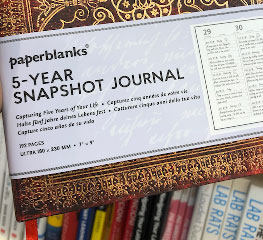
Snapshot Journals are designed so you can record daily activities and various KPIs. Even the weather, if you like.
The memory journal has a different purpose. It helps me develop mnemonic systems, test recall and work through memory problems.
Here’s the distinction:
| Memory Journal | Snapshot Journal |
|---|---|
| Develop Memory Palaces | Record daily activities |
| Capture mnemonic associations | Track personal KPIs |
| Test information from memory | Preserve snapshots of daily life |
| Analyze recall errors | Support future reflection |
| Repair memory techniques | Exercise autobiographical recall |
Both can help memory.
They simply do it differently.
A snapshot journal is particularly interesting if you want to exercise autobiographical memory by reconstructing what happened across previous the months and years. Literally “at a glance” as the product name “snapshot” promises.
Meanwhile, a dedicated memory journal is directly concerned with intentional learning and retrieval.
The same distinction applies to how I use index cards.
I use a physical Zettelkasten system, but information generally stays on those cards.
If I’ve memorized something from them, however, I may test my recall in the memory journal.
I don’t consider this kind of testing “migrating” the notes.
Rather, I’m testing what my memory can produce without having any notes or research resources nearby.
Other Ways To Exercise Memory Through Journaling
Once you’ve got the core memory journaling process underway, there are several other useful exercises worth trying.
Reconstruct Your Personal History
One exercise I’ve enjoyed is dedicating a page to each grade I attended in school.
Then I try to remember.
Who was there?
What happened?
Which teachers, friends and experiences still come to mind?
When I tried this, details surfaced about my friend Ryan in grade one and lunchtime adventures with my friend Eric in grade four.
Eric later died tragically in a skateboarding accident during high school.
Thinking back also brought memories of his mother, who often made tomato soup and grilled cheese sandwiches for us.
During a chaotic period of my childhood, those meals meant more than I probably realized at the time.
This kind of exercise can turn journaling into a genuine workout for episodic memory while also reconnecting you with people and experiences that shaped your life.
Journal Your Dreams
Dreams give you another kind of memory challenge.
After waking, try to retrieve as much as possible before other thoughts and activities interfere.
Can’t remember anything?
Write that down.
Even a sentence like “I didn’t remember any dreams” establishes the habit of checking.
If you’d like to develop the practice further, here’s my complete guide on how to remember your dreams.
Think Through Memory Problems On Paper
Sometimes a journal is simply where I think.
For example, if I’m struggling to create an association or solve some other learning problem, I’ll write through it.
One historical technique I sometimes draw upon is ars combinatoria.
You can sketch a combinatorial wheel directly in the journal and use it to generate everything from mnemonic images to solutions to various problems.
Again, there’s no need to turn every page into a formal system.
The point is to give your thinking somewhere to happen.
And do so in a way that takes the pressure off keeping all of those thoughts and processes in your mind. Offloading on paper lets you manage more ideas with greater effectiveness and efficiency.
How Often Should You Use A Memory Journal?
I personally aim to use mine every day.
Do I succeed 100% of the time?
No.
I’d estimate there are five to ten days each year when it simply doesn’t happen.
That’s fine.
And your schedule might look completely different.
For some people, weekly practice could be plenty.
In fact, waiting a little longer can make certain autobiographical exercises more challenging because you’re forcing yourself to reconstruct several days rather than recording everything immediately.
When training information you’ve deliberately memorized, however, I prefer frequent retrieval.
The larger principle is consistency without perfectionism.

Carrying a journal during walks and other daily activities makes it much easier for me to use it consistently.
And keeping my memory journal on my desk serves as a reminder of my commitment to use memory techniques as a way of life.
Common Memory Journaling Mistakes To Avoid
After teaching memory techniques for years, I’ve noticed that people can make journaling more complicated than it needs to be.
Here are the traps I’d avoid.
Copying Instead Of Practicing Retrieval From Memory
Writing information while glancing at the source may have uses.
But that’s not the memory test I’m talking about here. That kind of activity generally falls under the description of rote learning.
Instead, I recommend that you:
- Remove yourself from any chance that you’ll cheat by looking at the source information
- Open your memory journal
- Bring the target information to mind
- Write it down
- Then check the record for accuracy
This process will help ensure that you better retain information over time.
Trying To Create The Perfect Journal
There is no perfect layout.
Students have sent me all kinds of personalized memory journals over the years.
And they all look wonderful. Just check out this one by William Gordon:
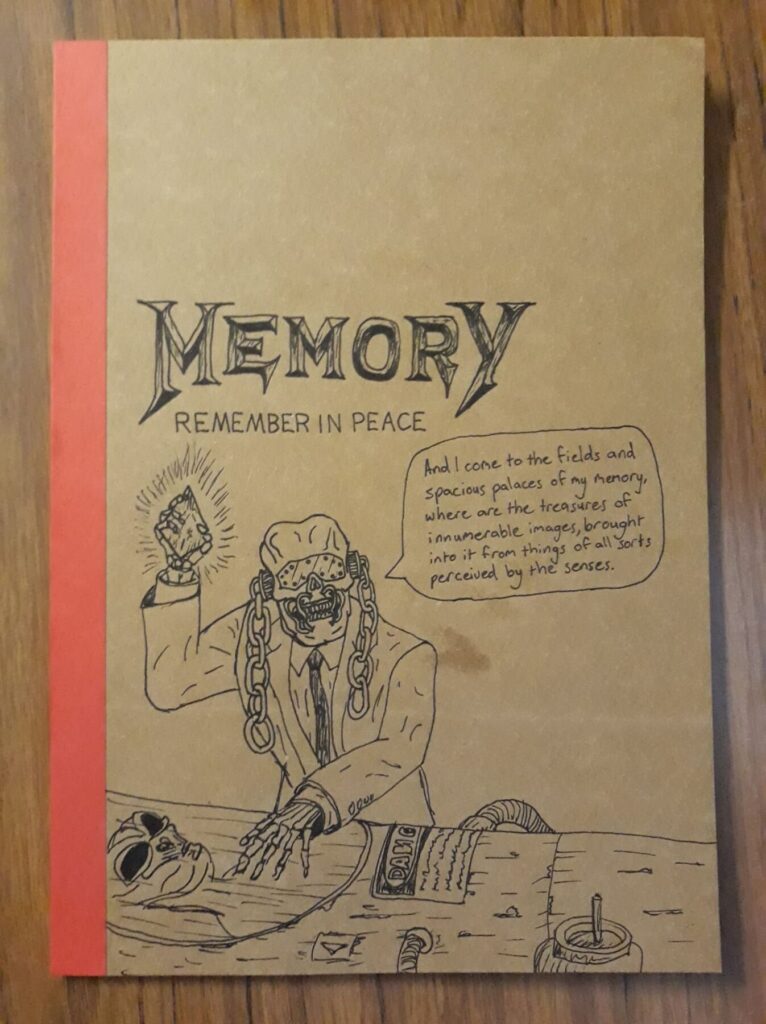
As I suggested in my book, The Victorious Mind, he personalized the cover. In this case, he even included one of St. Augustine’s most famous quotes about memory too.
But beyond that, I suggest treating the interior of the journal as a laboratory.
Rather than spent too much time designing a memory journal and sketching the perfect Memory Palace layouts, I suggest you preference the actual activities that train your memory.
Collecting Memory Terminology Instead Of Developing Memory Skills
You don’t need to become a librarian of mnemonic jargon.
Names like Memory Palace, journey method, Roman Room and method of loci can be useful.
However, knowing terminology isn’t the same as knowing how to remember.
Your journal should lead you to take action and analyze those actions in ways that move you closer to achieving results.
Being Afraid Of Making Errors
Mistakes are useful and we all need them in order to learn.
Give yourself room to fail.
Then use the data to improve how you’re using memory techniques next time around.
Can A Memory Journal Be Digital?
Of course.
If a digital journal gets you practicing, by all means use one.
You can also test recall by typing into a document or recording yourself speaking.
Personally, I prefer paper, but not because I believe there’s only one correct medium.
A physical journal works well for me because I can carry it around, sketch Memory Palaces quickly and use its presence as a reminder to practice proper Recall Rehearsal.
At the end of the day, please remember that even if the exact medium is flexible, the fundamentals of how memories form are not.
Start Your Memory Journal Today
If all of this sounds like a lot, don’t worry.
Your first memory journaling session can take five minutes.
Here’s what I suggest:
- Get a notebook.
- Write out everything you deliberately memorized earlier today.
- Add anything else from your day that you’d like to test yourself on.
- Do not check the original sources until you’ve finished retrieving.
- Compare your answers with the originals.
- Identify any errors and repair the associations involved.
Then test yourself again.
Over time, you’ll create something far more useful than a notebook filled with attractive notes.
You’ll have a physical record of the memory you’re successfully developing.
And if you’d like help building the Memory Palaces and mnemonic associations you’ll be testing in your new journal, complete my free memory improvement course:

The important thing is to start using what you’re learning.
Keep your journal flexible.
Give yourself permission to make mistakes.
Then retrieve, check the record, repair any mistakes and repeat.
That’s how a memory journal stops being another notebook on your shelf and supports the success of your memory training activities.

 Anthony Metivier is the founder of the Magnetic Memory Method, a systematic, 21st century approach to memorizing foreign language vocabulary, names, music, poetry and more in ways that are easy, elegant, effective and fun.
Dr. Metivier holds a Ph.D. in Humanities from York University and has been featured in Forbes, Viva Magazine, Fluent in 3 Months, Daily Stoic, Learning How to Learn and he has delivered one of the most popular TEDx Talks on memory improvement.
His most popular books include, The Victorious Mind and…
Anthony Metivier is the founder of the Magnetic Memory Method, a systematic, 21st century approach to memorizing foreign language vocabulary, names, music, poetry and more in ways that are easy, elegant, effective and fun.
Dr. Metivier holds a Ph.D. in Humanities from York University and has been featured in Forbes, Viva Magazine, Fluent in 3 Months, Daily Stoic, Learning How to Learn and he has delivered one of the most popular TEDx Talks on memory improvement.
His most popular books include, The Victorious Mind and… 



2 Responses
Hey Anthony,
Great post! I’m the worst at remembering things so keeping a journal could be really beneficial for me – thanks for all the tips. Since there’s so much other buzz going on from the moment you wake up, making it a habit – and an easy habit – should be a priority. For example, I’m a keen user of Evernote so one way of approaching this could be to create a specific folder in Evernote for a journal. Writing for 5 minutes every day rules out almost any excuse 🙂
Your Evernote idea sounds like a great plan, Camilla. You could also set your smartphone or use notifications on your computer to automatically prompt you to take this action as well.
Enjoy the transformations this will make for you!