
 Learning how to remember sections in law turned out to be very different from what I expected.
Before attending law school myself, I assumed much more verbatim memorization would be required.
That seemed reasonable.
After all, I had already spent more than a decade teaching memory techniques, coaching lawyers and helping thousands of readers learn legal terminology.
I had also co-authored a book on legal memory with Tom Briton, a retired memory enthusiast who held a JD.
Then I actually started studying law.
To my surprise, I was not required to memorize entire sections word-for-word.
Several people even pointed out that memorization is not really the main point of law school or legal practice.
Instead, you need to recognize issues, know that relevant laws and cases exist, find them when required and understand them well enough to apply them accurately.
In other words, memory still matters.
But not always in the way you might think.
My experience studying law as a memory expert has taught me to think about legal memorization more precisely.
Let’s look at what actually needs to be remembered and how I approach it.
How to Remember Sections in Law: What Actually Matters
The biggest thing I misunderstood before attending law school was how much memorization would be required.
Law involves a tremendous amount of information.
However, that does not mean you need to recite all of it.
In my experience, success has been much more about:
- Recognizing the legal issue
- Knowing which rules may apply
- Remembering where relevant material can be found
- Identifying possible “forking paths” in the analysis
- Understanding why courts decided cases in particular ways
- Keeping up with relevant standards
- Paying very close attention to details
That’s a much different challenge from memorizing hundreds of statutes word-for-word.
Of course, your particular course, assignment or jurisdiction may require something different.
Always follow those requirements first, especially when preparing for an open-book law exam, where knowing how your materials are organized can be more useful than trying to memorize everything.
But when exact wording isn’t required, I recommend using memory techniques to create fast and accurate access to legal keywords. This will likely help you more than trying to turn yourself into a walking statute book.
One: Let the Assignment Tell You What to Memorize
Students can easily waste time trying to memorize everything.
I don’t use a complicated system for deciding what deserves mnemonic attention.
Instead, I look at what the assignment, exam or upcoming quiz requires.
That simple decision keeps the memorization connected to an actual goal.
For example, you might need to remember:
- A section number
- The Act connected to that section
- A lettered subdivision
- The elements of a rule
- The basic meaning of a provision
- A case and why it matters
Sometimes exact wording will matter.
When it does, you can use techniques designed to memorize passages accurately.
Most of the time in my own law studies, however, that level of verbatim memorization has not been necessary.
Two: Give the Legal Information a Location
One of the most useful things you can do is give important legal information a stable mental location.
For that, I use the Memory Palace technique.
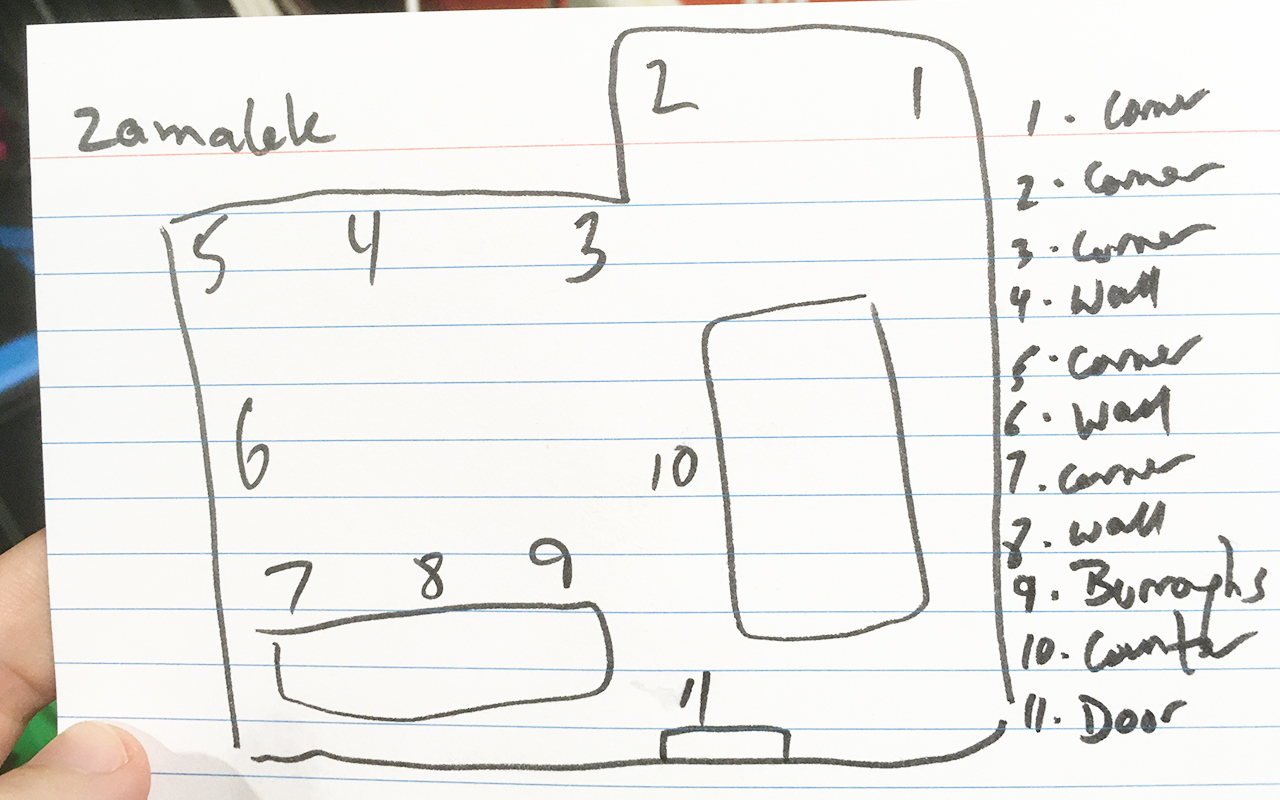
A Memory Palace is based on a location you already know.
You mentally place associations at specific points in that location so you can find the information again through structured recall.
Here’s an example of a Memory Palace I drew based on a bookstore I visited in Zamalek, Cairo:
For law, however, I recently used a different location with a very specific purpose.
I wanted to remember part of the Competition and Consumer Act 2010.
More specifically, I was interested in Schedule 2, the Australian Consumer Law, Chapter 2 and section 18 concerning misleading or deceptive conduct. You can check the current legislation directly through the Federal Register of Legislation.
Rather than choose a random Memory Palace, I used my Aunt Cassie’s home.
Why?
“Cassie” gives me a strong C connection for “Competition.”
Even better, I used her computer workstation next to the dining room.
The “comp” in computer creates another natural connection with Competition.
These kinds of pre-existing associations make memorization much faster because I’m not trying to invent everything from scratch.
Three: Use Number Associations for Section Numbers
Once I had the location established, I used my existing number associations for the numerical information.
My preferred tool is a 00-99 PAO System.
PAO stands for Person-Action-Object.
Having one ready means I don’t have to stop and dream up a new image every time I encounter a section number.
The associations already exist.
My PAO system is supported by the Major System, a phonetic mnemonic technique that converts numbers into consonant sounds and ultimately into memorable words and associations.
That preparation is especially useful in law because numbers appear everywhere.
You encounter:
- Section numbers
- Subsections
- Years
- Case dates
- Page numbers
- Numbered tests and elements
Instead of repeatedly wrestling with abstract digits, you can translate them into associations your memory handles much more readily.
Four: Memorize the Gist When Verbatim Recall Is Not Required
Here’s where my actual law-school experience changed my thinking.
I did not memorize the wording of section 18 verbatim.
I memorized what I needed to identify the provision correctly and understand its gist.
That was enough for the purpose at hand.
If I needed to answer a question about it, I wanted to recognize the issue.
If I needed the exact language, I could locate the authoritative version and check it.
That distinction matters.
A lawyer dealing with multiple clients and potentially serious consequences should not necessarily rely on memory for precise statutory wording when the current written law can be consulted.
Memory should help you get to the right information.
It should not create overconfidence about wording that ought to be verified.
That’s one reason I now think of legal memory less as storing an entire library in your head and more as building an exceptionally good navigation system.
Why Law School Made Me Less Interested in Verbatim Memorization
Ironically, attending law school made me more cautious about telling people to memorize legal passages word-for-word.
There’s nothing wrong with developing that ability.
I’ve memorized many passages from other kinds of material, and the skill is tremendously valuable.
But legal education introduced me to a different emphasis.
One common framework is IRAC:
- Issue
- Rule
- Application
- Conclusion
The Australian National University has a useful overview of this form of legal problem solving.
What matters to me from a memory perspective is what comes first:
You have to spot the issue.
That requires pattern recognition.
Next, you need to know that a relevant rule exists and where to find the authority for it.
Then you have to understand the rule well enough to apply it to the facts.
Simply being able to recite a passage doesn’t automatically give you those abilities.
In fact, depending too heavily on recitation could become counterproductive if it distracts you from checking the actual source or understanding how the rule applies.
That’s why I now see mnemonic techniques as supporting legal reasoning rather than replacing it.
Use a Magnetic Bookmark to Find Legal Information Again
One of my favorite techniques for law school has been what I call the Magnetic Bookmark.
This is genuine memorization, but the goal is retrieval rather than recitation.
For example, many of my legal textbooks are digital.
When I encounter something I know I’ll want to review, I can memorize the page number using an existing number association.
Later, that association brings the page back to mind.
I can then return directly to the source.
The technique works because numbers stop being abstract.
Instead of hoping I’ll somehow remember that an important discussion appeared around page 92, I can use the appropriate number association and connect it with the material I want to find again.
I explain the Magnetic Bookmark along with several other practical approaches in my list of memory improvement tips.
For legal studies, this approach fits beautifully with the reality that knowing where to find accurate information can matter just as much as carrying the information itself.
How I Review Legal Information for Long-Term Retention
Creating the associations is only the beginning.
You also need to retrieve them.
My basic workflow looks like this:
- Encode the information using a Memory Palace and associations
- Test my recall later
- Retrieve it again the next day or after another useful interval
- Write it out when additional precision is useful
- Continue testing it until recall feels secure
I repeat this process a few times when I want long-term retention.
My approach is called Recall Rehearsal.
It’s related to retrieval practice, which has been studied extensively as a way of strengthening long-term retention. One classic experiment by Roediger and Karpicke is available through PubMed.
The important point is that I don’t merely look at my associations again.
I attempt to bring the information back without immediately consulting the answer.
That act of retrieval matters.
My own version also involves recalling material in different orders rather than continually marching through it from beginning to end. You can see the broader process in my guide to active recall.

Writing from memory can also expose gaps very quickly.
That’s useful whether you’re dealing with legal material, a speech or any other information you want available on demand.
What Lawyers I’ve Coached Actually Struggle to Remember
My perspective on legal memory doesn’t come only from attending law school.
I’ve also coached lawyers.
Two recurring problems stand out.
Remembering Section Numbers and Lettered Divisions
Numbers and letters can become confusing because they are abstract.
You might understand a rule perfectly well but still mix up the section number or subdivision.
That’s exactly where established number and alphabet systems shine.
Once those systems are automatic, you can attach the relevant legal information quickly instead of inventing a new trick every time.
Remembering Their Own Notes
Another challenge involves something much more mundane:
People take notes and then lose track of what they’ve extracted.
The information is technically available.
They just don’t remember that they have it or where it went.
For this problem, I teach lawyers to combine memory techniques with the Zettelkasten method.
The note-taking system helps organize extracted ideas.
Mnemonic techniques help make important parts of that system mentally accessible.
Together, they reduce the problem of producing piles of notes that disappear into notebooks, folders and apps.
What I Learned From Co-Authoring a Book About Legal Memory
Long before I attended law school myself, Tom Briton suggested that a book about remembering legal terminology would be useful.
Tom was a retired memory enthusiast with a JD.
I brought my experience with mnemonic systems and wrote the material.
He vetted what I produced from his legal perspective.
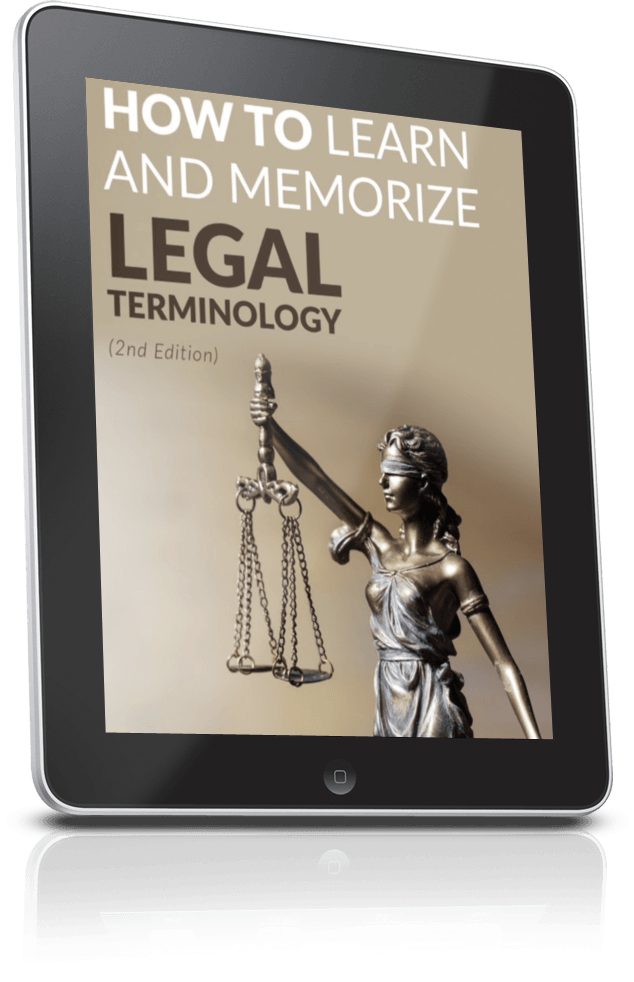
The result was How to Learn and Memorize Legal Terminology.
The book sold very well for many years.
Since then, actually studying law has given me an additional perspective I did not have when Tom and I worked on that project.
The memory techniques still work.
What changed was my understanding of when to apply them.
I once expected legal education to demand more raw memorization.
Now I see that the deeper challenge involves recognition, retrieval, analysis and detail.
That’s an important distinction.
Two Mnemonic Mistakes I See Lawyers Make
People sometimes struggle with mnemonic techniques for reasons that have very little to do with their memories.
The first problem is reinventing the wheel.
Instead of learning established techniques as described and practicing them, people start changing everything immediately.
Then they conclude that mnemonics don’t work.
Learning the fundamentals first is much more efficient.
Once you’ve developed skill, adaptation becomes much easier.
The second problem is creating associations that aren’t elaborate enough.
A weak association can disappear almost as quickly as the information you’re trying to remember.
That’s why I teach a model called KAVE COGS.
It involves:
- Kinesthetic
- Auditory
- Visual
- Emotional
- Conceptual
- Olfactory
- Gustatory
- Spatial
You don’t need every element every time.
Rather, the framework gives you ways to strengthen an association when it feels weak.
My tutorial on visual memory techniques and KAVE COGS goes into the process in more detail.
Finally, even excellent associations can fail if you never practice retrieving them.
That’s why Recall Rehearsal is part of the system, not an optional extra.
Do Law Students Need to Invent Hundreds of Mnemonic Images?
No.
This is one of the biggest misunderstandings I see in generic mnemonic advice.
People imagine that they have to sit around inventing hundreds of bizarre pictures before they can remember anything.
That sounds exhausting because it is.
The Magnetic Memory Method takes a different approach.
You complete exercises that help you identify associations already present in your memory.
Then you learn how to elaborate those associations when needed.
Think about my Competition and Consumer Act example.
I didn’t invent Aunt Cassie.
I already knew her.
Her name naturally gave me a C connection.
The computer station already existed in her home, and “computer” naturally supplied the “comp” connection.
Most of the raw material was already there.
I simply learned how to use it.
That’s much faster than treating every new piece of information as a blank canvas requiring some elaborate act of imagination.
Generic mnemonic systems can become painful when they make you manufacture everything from scratch.
In my view, that’s unnecessary.
Should You Memorize More Than One Section at a Time?
I still like practicing with two or three pieces of information rather than obsessing over one item endlessly.
This isn’t because law school has required me to memorize multiple sections.
It hasn’t.
Rather, years of memorizing other kinds of material have shown me the value of rotating what I practice.
One reason this can work well involves interleaving.
Switching between material gives you a break from hammering the same information repeatedly.
I regularly rotate what I’m reviewing, guided by my memory journal and a long habit of testing what I’ve memorized.
You don’t have to follow an arbitrary number.
The important point is to retrieve what you’re learning instead of endlessly rereading one section until it merely feels familiar.
Is Any Mnemonic Effort Wasted on Legal Material?
Personally, I don’t think mnemonic effort is wasted so long as you’re actually using the techniques optimally.
Even if a professor doesn’t require you to memorize a particular section, practicing with it can still develop your memory skills.
That’s an important distinction.
You might not need to memorize hundreds of statutes.
But learning to memorize a few section numbers, cases, page references or legal concepts gives you practice using your memory deliberately.
Those skills transfer to other kinds of information.
The mistake isn’t memorizing something you technically could have looked up.
The mistake is using an inefficient method, skipping retrieval practice or assuming that memorization can replace understanding.
How to Remember Sections in Law Without Becoming a Walking Statute Book
So what’s my current answer to the question of how to remember sections in law?
First, determine what you actually need to know.
Then give important information stable locations and meaningful associations.
Use established number systems for section numbers and dates.
Memorize exact wording when exact wording genuinely matters.
Otherwise, focus on understanding the gist, recognizing the issue and knowing how to retrieve the authoritative source.
After encoding the information, use Recall Rehearsal until it becomes reliably accessible.
Most importantly, don’t confuse memory with legal judgment.
What surprised me most about law school was discovering that legal work involves far more than remembering rules.
You need to recognize information, identify issues, notice possible forking paths, understand why decisions were made, find the right authorities and pay extremely close attention to detail.
Memory techniques support all of those activities.
They don’t eliminate the need to think.
If you’d like help developing the underlying mnemonic systems, grab my FREE Memory Improvement Kit:

It will help you develop Memory Palaces and the core mnemonic skills you can apply to legal information, section numbers and much more.
Here’s to remembering what matters, finding what you need and using both with precision.

 Anthony Metivier is the founder of the Magnetic Memory Method, a systematic, 21st century approach to memorizing foreign language vocabulary, names, music, poetry and more in ways that are easy, elegant, effective and fun.
Dr. Metivier holds a Ph.D. in Humanities from York University and has been featured in Forbes, Viva Magazine, Fluent in 3 Months, Daily Stoic, Learning How to Learn and he has delivered one of the most popular TEDx Talks on memory improvement.
His most popular books include, The Victorious Mind and…
Anthony Metivier is the founder of the Magnetic Memory Method, a systematic, 21st century approach to memorizing foreign language vocabulary, names, music, poetry and more in ways that are easy, elegant, effective and fun.
Dr. Metivier holds a Ph.D. in Humanities from York University and has been featured in Forbes, Viva Magazine, Fluent in 3 Months, Daily Stoic, Learning How to Learn and he has delivered one of the most popular TEDx Talks on memory improvement.
His most popular books include, The Victorious Mind and…